

Home
Class 12
PHYSICS
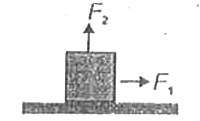
In the figure shown, horizontal force F(...

In the figure shown, horizontal force `F_(1)` is applied on a block but the block does not slide. Then as the magnitude of vertical force `F_(2)` is increased from zero the block begins to slide, the correct statement is

Promotional Banner

Similar Questions

Explore conceptually related problems

In the figure shown, the minimum force F to be applied perpendicular to the incline so that the block does not slide is

In the figure shown, the minimum force F to be applied perpendicular to the incline so that the block does not slide is

A block lies on a floor. (a) What is the magnitude of the frictional force on it from the floor ? (b) If a horizontal force of 5N is now applied to the block. But the block dose not move. What is the magnitude of the fricition on it ? (c) If the maximum value f_(c "max") of the static frictional force on the block is 10 N, will the block move if the magnitude of the horizontally applied force is 8 N? (d) If it is 12 N ? (e) What is te magnitude of the frictional force in part (c) ?

Force F is graduallly increased from zero .Determine whether the block will first slide or lift up?

Force F is graduallly increased from zero .Determine whether the block will first slide or lift up?

A block of mass m placed on an incline just begins to slide when inclination of the incline is made theta_(0) = 45^(@) . With inclination equal to theta = 30^(@) , the block is placed on the incline. A horizontal force (F) parallel to the surface of the incline is applied to the block. The force F is gradually increased from zero. At what angle a to the force F will the block first begin to slide?

A cubical block of side L rests on a rough horizontal surface with coefficient of friction mu . A horizontal force F is applied on the block as shown. If the coefficient of frictions sufficienty high so that the block does not slide before toppling, the minimum force required to topple the block is : .