

Home
Class 11
PHYSICS
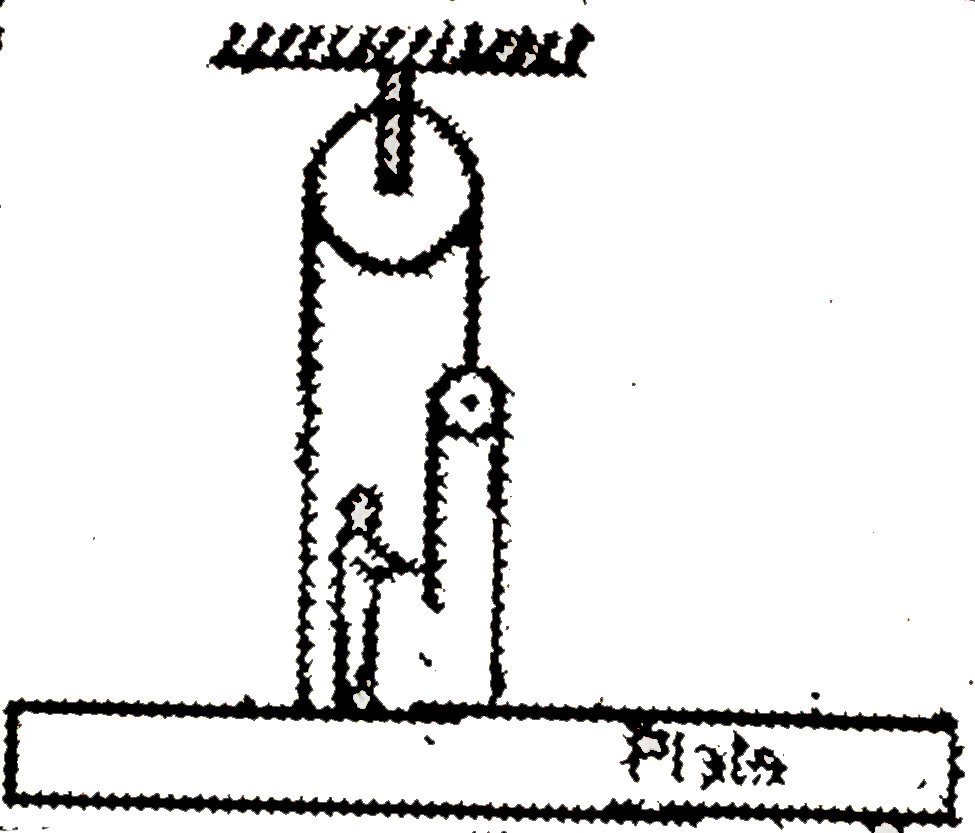
In the arrangement shown pulley and thre...

In the arrangement shown pulley and thread are mass less. Mass of plate is 20 kg and that of boy is 30 kg.
Then :

Promotional Banner

Similar Questions

Explore conceptually related problems

In the arrangements shown in the figure masses of each ball is 1 kg and mass of trolley is 4 kg . In the figure, shell of mass 1 kg moving horizontally with velocity v = 6 ms^(-1) collides with the ball and get stuck to it then its maximum deflection of the thread (length 1.5 m ) with vertical

In the arrangements shown in the figure masses of each ball is 1 kg and mass of trolley is 4 kg . In the figure, shell of mass 1 kg moving horizontally with velocity v = 6 ms^(-1) collides with the ball and get stuck to it then its maximum deflection of the thread (length 1.5 m ) with vertical

In the arrangement shown below pulleys are mass less and frictionless and threads are in responsible block of mass m_(1) will remain at rest if :

In the arrangement shown in figure-2.124 pulley A and B are massless and the thread is inextensible. Mass of pulley C is equal to m. If friction in all the pulleys negligible, then :

In the arrangement , shown below pulleys are massless and frictionless and threads are inextensible , block of mass m_(1) will remain at rest if

In the arrangement , shown below pulleys are massless and frictionless and threads are inextensible , block of mass m_(1) will remain at rest if

In the arrangement shown below, pulleys are mass-less and friction-less and threads are in-extensible. Block of mass m_(1) will remain at rest if :

In the arrangement shown the fixed pulley is massless and frictionless. If the acceleration of block of mass 1kg is (30)/(x)m//s^(2) . Find the value of x .

In the arrangement shown the fixed pulley is massless and frictionless. If the acceleration of block of mass 1kg is (30)/(x)m//s^(2) . Find the value of x .

In the arrangement shown in fig. pulleys are smooth and massless. Threads are massless and inextensible. Find acceleration of mass m_(1) .