

Home
Class 12
PHYSICS
In the arrangement shown in the figure p...

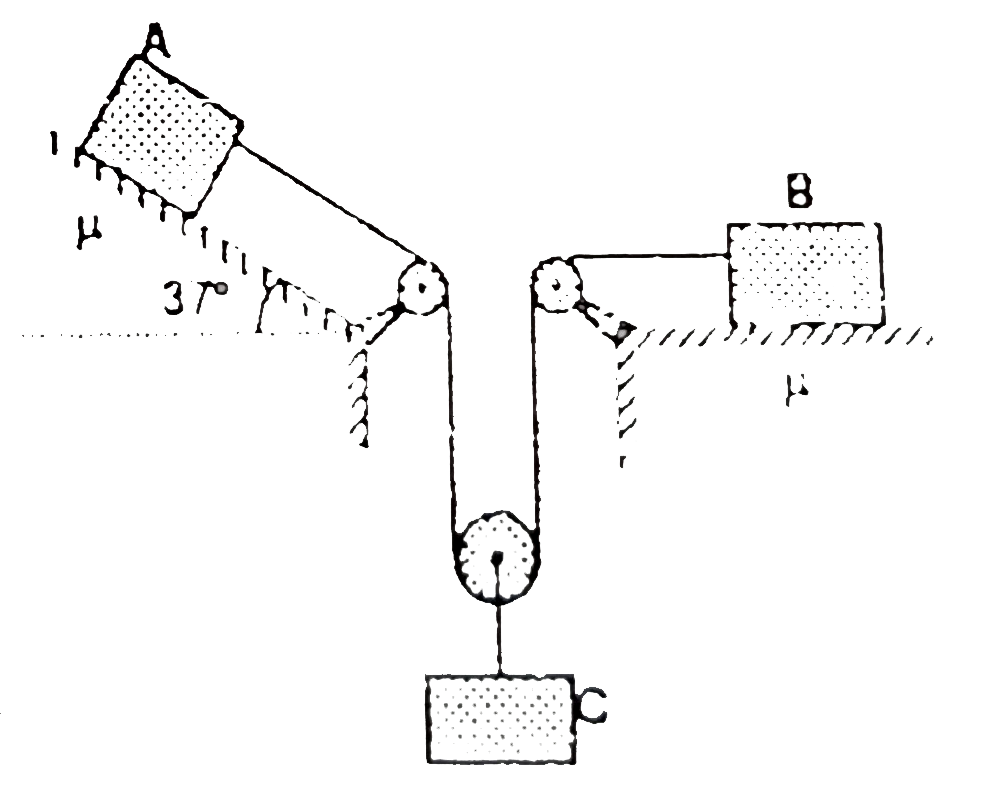
In the arrangement shown in the figure pulleys are small, light and frictionless, threads are inextensible and mass of blocks `A`, `B` and `C` is `m_(1)=5kg`, `m_(2)=4kg` and `m_(3)=2.5kg` respectively and co-efficient of friction for both the planes is `mu=0.50`. Calculate the acceleration of block `A` (in `m//s^(2)`) when the system is released from rest. (`g=10 m//s^(2)`)

Promotional Banner

Similar Questions

Explore conceptually related problems

In the arrangement shown in figure pulleys are mass of block A,b and C is m_(1) = 5 kg m_(2) = 4 kg and m_(3) = 2.5 kg respectively .Co-efficient acceleration of friction for both the plane is mu = 0.50 Calculate acceleration of which block when system is released from rest

In the arrangement shown in figure pulleys are mass of block A,b and C is m_(1) = 5 kg m_(2) = 4 kg and m_(3) = 2.5 kg respectively .Co-efficient acceleration of friction for both the plane is mu = 0.50 Calculate acceleration of which block when system is released from rest

Pulleys shown in the system of the figure are massless and friction less. Threads are inextensible. Mass of block A, B and C are m_(1) kg,m_(2) =4kg and m_(3) = 2.75kg , respectively .Calculate acceleration of A block

Pulleys shown in the system are massless and fricionless. Threads are inextensible. The mass of blocks A, B, and C are m_(1)=2kg, m_(2)=4kg , and (m_3)=2.75 kg , respectively. Calculate the acceleration of each block.

In the arrangement , shown below pulleys are massless and frictionless and threads are inextensible , block of mass m_(1) will remain at rest if

In the arrangement , shown below pulleys are massless and frictionless and threads are inextensible , block of mass m_(1) will remain at rest if

In the figure-2.205 shown in blocks A, B and C has masses m_(A)= 5 kg, m_(B) = 5 kg and m_(C )= 10kg respectively, find the acceleration of the three blocks. Assume all pulleys and strings are ideal. (Take g = 10m//s^(2) )

In the system shown in figure m_(B)=4kg , and m_(A)=2kg . The pulleys are massless and friction is absent everywhere. The acceleration of block A is.

Three blocks of masses m_(1)=4kg, m_(2)=2kg, m_(3)=4kg are connected with ideal strings passing over a smooth, massless pulley as shown in figure. The acceleration of blocks will be (g=10m//s^(2))

Three blocks of masses m_(1)=4kg, m_(2)=2kg, m_(3)=4kg are connected with ideal strings passing over a smooth, massless pulley as shown in figure. The acceleration of blocks will be (g=10m//s^(2))