

Home
Class 11
PHYSICS
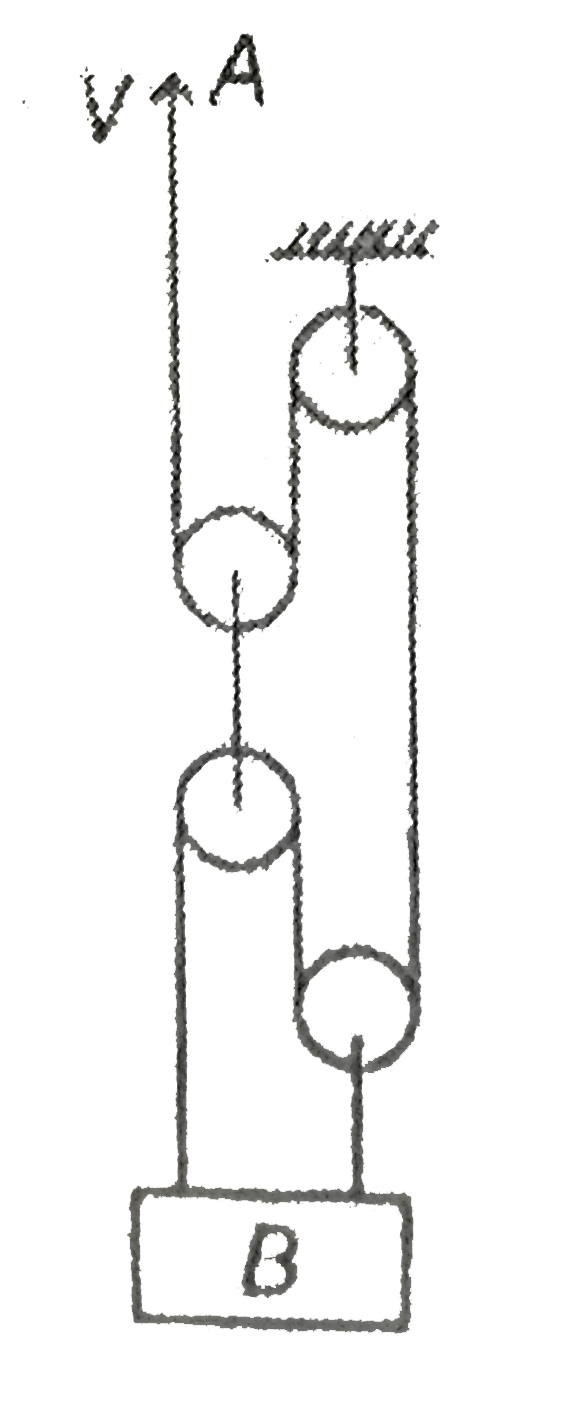
In the arrangement shown, end A of light...

In the arrangement shown, end A of light intextensible string is pulled with constant velocity v. the velocity of block B is

Promotional Banner

Similar Questions

Explore conceptually related problems

In the arrangement shown in the fig, end A of the string is being pulled with a constant horizontal velocity of 6 m//s . The block is free to slide on the horizontal surface and all string segments are horizontal. Find the velocity of point P on the thread.

Block B moves to the right with a constant velocity v_(0) . The velocity of body a relative to b is

Block B moves to the right with a constant velocity v_(0) . The velocity of body A relative to B is :

In the arrangement shown, blocks A and B connected with an inextensible string move with velocities v_(1) and v_(2) along horizontal direction. The ratio of v_(2)/v_(1) is:

In each of the three arrangements, the block of mass m_(1) is being pulled left with constant velocity. There is no friction anywhere. The string are light and anextensible and pulleys are massless. The ratio of the speed of the block of mass m_(2) in the three cases respectively is:

If the point P on string shown in figure-1.96 is pulled down with a velocity v, find the velocity of the block A connected to another string passing over a step pulley with radii ratio 1:2 .

In the figure shown, the blocks A and B are connected with an inextensible string. If the block B is pulled with a velocity of 5 m/s then it is observed that block A moves with 10 m/s. Find the angle theta in (degree) shown in the diagram:

Figure shows a rod of length £ resting on a wall and the floor. Its lower end A is pulled towards left with a constant velocity v. Find the velocity of the other end B downward when the rod makes an angle Q with the horizontal

The end B of the rod AB which makes angle theta with the floor is being pulled with a constant velocity v_(v) as shown. The length of the rod is l .