

Home
Class 12
PHYSICS
Two block of same mass'm' are joined wit...

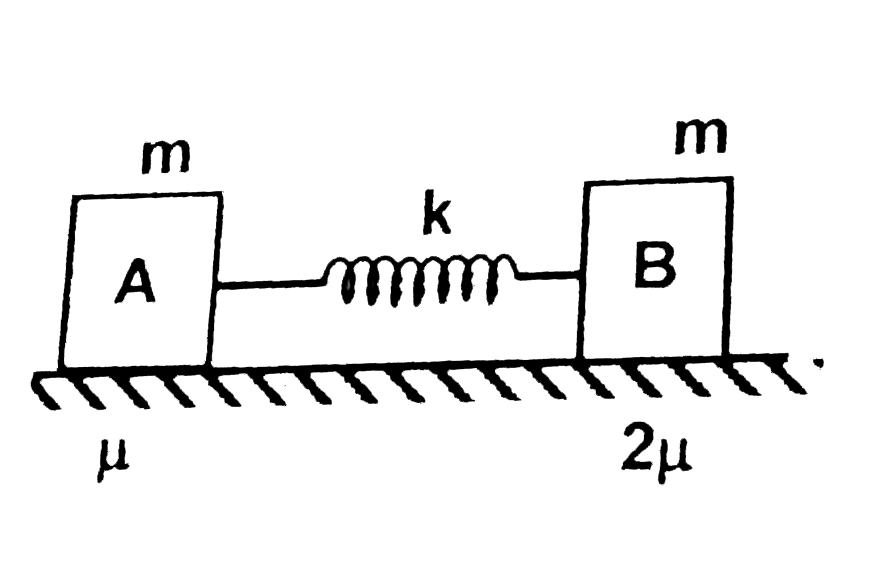
Two block of same mass'm' are joined with an dideal spring of spring constant k and sept on a rough surface as shown in figure. The spring is initially unstretched and coefficient of friction between the blocks and horizontal surface is `mu` and `2 mu` respectively. What should be the maximum speed of block 'A' such that the block 'B' does not move ?

Promotional Banner

Similar Questions

Explore conceptually related problems

Two block of masses m1 and m2 are connected with a massless unstretched spring and placed over a plank moving with an acceleration 'a' as shown in figure. The coefficient of friction between the blocks and platform is mu

Two block of masses m1 and m2 are connected with a massless unstretched spring and placed over a plank moving with an acceleration 'a' as shown in figure. The coefficient of friction between the blocks and platform is mu

A block of mass m is moving with a speed v on a horizontal rought surface and collides with a horizontal monted spring of spring constant k as shown in the figure .The coefficient of friction between the block and the floor is mu The maximum cobnpression of the spring is

The blocks ov mass m_(1)=1kg and m_(2)=2kg are connected by an ideal spring, rest on a rough horizontal surface. The spring is unstressed. The spring constant of spring is K=2N//m . The coefficient of friction between blocks and horizontal surface is mu=(1)/(2) . Now the left block is imparted a velocity u towards right as shown. The largest value of u( in m//s) such that the block of mass m_(2) never moves is ( Take g=10m//s^(2))

The blocks ov mass m_(1)kg and m_(2)=2kg are connected by an ideal spring, rest on a rough horizontal surface. The spring is unstressed. The spring constant of spring is K=2N//m . The coefficient of friction between blocks and horizontal surface is mu=(1)/(2) . Now the left block is imparted a velocity u towards right as shown. The largest value of u( in m//s) such that the block of mass m_(2) never moves is ( Take g=10m//s^(2))

A block of mass m is attached to one end of a mass less spring of spring constant k. the other end of spring is fixed to a wall the block can move on a horizontal rough surface. The coefficient of friction between the block and the surface is mu then the compession of the spring for which maximum extension of the spring becomes half of maximum compression is .

A block of mass m is attached to one end of a mass less spring of spring constant k. the other end of spring is fixed to a wall the block can move on a horizontal rough surface. The coefficient of friction between the block and the surface is mu then the compession of the spring for which maximum extension of the spring becomes half of maximum compression is .

A block of mass m is moving on a rough horizontal surface. mu is the coefficient of kinetic friction between the block and the surface. What is the net force exerted by the surface on the block?

A block of mass 'm' is pulled by a constant power 'p' placed on a rough horizontal plane . The coefficient of friction between the block and the surface is mu . Maximum velocity of the block will be