

Home
Class 12
PHYSICS
Two charged particle of equal mass are c...

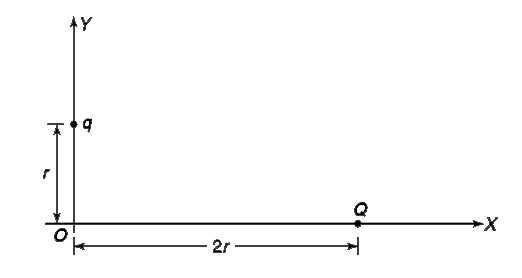
Two charged particle of equal mass are constrained to move along X and Y direction. The X – Y plane is horizontal and the tracks are smooth. The particles are released from rest when they were at positions shown in the figure. At the instant distance of q becomes 2r from the origin, find the location of charge Q.

Promotional Banner

Similar Questions

Explore conceptually related problems

Three equal negative charges, -q_(1) each form the vertices of and equilateral triangle . A particle of mass m and a positive charge q_(2) is constrained to move along a line perpendicular to the plane of triangle and through its center, which at a distance r from each of the negative charges as shown in fig. The whole systen is kept in gravity-free space, Find the tome period of vibration of the particle for small displacement from the equilibrium position.

Three equal negative charges, -q_(1) each form the vertices of and equilateral triangle . A particle of mass m and a positive charge q_(2) is constrained to move along a line perpendicular to the plane of triangle and through its center, which at a distance r from each of the negative charges as shown in fig. The whole systen is kept in gravity-free space, Find the time period of vibration of the particle for small displacement from the equilibrium position.

Electric field E = – bx + a exists in a region parallel to the X direction (a and b are positive constants). A charge particle having charge q and mass m is released from the origin X = 0. Find the acceleration of the particle at the instant its speed becomes zero for the first time after release.

Two identical particles of mass m carry a charge Q , each. Initially one is at rest on a smooth horizontal plane and the other is projected along the plane directly towards first particle from a large distance with speed v. The closest distance of approach be .

Two identical particles of mass m carry a charge Q , each. Initially one is at rest on a smooth horizontal plane and the other is projected along the plane directly towards first particle from a large distance with speed v. The closest distance of approach be .

Two identical particles of mass m carry a charge Q, each. Initially one is at rest on a smooth horizontal plane and the other is projected along the plane directly towards first particle from a large distance with speed v. The closest distance of approach be .

Two identical particles of mass m carry a charge Q , each. Initially one is at rest on a smooth horizontal plane and the other is projected along the plane directly towards first particle from a large distance with speed v. The closest distance of approach be .

A charged particle (charge q, mass m) has velocity v_(0) at origin in +x direction. In space there is a uniform magnetic field B in -z direction. Find the y coordinate of particle when is crosses y axis.

A charged particle (charge q, mass m) has velocity v_(0) at origin in +x direction. In space there is a uniform magnetic field B in -z direction. Find the y coordinate of particle when is crosses y axis.