

Home
Class 9
PHYSICS
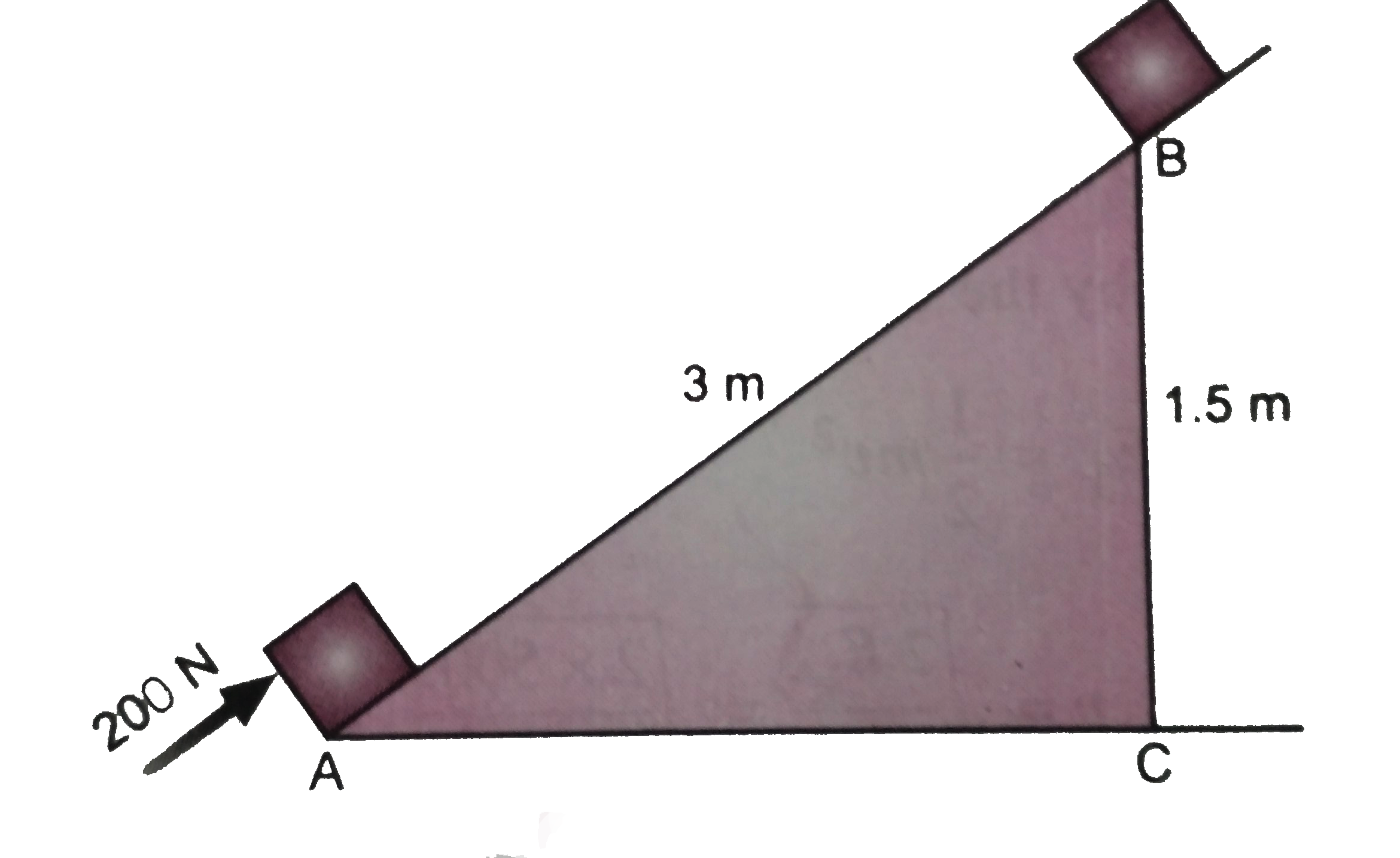
A block of mass 30 kg is pulled up by a ...

A block of mass 30 kg is pulled up by a rope as shown in Fig. with a constant speed by applying a force of 200 N parallel to the slope. A and B are initial and the final positions of the block. Calculate:
(a) the work done by the force in moving the block A to B,
(b) the potential energy gained by the block,
(c) account for the difference in work done the force and the increase in potential energy of the block.

Promotional Banner

Similar Questions

Explore conceptually related problems

A block of mass 30 kg is pulled up a slope as shown in with constant speed by applying a force of 200 N parallel to the slope from the initial position A to the position B, (a)Calculate : (i)the work done by force in moving the block from A to B, and (ii)The potential energy gained by the block Take, g=10 m s^(-2) (b)Account for the difference in answers to parts (i) and (ii)

A block A, weighing 100 N is pulled up a slope of length 5 m by means of a constant force F (= 100 N) as illustrated in Fig. (a) What is the work done by the force F in moving the block A 5 m along the slope ? (b) What is the increase in potential energy of the block A? (c) Account for the difference in the work done by the force and the increase in potential energy of the block

A 5 kg block is lifted vertically through a height of 5 metre by a force of 60N. Determine (i) the work done by applied force in lifting the block, (ii) the potential energy of the block at 5m, (iii) the kinetic energy of the block at 5 m (iv) the velocity of the block at 5 m-

A block of mass M is attached to a uniform rope of mass m . This arrangement is pulled by applying a force F at the rope as shown. Find the tension in the rope (a) at the junction of the rope and the block (b) at the mid point of the rope.

A cord is used to vertically lower an initially stationary block of mass M at a constant downward acceleration of g/4. When the block has fallen a distance d, find (a) the work done by the cord's force on the block, (b) the work done by the graviational force on the block, (c) the kinitic energy of the block, and (d) the speed of the block.

A block of mass M is pulled along a horizontal frictionless surface by a rope of mass m as shown in A horizontal force F is applied to one end of the rope. Find (a) the acceleration of the rope and block (b) the force that the rope exerts on the block (c) the tension in the rope at its mid point

A block of mass M is pulled along a horizontal frictionless surface by a rope of mass m as shown in A horizontal force F is applied to one end of the rope. Find (a) the acceleration of the rope and block (b) the force that the rope exerts on the block (c) the tension in the rope at its mid point

A block of mass M is pulled along a horizontal frictionless surface by a rope of mass m as shown in A horizontal force F is applied to one end of the rope. Find (a) the acceleration of the rope and block (b) the force that the rope exerts on the block (c) the tension in the rope at its mid point

A block of mass 10 kg slides down on an incline 5 m long and 3 m high. A man pushes up on the ice block parallel to the incline so that it slides down at constant speed. The coefficient of friction between the ice and the incline is 0.1. Find : (a) the work done by the man on the block. (b) the work done by gravity on the block. (c) the work done by the surface on the block. (d) the work done by the resultant forces on the block. (e) the change in K.E. of the block.

A block of mass 10 kg slides down on an incline 5 m long and 3 m high. A man pushes up on the ice block parallel to the incline so that it slides down at constant speed. The coefficient of friction between the ice and the incline is 0.1. Find : (a) the work done by the man on the block. (b) the work done by gravity on the block. (c) the work done by the surface on the block. (d) the work done by the resultant forces on the block. (e) the change in K.E. of the block.