

Home
Class 12
PHYSICS
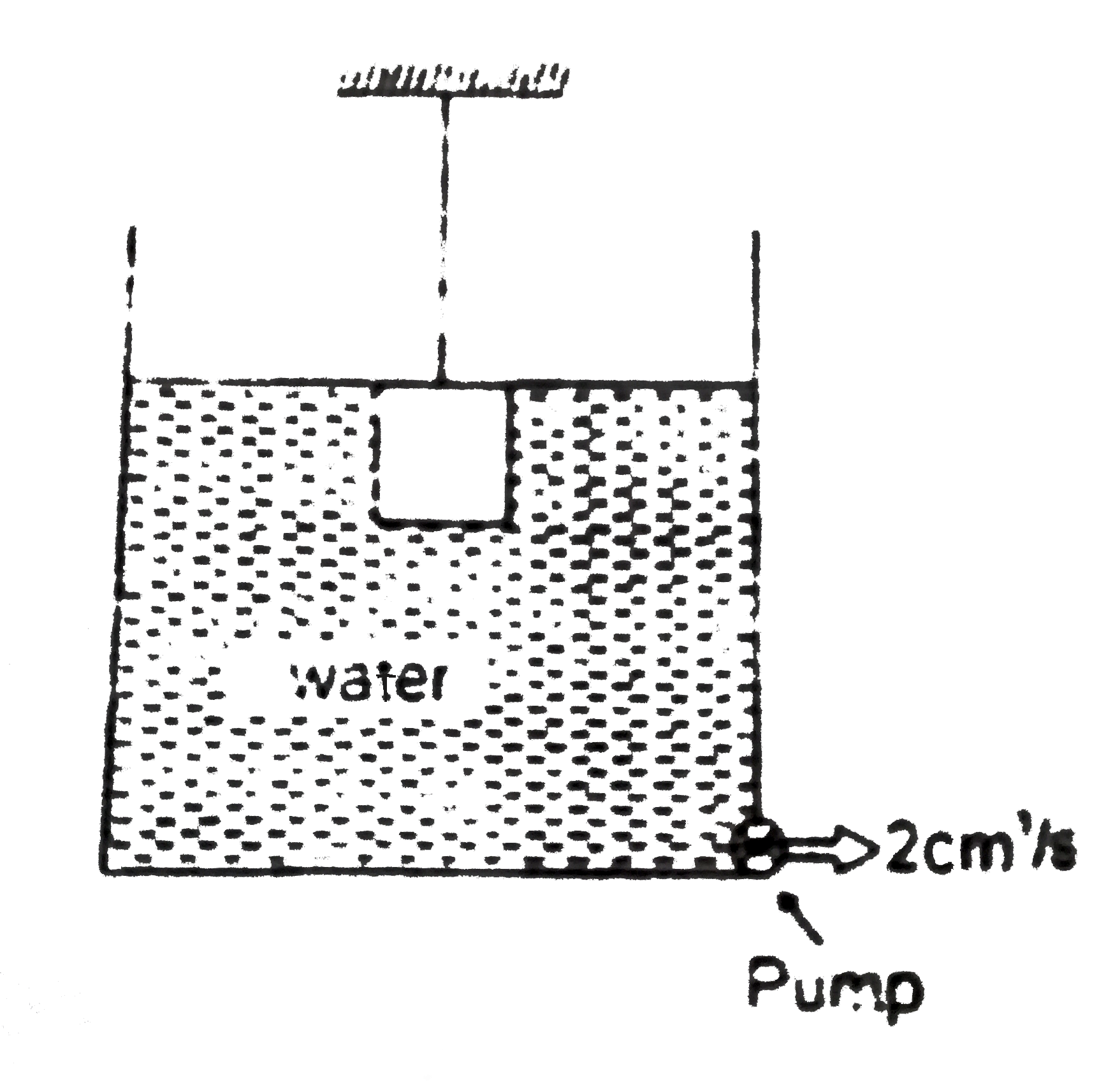
Figure shows a cubical block of side 10 ...

Figure shows a cubical block of side 10 cm and relative density 1.5 suspended by a wire of cross sectional area `10^(-6) m^(2)`. The breaking stress of the wire is `7 xx 10^(6) N//m^(2)`. The block is placed in a beaker of base area `200 cm^(2)` and initially i.e. at t = 0, the top surface of water & the block coincide. There is a pump at the bottom corner which ejects `2 cm^(3)` of water per sec. Find the time at which the wire will break.

Promotional Banner

Similar Questions

Explore conceptually related problems

A current of 5 A is passing through a metallic wire of cross- sectional area 4 xx 10^(-6) m^(2) . If the density of charge carries of the wire is 5 xx 10^(26) m^(-3) , the drift velocity of the electrons will be

A current of 2 A is passing through a metal wire of cross sectional area 2 xx 10^(-6) m^(-2) . If the number density of free electrons in the wire is 5 xx 10^(26) m^(-3) , the drift speed of electrons is (given e = 1.6 xx 10^(-19) C)

The resistance of 300 m long wire with cross-sectional area 10^(-6)m^2 and resistivity 10^(-7) Omegam is …………… .

Calculate the force required to increase the length of a steel wire of cross- sectional area 10^(-6)m^(2) by 0.5% given: Y_(("for steel"))=2xx10^(11)N-m^(2)

A body of mass 500 g is fastened to one end of a steel wire of length 2m and area of cross-section 2m m^(2) . If the breaking stress of the wire is 1.25 xx 10^(7) N//m^(2) , then the maximum angular velocity with which the body can be rotated in a horizontal circle is

A wire of length 1m is stretched by a force of 10N. The area of cross-section of the wire is 2 × 10^(–6) m^(2) and Y is 2 xx 10^(11) N//m^(2) . Increase in length of the wire will be -

A current of 5 A is passing through a metallic wire of cross-section area 4 xx 10^-6 m^2 . If the density of the charge carries in the wire is 5 xx 10^36 //m^3 , the drift velocity of the electrons is.