

Home
Class 12
PHYSICS
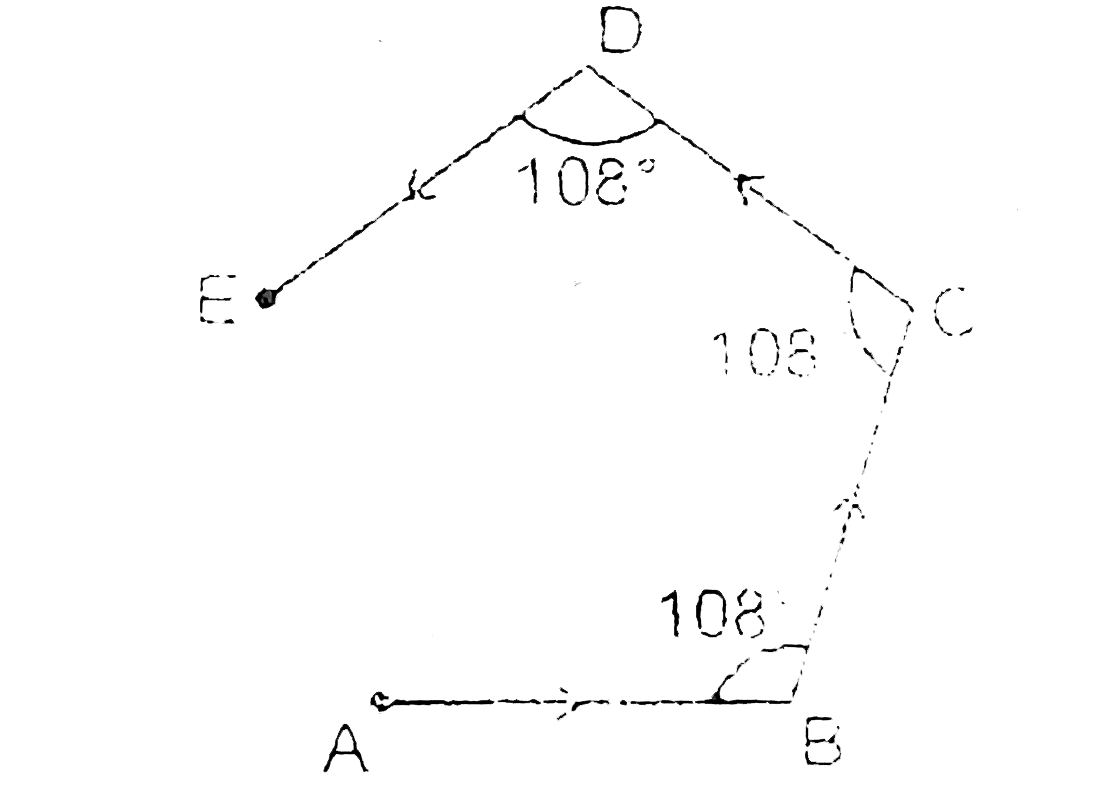
A particle moves in a plane from A to E ...

A particle moves in a plane from `A` to `E` along the shown path. It is given that `Ab=BC=CD=DE=10` metre. Then the magnitude of net displacement of particle is :
.

Promotional Banner

Similar Questions

Explore conceptually related problems

A particle moves along a path ABCD as shown in the figure. Then the magnitude of net displacement of the particle from position A to D is:

A particle moves along a path ABCD as shown in the figure. Then the magnitude of net displacement of the particle from position A to D is:

A particle moves along a straight line by a metre and then makes an angle theta with the line and travels b metre. Find the resultant displacement of the particle.

A particle travels from A to B path shown in figure, then the displacement of particle is : .

A particle travels from A to B path shown in figure, then the displacement of particle is : .

A particle moves from A to B in a circular path of radius R covering an angle theta as shown in figure. Find the ratio of magnitude of distance and magnitude of displacement of the particle.

A particle travels along the path ABC, as shown in the figure given below, AB = BC = l, calculate the path length and displacement of the particle

A particle travels along the path ABC, as shown in the figure given below, AB = BC = l, calculate the path length and displacement of the particle

A particle goes along a quadrant of a circle of radius 10m from A to B as shown in fig. Find the magnitude of displacement and distance along the path AB, and angle between displacement vector and x-axis ?

A particle goes along a quadrant of a circle of radius 10m from A to B as shown in fig. Find the magnitude of displacement and distance along the path AB, and angle between displacement vector and x-axis ?