

Home
Class 12
MATHS
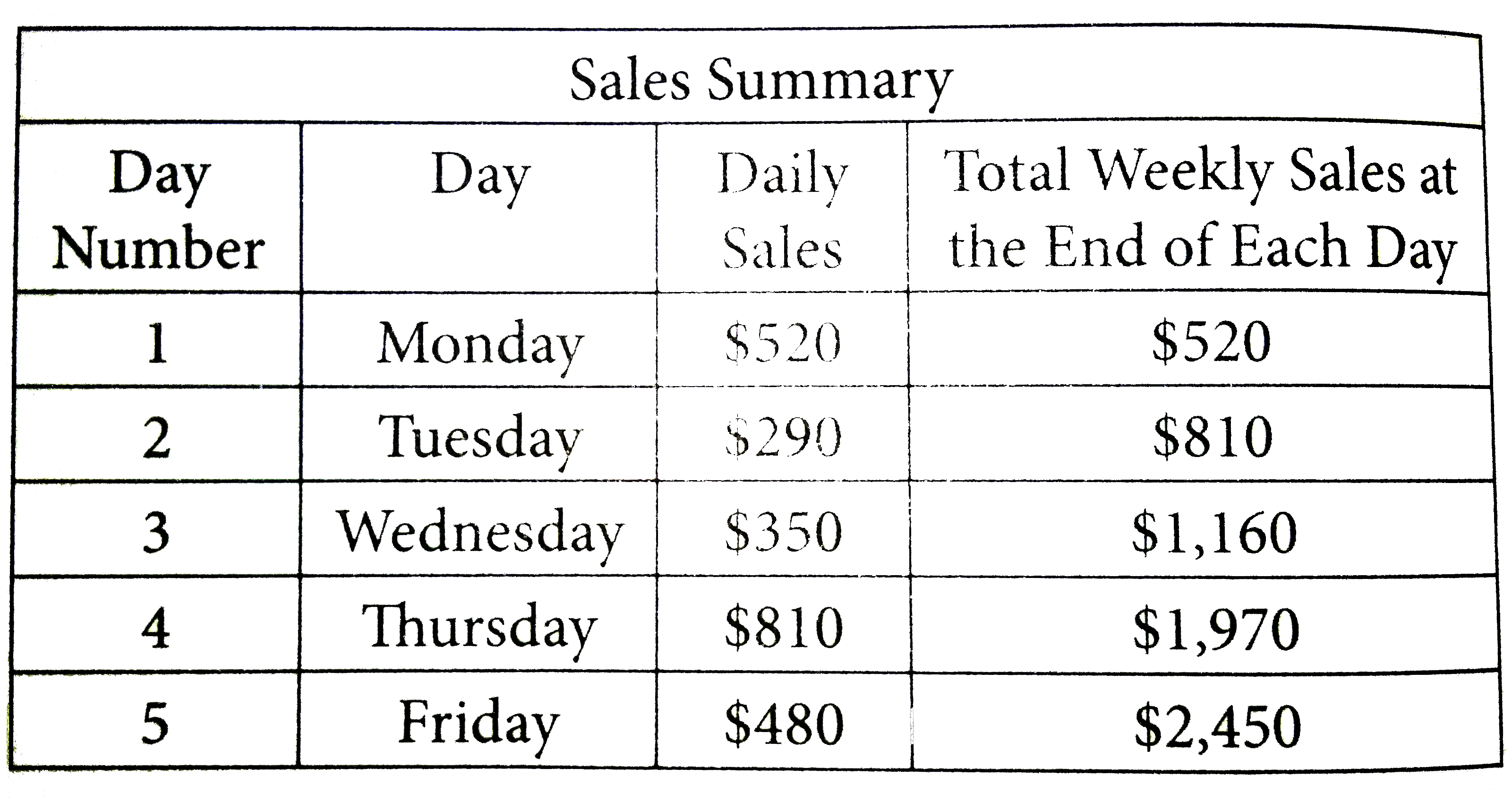
A salesperson recorded her sales during ...


A salesperson recorded her sales during a particular 5-day work week, shown in the table above, in order to study her daily sales.
During her eight-hour shift on Wednesday, the salesperson sold items that had an average price of $8.10. To the nearest tenth of an item, what is the number of items she sold per hour on Wednesday?

Promotional Banner

Similar Questions

Explore conceptually related problems

A salesperson recorded her sales during a particular 5-day work week, shown in the table above, in order to study her daily sales. The salesperson wants to increase her averages sales per day by 20% in the following week. Given the information in the chart above, what should her daily sales average be for the following week?

Arti, Bharti and Seema are partners sharing profits in the proportion of 3:2:1 and their Balance Sheet as on March 31, 2016 stood as follows : Bharti died on June 12, 2016 and according to the deed of the said partnership, her executors are entitled to be paid as under : (a) The capital to her credit at the time of her death and interest thereon @ 10% per annum. (b) Her proportionate share of reserve fund. (c) Her share of profits for the intervening period will be based on the sales during that period, which were calculated as Rs.1,00,000. The rate of profit during past three years had been 10% on sales. (d) Goodwill according to her share of profit to be calculated by taking twice the amount of the average profit of the last three years less 20% . The profits of the previous years were : 2013 – Rs.8,200 2014 – Rs.9,000 2015 – Rs.9,800 The investments were sold for Rs.16,200 and her executors were paid out. Pass the necessary journal entries and write the account of the executors of Bharti.

(Manufacturing problem) A manufacturer has three machines I , II and III installed in his factory. Machines I and II are capable of being operated for at most 12 hours where as machine III must be operated for atleast 5 hours a day. She produces only two items M and N each requiring the use of all the three machines. The number of hours required for producing 1 unit of each of M and N on the three machines are given in the following table: She makes a profit of Rs 600 and Rs 400 on items M and N respectively. How many of each item should she produce so as to maximise her profit assuming that she can swll all the items that she produced ? What will be the maximum profit ?

(Manufacturing problem) A manufacturer has three machines I, II and III installed in his factory. Machines I and II are capable of being operated for at most 12 hours whereas machine HI must be operated for atleast 5 hours a day. She produces only two items M and N each requiring the use of all the three machines. The number of hours required for producing 1 unit of each of M and N on the three machines are given m the following table: She makes a profit of Rs 600 and Rs 400 on items M and N respectively. How many of each item should she produce so as to maximise her profit assuming that she can sell all the items that she produced? What will be the maximum profit?

(Manufacturing problem): A manufacturer has three machines. I, II and III installed in his factory. Machines I and II are capable of being operated for at most 12 hours whereas machine III must be operated for atleast 5 hours a day. She produces only two items M and N each requiring the sue of all the three machines. The number of hours required for producing 1 unit of each of M and N on the three machies are given in the follownig table: She makes a profit of Rs. 600 and Rs. 400 on items M and N respectively. How many of each item should be produce so as to maximise her profit assuming that she can sell all the items that she produced? What will be the maximum profit?

(Manufacturing problem) A manufacturer has three machines I, II and III installed in his factory. Machines I and II are capable of being operated for at most 12 hours whereas machine III must be operated for atleast 5 hours a day. She produces only two items M and N each requiring the use of all the three machines. The number of hours required for producing 1 unit of each of M and N on the three machines are given in the following table : She makes a profit of Rs. 600 and Rs. 400 on items M and N respectively. How many of each should she produce so as to maximise her profit assuming that she can sell all the items that she produced? What will be the maximum profit ?