Home
Class 12
PHYSICS
A particle is moving along a vertical ...

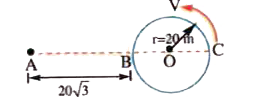
A particle is moving along a vertical circle of radius r = 20 m with a constnat vertical circle of radius r = 20 m with a constnat speed v = 31.4m/s as shown is figure . Straight line ABC is horizontal and passes throught the centre of the circle . A shell if fired from point A at the instant when the particle is at C. If distance AB is `20sqrt(3)` m and the shell collide with the particle at B , then prove `tan theta = ((2 n -1)^(2))/(sqrt(3)) `.where n is an interger. Further , show that smallest value of `theta ` is `30^(@)`.

Text Solution

Verified by Experts

As at the time of firing of th shell , the particle was at C and the shell collides with it at B, therefore the number of the revolution completed by the particle is odd multiple of half i.e., (2n-1)/2, where n is an integer .
Let the time period of the particle , then
`T = (2pir)/(v) = (2xx3014 xx 20)/(31.4) = 4 ` second.
IF the time of the flight of the shell , then t = time of `[(2n-1)//2]` revolutions of the particle
` = ((2-1))/(2) xx 4 = 2(2n -1)` second .
for a projectile , the time of flight is given by ` t = (2u sin theta)/(g)`
Hence `(2 u sin theta)/(g) = 2(2n-1)" ".......(i)`
The range of the projectile is given by `R = (u^(2) sin 2 theta)/(g)`
Hence `(u^(2) sin 2 theta)/(g) = 20 sqrt(3)" "........(ii)`
From equation (i) and (ii) `tan theta = ((2n-1)^(2))/(sqrt(3))`
For `theta` to be smallest , n =1 so `tan theta =((2n-1))/(sqrt(3))`
Promotional Banner

Topper's Solved these Questions

  • MOTION IN A PLANE

    AAKASH SERIES|Exercise SHORT ANSWER TYPE QUESTIONS|6 Videos
  • MOTION IN A PLANE

    AAKASH SERIES|Exercise VERY SHORT ANSWER TYPE QUESTIONS|10 Videos
  • MOTION IN A PLANE

    AAKASH SERIES|Exercise EXERCISE-3 (Circular Motion)|7 Videos
  • MOTION IN A STRAIGHT LINE

    AAKASH SERIES|Exercise very Short answer type question|15 Videos

Similar Questions

Explore conceptually related problems

A particle of mass M moves in a circular path of radius r with a constant speed equal to V. Then its centripetal acceleration is

A particle of mass m is moving in a horizontal circle of radius r, under a centripetal force equal to - (K//r^(2)) , where K is constant. What is the total energy of the particle ?

A particle is moving in a circle of radius R = 1m with constant speed v = 4 m/s. The ratio of the displacement to acceleration of the foot of the perpendicular drawn from the particle onto the diameter of the circle is

Construct a circle with centre M and radius 4 cm

Construct a circle with centre M and radius 10 cm.
