Home
Class 12
PHYSICS
(a) Draw the schematic sketch of a cyclo...

(a) Draw the schematic sketch of a cyclotron. Explain the shape of the path on which charged particle moves when the particle is accelerated by it.
(b) To convert a given galvanometer into a voltmeter of ranges 2 V, V and `V/2` volt, resistances `R_(1),R_(2)` and `R_(3)` ohm respectively, are required to be connected in series with the galvanometer. Obtain the relationship between `R_(1), R_(2)` and `R_(3)`.

Text Solution

Verified by Experts

The correct Answer is:
a

(a) The schematic sketch of a cyclotron is drawn here. The positively charged particle produced at the centre of cyclotron is attracted towards the dee (say `D_(1)`) which is at a negative potential at that time. The charged particle acquires some velocity (say `v_(1)`) due to attraction of electric field. But once the charged particle enters into the dee, it describes a circular path of radius `r_(1)=(mv_(1))/(qB)`.
After describing a semicircular path inside dee `D_(1)`, the particle comes in the gap between the two dees. In the resonance condition, the direction of electric field just gets reversed during this time and particle is again accelerated towards the dee `D_(2)` and its velocity `v_(2)` becomes greater. So, the charged particle describes a semicircular path in dee `D_(2)` whose radius `r_(2)=(mv_(2))/(qB)` is slightly greater than `r_(1)` As time taken by charged particle to cover the semicircular path remains unchanged, same thing happens again and again and particle describes semicircular paths of gradually increasing radii in dees `D_(1)` and `D_(2)` again and again.
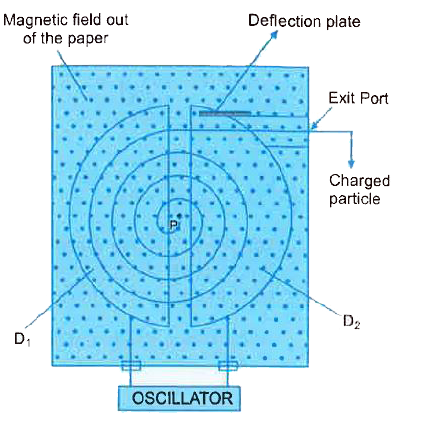
(b) Let us have a galvanometer of resistance `R_(G)` and giving full scale deflection for a current `I_(g)` to convert it into a voltmeter of ranges 2V,V and `V/2` respectively, we are joining resistances `R_(1),R_(2)` and `R_(3)` so we have
`R_(1)=(2V)/(I_(g))-R_(g)` ...(i)
`R_(2)=V/(I_(g))-R_(g)` ....(ii)
and `R_(3)=(v//2)/(I_(g))-R_(g)` ....(iii)
On solving these equations, we get
`R_(1)-R_(2)=2R_(3)` or `R_(1)=R_(2)+2R_(3)`

Promotional Banner

Topper's Solved these Questions

  • EXAMINATION PAPER 2020 (SOLVED)

    U-LIKE SERIES|Exercise SECTION C|8 Videos
  • ELECTROSTATIC POTENTIAL AND CAPACITANCE

    U-LIKE SERIES|Exercise SELF ASSESSMENT TEST|1 Videos
  • MAGNETISM AND MATTER

    U-LIKE SERIES|Exercise SELF ASSESSMENT TEST (Section D)|1 Videos

Similar Questions

Explore conceptually related problems

Two ideal batteries of emf V_(1) and V_(2) and three resistance R_(1)R_(2) and R_(3) are connected The current in resistance R_(2) would be zero if

Two cells of emf 3V and 5V and internal resistance r_(1) and r_(2) respectively are in series with an external resistance R. if the p.d. across 1 st cell is zero, then R is

A galvanmeter of resistance G is converted into a voltmeter of range 0 -1V by connecting resistance R_1 in series with it. The additional resistance that should be connected in series with R_1 to increase the range of the voltmeter to 0-2 V will be :

In the following figure, the reading of an ideal voltmeter V is zero. Then, the relation between R, r_(1) " and " r_(2) is

The resistors of resistances R_(1)=100pm3" ohm and R"_(2)=200pm 4ohm are connected in series. The equivalent resistance of the series combination is

Two ideal batteries of emf V_(1)andV_(2) and these resistances R_(1),R_(2)andR_(3) are connected as shown in the figure . The current in resistance R_(2) would be zero if

A voltmeter of resistance 600 Omega when connected in turn across resistances R_(1) and R_(2) gives readings of V_(1) and V_(2) , respectively. If the battery is ideal, then

A galvanometer is to be converted into a voltmeter and an ammeter successively by using either of two resistances R_1 and R_2 (R_1 gt R_2)
