Home
Class 12
PHYSICS
(a) What is meant by plane polarised lig...

(a) What is meant by plane polarised light? An unpolarised light is incident at an angle `theta` on the surface of glass of refractive index n. If the reflected and refracted rays are perpendicular to each other, then obtain the relationship between n and `theta`.
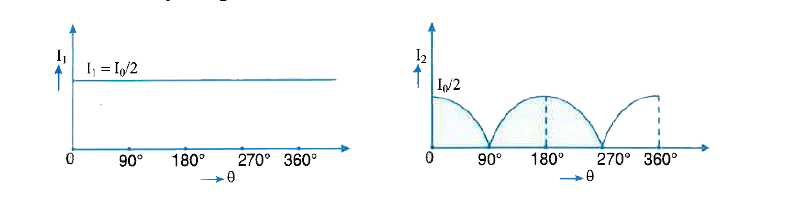
(b) Two polaroids P1 and P2 are placed in a crossed position. Unpolarised light of intensity `I_(0)` is incident on `P_(1)`. If `P_(2)` is rotated through an angle `theta` about the direction of propagation of light, keeping `P_(1)` fixed, plot the graph of intensity of light for `0°lt theta < 360°` which is (i) transmitted by `P_(1)` and (ii) transmitted by `P_(2)`.

Text Solution

Verified by Experts

The correct Answer is:
a

(a) A plane polarised light is that in which all electric vectors of propagating light wave are constrained to oscillate in one particular plane perpendicular to the direction of propagation of light wave.
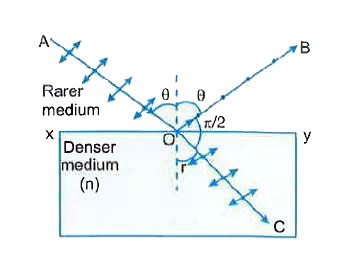
Let an unpolarised light be incident at an angle `theta` on the surface of glass of refractive index . n. such that the reflected and refracted rays are perpendicular to each other. Then as shown in adjoining figure.
`angletheta+angler=pi/2rArrangler=pi/2-angletheta`
As per Snell.s law of refraction, we can write
`(sintheta)/(sinr)=n`
`rArr(sintheta)/(sin(pi/2-theta))=nrArr(sintheta)/(costheta)=nrArrtantheta=n`

The relation n = tan `theta` is known as Brewster.s law and under this condition the reflected light is completely plane polarised one as shown in figure.
(b) Here intensity of unpolarised light = `I_(0)`
(i) Intensity of light transmitted by `P_(1),I_(1)=(I_(0))/2` and this intensity does not change on rotating `P_(2)`.
(ii) Intensity of light transmitted by `P_(2),I_(2)=I_(1)cos^(2)theta` and it changes with change in value of `theta`. Variation of `I_(1)` and `I_(2)` is shown below :
Promotional Banner

Topper's Solved these Questions

  • EXAMINATION PAPER 2020 (SOLVED)

    U-LIKE SERIES|Exercise SECTION C|8 Videos
  • ELECTROSTATIC POTENTIAL AND CAPACITANCE

    U-LIKE SERIES|Exercise SELF ASSESSMENT TEST|1 Videos
  • MAGNETISM AND MATTER

    U-LIKE SERIES|Exercise SELF ASSESSMENT TEST (Section D)|1 Videos

Similar Questions

Explore conceptually related problems

Unpolarized light is incident on a plane glass surface. What should be the angle of incidence so that the reflected and refracted rays are perpendicular to eachother ?

A ray of light in incident on a glass plate at an angle of 60^@ . What is the refractive index of glass if the reflected and refracted rays are perpendicular to each other?

Unpolarized light is incident on a plane glass surface. The angle of incidence so that reflected and refracted rays and perpendicular to each other, then

Light is incident on a plane glass sheet at an angle of 70^@ . Find the refractive index of glass sheet if the reflected and refracted rays are perpendicular to each other.

Unpolarized light is incident on a plane glass surface having refractive index . The angle of incidence at which reflected and refracted rays would become perpendicular to each other is :

A ray of light is incident on the surface of a glass plate of reflective index 1.536 such that the reflected and refracted rays are mutually perpendicular. What is the angle of reflection ?

A ray of light is incident on a transparent glass slab of refractive index sqrt3 . If the reflected and refracted rays are mutually perpendicular, what is the angle of incidence?

A ray of light strikes a glass plate at an angle of 40^(@) . If the reflected and refracted rays are perpendicular to each other the index of refractive of glass is