Text Solution
Verified by Experts
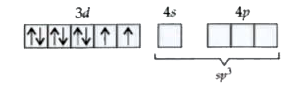
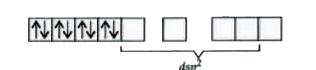



Topper's Solved these Questions
COORDINATION COMPOUNDS
U-LIKE SERIES|Exercise SELF ASSESSMENT TEST|7 VideosCOORDINATION COMPOUNDS
U-LIKE SERIES|Exercise SHORT ANSWER QUESTIONS (2 marks each)|54 VideosCHEMISTRY IN EVERYDAY LIFE
U-LIKE SERIES|Exercise LONG ANSWER QUESTIONS - I|21 VideosELECTROCHEMISTRY
U-LIKE SERIES|Exercise SELF ASSESSMENT TEST (SECTION D)|1 Videos
Similar Questions
Explore conceptually related problems
U-LIKE SERIES-COORDINATION COMPOUNDS-LONG ANSWER QUESTIONS-I (3 marks each)
- Write the IUPAC name of the following complex : [Co(NH(3))(5)(CO(3))]C...
Text Solution
|
- What type of isomerism is shown by the complex [Co(NH(3))(5)(SCN)]^(2+...
Text Solution
|
- Why is [NiCl(4)]^(2-) paramagnetic while [Ni(CN)(4)]^(2-) is diamagnet...
Text Solution
|
- Why are low spin tetrahedral complexes rarely observed ?
Text Solution
|
- Define crystal field splitting energy. On the basis of crystal field t...
Text Solution
|
- [Ni(CN)(4)]^(2-) is colourless whereas [Ni(H(2)O)(6))^(2+) is green. W...
Text Solution
|
- For the complex [Fe(CN)(6)]^(3-), write the hybridisation type, magnet...
Text Solution
|
- Draw one of the geometrical isomers of the complex [Pt(en)(2)Cl(2)]^(2...
Text Solution
|
- For the complex [Fe(H(2)O)(6)]^(3+), write the hybridisation, magnetic...
Text Solution
|
- Draw one of the geometrical isomers of the complex [Pt(en)(2)Cl(2)]^(2...
Text Solution
|
- For the complex [Fe(CO)(5)], write the hybridisation, magnetic charact...
Text Solution
|
- Define crystal field splitting energy.
Text Solution
|
- What type of isomerism is shown by the complex [Cr(H(2)O)(6)]Cl(3) ?
Text Solution
|
- On the basis of crystal field theory, write the electronic configurati...
Text Solution
|
- Write the hybridisation and shape of [CoF(6)]^(3-). [Atomic number of ...
Text Solution
|
- Draw the geometrical isomers of complex [Pt(NH(3))(2)Cl(2)].
Text Solution
|
- On the basis of crystal field theory, write the electronic configurati...
Text Solution
|
- Write the hybridisation and magnetic behaviour of the complex [Ni(CO)(...
Text Solution
|
- Draw the geometrical isomers of complex [Pt(en)(2)Cl(2)]^(2+) .
Text Solution
|
- On the basis of crystal field theory, write the electronic configurati...
Text Solution
|