Home
Class 12
MATHS
A merchant plans to sell two types of...

A merchant plans to sell two types of personal computers - a desktop model and a portable model that will cost Rs 25000 and Rs 40000 respectively. He estimates that the total monthly demand of computers will not exceed 250 units. Determine the nu

Text Solution

Verified by Experts
Let number of desktops be `x`,
and number of portable computers be `y`


According to Question:
Monthly demand of both items = maximum 250 units
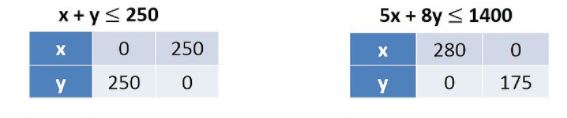
`therefore x+y<=250 " " " " ....(1)`

Also,
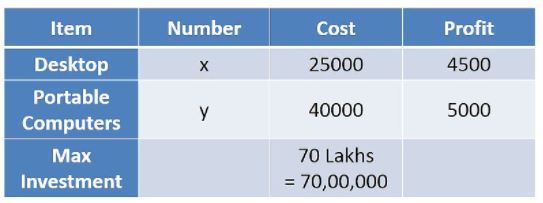
Cost of Desktop = Rs 25000
Cost of Computers= Rs 40000
Max Investment = Rs 70,00,000

Hence,
` " " " 25000x+40000y<=70,00,000`
` " " " 5x+8y<=1400 " " " " ....(2)`

As we need to maximize profit,
Hence, Function used here will be Maximize `Z`

Profit on Desktop `to` Rs 4500
Profit on Computers `to` Rs 5000
`therefore` Maximize `Z=4500x+5000y`

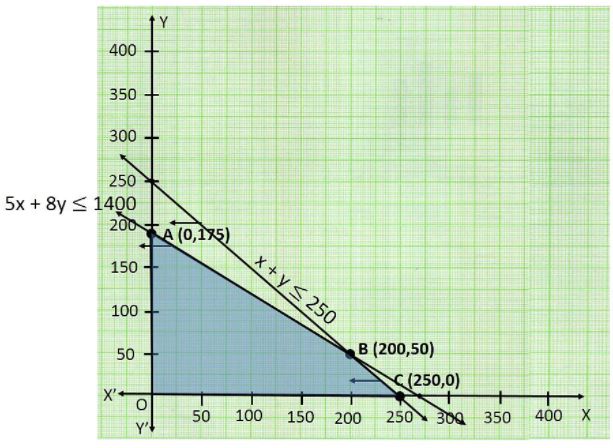
Combining all constraints
Max `Z=4500x+5000y`
`x+y<=250`
`5x+8y<=1400`
`x>=0, y>=0`


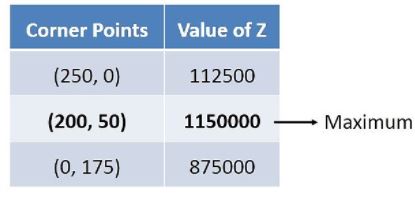
Hence, the profit will be maximum if company produces:
Number of desktops =200
Number of portable computers = 50

Maximum Profit = Rs 11,50,000
Promotional Banner

Topper's Solved these Questions

  • LINEAR PROGRAMMING

    NCERT ENGLISH|Exercise SOLVED EXAMPLES|11 Videos
  • INVERSE TRIGONOMETRIC FUNCTIONS

    NCERT ENGLISH|Exercise Solved Examples|13 Videos
  • MATRICES

    NCERT ENGLISH|Exercise All Questions|105 Videos

Similar Questions

Explore conceptually related problems

A company sells its product at Rs 10 per unit. Fixed costs are Rs 35000 and variable costs are estimated to run 30% of total revenue. Determine the (i) total cost function (ii) the quantity the company must sell to cover the fixed cost.

A manufacturer considers that men and women workers are equally efficient and so he pays them at the same rate. He has 30 and 17 units of workers (male and female) and capital respectively, which he uses to produce two types of goods A and B. To produce one unit of A, 2 workers and 3 units of capital are required while 3 workers and 1 unit of capital is required to produce one unit of b. If A and B are priced at Rs. 100 and Rs. 120 per unit respectively, how should he use his resources to maximize the total revenue? Form the above as an LPP and solve graphically. Do you agree with this view of the manufacture that men and women workers are equally efficient and so should be paid at the same rate?

Hasan buys two kinds of cloth materials for school uniforms, shirt material that costs him Rs 50 per metre and trouser material that costs him Rs 90 per metre. For every 2 meters of the trouser material he buys 3 metres of the shirt material. He sells the materials at 12% and 10% profit respectively. His total sale is Rs 36,660. How much trouser material did he buy?