Home
Class 10
MATHS
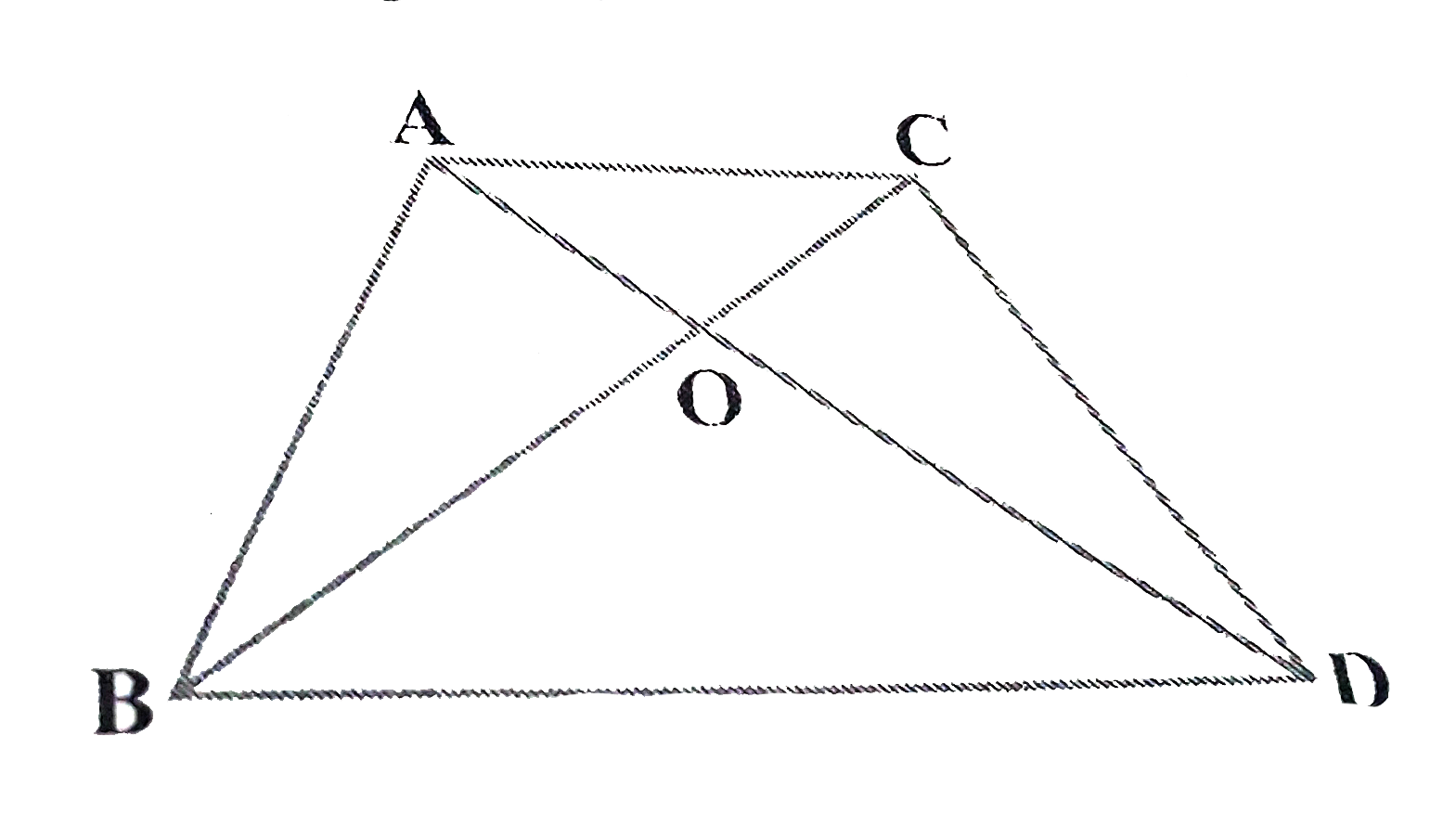
In figure ABC and DBC are two triangles...

In figure ABC and DBC are two triangles on the same base BC. If AD intersects BC at O, show that `(a r(A B C))/(a r(D B C))=(A O)/(D O)`.

Text Solution

Verified by Experts


`triangleABC` and `triangleDBC` are two triangles on the same base `BC`. If `AD` intersects `BC` at `O`.
To Prove:
`(Ar(ΔABC))/(Ar(ΔDBC))= (AO)/(DO)`
Construction: Drawn `AP⊥BC `and `DM⊥BC`. ...
Promotional Banner

Similar Questions

Explore conceptually related problems

In Figure, /_\ A B C and /_\ D B C are on the same base B C . If A D and B C intersect at O , prove that (A r e a\ ( A B C))/(A r e a\ ( D B C))=(A O)/(D O) .

The diagonals of quadrilateral A B C D intersect at O . Prove that (a r( A C B))/(a r( A C D))=(B O)/(D O)

ABC and DBC are two isosceles triangles on the same base BC (see Fig. 7.33). Show that /_A B D\ =/_A C D

In Figure, A B C\ a n d\ ABD are two triangles on the base A B . If line segment C D is bisected by A B\ a t\ O , show that a r\ (/_\ A B C)=a r\ (\ /_\ A B D)

Triangles A B C and DBC are on the same base B C with A, D on opposite side of line B C , such that a r(_|_ A B C)=a r( D B C)dot Show that B C bisects A Ddot

Triangles A B C and DBC are on the same base B C with A, D on opposite side of line B C , such that a r(triangle A B C)=a r( triangle D B C) . Show that B C bisects A D .

Triangles ABC and DBC are two isosceles triangles on the same base BC and their vertices A and D are on the same side of BC. If AD is extended to intersect BC at P, show that: Delta ABP ~= Delta ACP

Triangles ABC and DBC are two isosceles triangles on the same base BC and their vertices A and D are on the same side of BC. If AD is extended to intersect BC at P, show that: AP bisects angle BAC and BDC.

ABC and DBC are two triangle on the same base BC such that A and D lie on the opposite sides of BC,AB=AC and DB =DC ,Show that AD is the perpedicular bisector of BC.

DeltaA B C and DeltaD B C are two isosceles triangles on the same base BC and vertices A and D are on the same side of BC (see Fig. 7.39). If AD is extended to intersect BC at P, show that (i) \ DeltaA B D~=DeltaA C D (ii) DeltaA B P~=DeltaACP (iii) AP bisects ∠ A as well as ∠ D (iv) AP is the perpendicular bisector of BC
