

Home
Class 11
PHYSICS
A thermodynamic system is taken from an ...

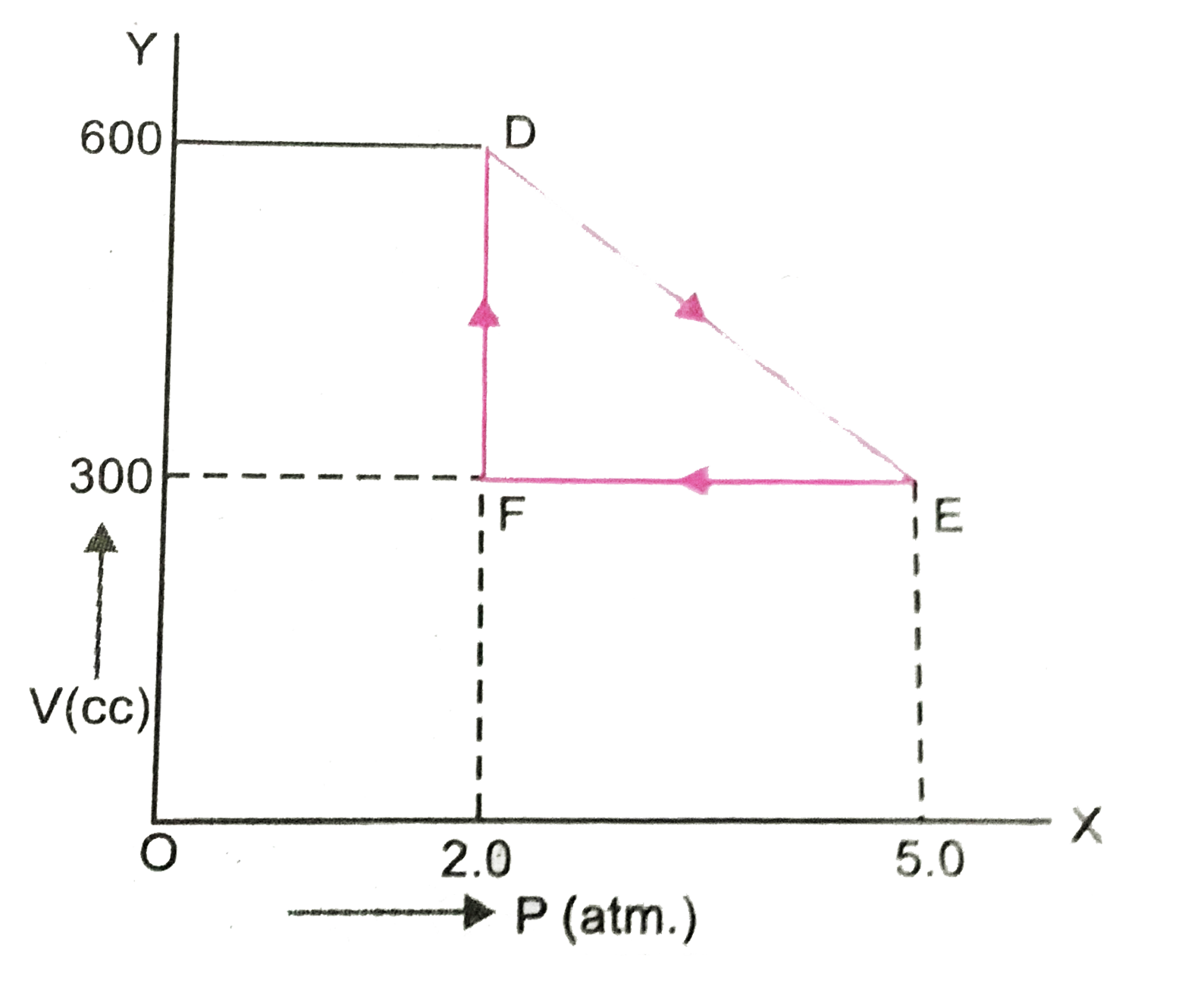
A thermodynamic system is taken from an original state D to an intermediate state E by the linear process shown in (figure)

Its volume is then reduced to the original value from E to D via F by an isobaric process. Calculate the total work done by the gas from D to E to F to D.

Text Solution

Verified by Experts

`"Total work done by the gas from" D " to " E " to " F = "Area of" DeltaDEF`
`"Area of" DeltaDEF=(1)/(2)DExxEF`
Where,
DF = Change in pressure
`=600N//m^(2)-300N//m^(2)`
`=300N//m^(2)`
FE = Change in volume
`=5.0m^(3)-2.0m^(3)`
`=3.0m^(3)`
`"Area of" DeltaDEF=(1)/(2)xx300xx3=450J`
Therefore, the total work done by the gas from D to E to F is 450 J.
Promotional Banner

Topper's Solved these Questions

  • THERMAL PROPERTIES OF MATTER

    NCERT ENGLISH|Exercise EXERCISE|22 Videos
  • UNITS AND MEASUREMENT

    NCERT ENGLISH|Exercise EXERCISE|33 Videos

Similar Questions

Explore conceptually related problems

A thermodynamic process is carried out from an original state D to an intermediate state E by the linear process shown in figure. The total work is done by the gas from D to E to F is

An ideal gas change from state a to state b as shown in Fig. what is the work done by the gas in the process?

A thermodynamic system consists of a cylinder-piston attangement with ideal gas in it. It goes from the state i to the state f as shwon in the figure. The work done by gas during the process is

An ideal gas goes from the state i to the state int as shown in .the work done by the gas during the process

A monatomic idea gas of 2 mol is taken through a cyclic process starting from A as shown in figure. The volume ratio are V_(B)//V_(A)=2 and V_(D)//V_(A)=4 . If the temperature T_(A) at A is 27^(@)C , and gas constant is R . Calculate. The total work done by the gas during the complete cycle.

A certain mass of gas is taken from an initial thermodynamics state A to another state B by process I and II. In process I for the gas does 5 J of work and absorbs 4 J of heat energy. In process II, the gas absorbs 5 J of heat. The work done by the gas in process II is

Statement I: When an ideal gas is taken from a given thermodynamics state A to another given thermodynamic state B by any polytropic process, the change in the internal energy of the system will be the same in all processes. Statement II: Internal energy of the ideal gas depends only upon its absolute temperature.

A sample of ideal gas is taken through the cyclic process shown in the figure. The temerauture of the gas in state A is T_(A) =200 K. In states B and C the temperature of the gas is the same. Net work done by the gas in the process is

calculate the work done by a gas as it is taken from the state a to b, b to c and c to a as shown in

1.0 mol of a monoatomic ideal gas is expanded from state (1) to state (2) as shown in figure. Calculate the work done for the expansion of gas from state (1) to state (2) at 298 K.