Home
Class 12
PHYSICS
Fig shows a charge array known as an 'el...

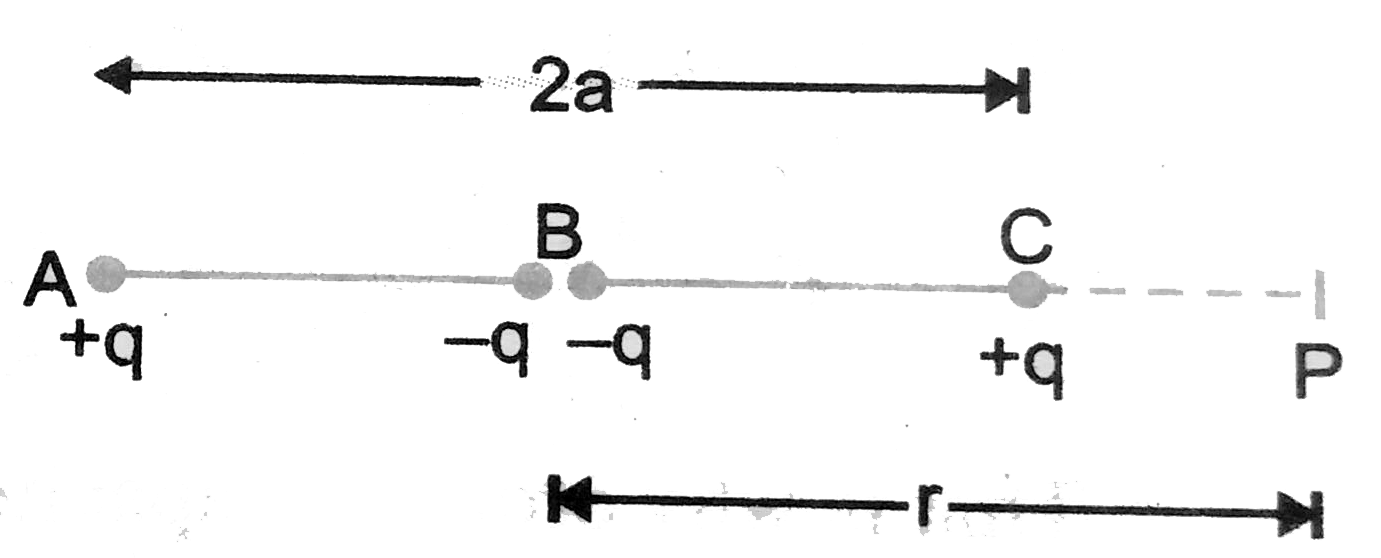
Fig shows a charge array known as an 'electric quadrupole'. For a point on the axis of the quadrupole, obtain the dependence of potential on r for `r//a gtgt 1`, and contract your results with that due to an electric dipole and an electric monopole (i.e, a single charge).

Text Solution

Verified by Experts
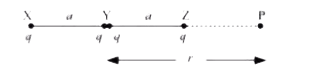
Four charges of same magnitude are placed at points X, Y, Y and Z respectively, as shown in the following figure.

A point is located at P, Which is r distance away from point Y.
The system of charges forms an electric quadrupole.
It can be considered that the system of the electric quadrupole has three charges.
Charge +q placed at point X
Charge `-2q` placed at point Y
Charge `+q` placed at point Z
`XY = YZ = a`
`YP= r`
`PX = r+a`
Electrostatic potential caused by the system of three charges at point P is given by,
`V = (1)/(4pi in_(0))[(q)/(XP) - (2q)/(YP)+(q)/(ZP)]`
`= (1)/(4pi in_(0))[(q)/(r+a) -(2q)/(r)+(a)/(r-a)]`
`= (Q)/(4pi in_(0))[(r(r-a)-2(r+a)(r-a)+r(r+a))/(r(r+a)(r-a))]`
`= (q)/(4pi in_(0))[(r^(2)-ra-2r^(2)+2a^(2)+r^(2)+ra)/(r(r^(2)-a^(2)))] = (q)/(4pi in_(0))[(2a^(2))/(r(r^(2)-a^(2)))]`
`= (2qa^(2))/(4pi in_(0) r^(3)(1-(a^(2))/(r^(2))))`
Since `(r)/(a) gt gt 1`
`:. (a)/(r) lt lt 1`
`(a^(2))/(r^(2))` is taken as negligible.
`:. V = (2qa^(2))/(4pi in_(0) r^(3))`
It can be inferred that potential, `V prop (1)/(r^(3))`
However, it is known that for a diople, `V prop (1)/(r^(3))`
And , for a monopole, `V prop (1)/(r)`
Promotional Banner

Topper's Solved these Questions

  • ELECTROSTATIC POTENTIAL AND CAPACITANCE

    NCERT ENGLISH|Exercise Exercise|37 Videos
  • ELECTROMAGNETIC WAVES

    NCERT ENGLISH|Exercise Exercise|15 Videos
  • MAGNETISM AND MATTER

    NCERT ENGLISH|Exercise Exercise|25 Videos

Similar Questions

Explore conceptually related problems

Figure shows a charge array known as an "electric quadrupole". For a point on the axis of the quadruple, the dependence of potential on r(r/agt gt1) is 1/(r^(n)) . Find n ?

Draw a plot showing the variation of (i) electric field (E ) and (ii) electric potential (V) with distance r due to a point charge Q.

Electric field intensity (E) due to an electric dipole varies with distance (r ) from the point of the center of dipole as :

(i) Derive the expression for the specific for the electric potential due to an electric dipole at a point on its axial line. (ii) Depiet the equivpotential surfaces due to an electric dipole.

A circular coil of radius R carries an electric current. The magnetic field due to the coil at a point on the axis of the coil located at a distance r from the centre of the coil, such that r gtgt R , varies as

A circular coil of radius R carries an electric current. The magnetic field due to the coil at a point on the axis of the coil located at a distance r from the centre of the coil, such that r gtgt R , varies as

The potential at a point due to an electric dipole will be maximum and minimum when the angles between the axis of the dipole and the line joining the point to the dipole are respectively

Two charges e and 3e are placed at a distance r. The distance of the point where the electric field intensity will be zero is

Intensity of an electric field (E) depends on distance r due to a dipole, is related as

Obtain an expression for electric potential .V due to a point charge .Q at a distance r.

NCERT ENGLISH-ELECTROSTATIC POTENTIAL AND CAPACITANCE-Exercise
  1. In a hydrogen atom, the electron and proton are bound at a distance of...

    Text Solution

    |

  2. If one of the two electrons of a hydrogen molecule is removed, we get ...

    Text Solution

    |

  3. Two charged conducting spheres of radii a and b are connected to eac...

    Text Solution

    |

  4. Two charges -q and +q are located at points (0, 0, –a) and (0, 0, a), ...

    Text Solution

    |

  5. Fig shows a charge array known as an 'electric quadrupole'. For a poin...

    Text Solution

    |

  6. An electrical technician requires a capacitance of 2 muF in a circuit ...

    Text Solution

    |

  7. What is the area of the plates of a 2 farad parallel plate air capac...

    Text Solution

    |

  8. Obtain equivalent capacitance of the following network, Fig. For a ...

    Text Solution

    |

  9. The plates of a parallel plate capacitor have an area of 90 cm^(2) ea...

    Text Solution

    |

  10. A 4 muF capacitor is charged by a 200 V supply. It is then disconnect...

    Text Solution

    |

  11. Show that the force on each plate of a parallel plate capacitor has a ...

    Text Solution

    |

  12. A spherical capacitor consists of two concentric spherical conductors...

    Text Solution

    |

  13. A spherical capacitor has an inner sphere of radius 12 cm and an oute...

    Text Solution

    |

  14. Answer carefully: (a) Two large conducting spheres carrying charges ...

    Text Solution

    |

  15. A cylindrical capacitor has two co-axial cylinders of length 15 cm a...

    Text Solution

    |

  16. A parallel plate capacitor is to be designed with a voltage rating 1 K...

    Text Solution

    |

  17. Describe schematically the equipotential surfaces corresponding to (...

    Text Solution

    |

  18. In a Van de graaf type generator a spherical metal shell is to be a ...

    Text Solution

    |

  19. A small sphere of radius r(1) and charge q(1) is enclosed by a spheri...

    Text Solution

    |

  20. Answer the following: (a) The top of the atmosphere is at about 400 ...

    Text Solution

    |

