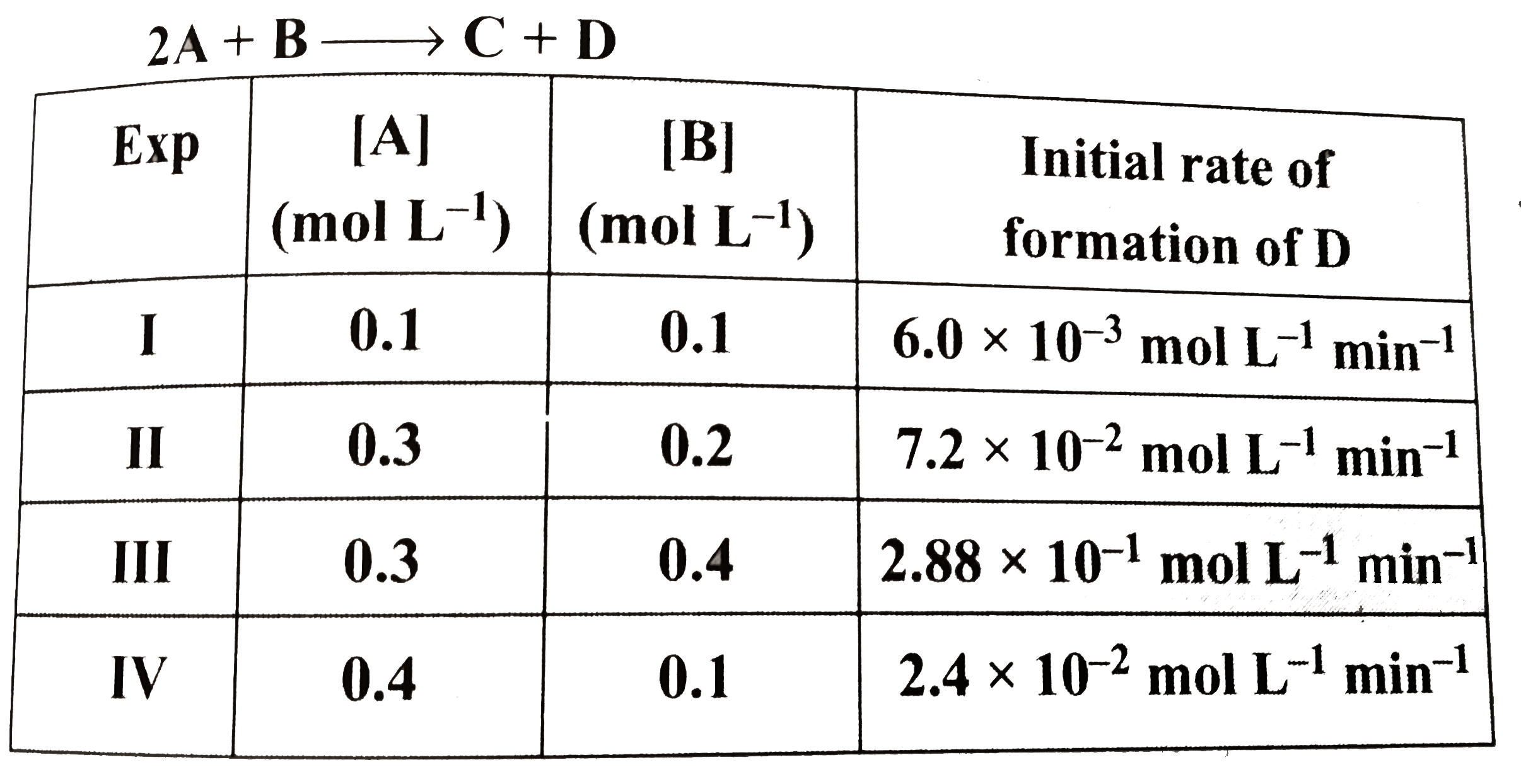
The following rate data were obtained at `303 K` for the following reaction: `2A + B rarr C + D` What is the rate law? What is the order with respect to each reactant and the overall order? Also calculate the rate constant and write its units.
Text Solution
Verified by Experts
Let the order of the reaction with respect to A be x and with respect to B be y . Therefore , rate of the reaction is given by , Rate = `k[A]^(x) [B]^(y)` According to the question , `6.0 xx 10^(-3) = k [0.1]^(x) [0.1]^(y) " " (i)` `7.2 xx 10^(-2) = k [0.3]^(x) [0.2]^(y) " " (ii)` `2.88 xx 10^(-1) = k [0.3]^(x) [0.4]^(y) " " (iii) ` `2.40 xx 10^(-2) = k [0.4]^(x) [0.1]^(y) " " (iv)` Dividing equation (iv) by (i) , we obtain `(2.40 xx 10^(-2))/(6.0 xx 10^(-3)) = (k [0.4]^(x)[0.1]^(y))/(k [0.1]^(x) [0.1]^(y))` `implies 4 = ([0.4]^(x))/([0.1]^(x))` `implies 4 = ((0.4)/(0.1))^(x)` `implies (4)^(1) = 4^(x)` `implies x = 1 ` Dividing equation (iii) by (ii) , we obtain `(2.88 xx 10^(-1))/(7.2 xx 10^(-2)) = (k [0.3]^(x) [ 0.4]^(y))/(k[0.3]^(x) [ 0.2]^(y))` `implies 4 = ((0.4)/(0.2))^(y)` `implies 4 = 2^(y)` `implies 2^(2) = 2^(y)` `implies y = 2 ` Therefore , the rate law is Rate = k `[A][B]^(2)` `implies k = ("Rate")/([A][B]^(2))` From experiment l , we obtain `k = (6.0 xx 10^(-3) "mol" L^(-1) "min"^(-1))/((0.1 "mol" L^(-1)) (0.1 "mol" L^(-1))^(2))` `6.0 L^(2) "mol"^(-2) "min"^(-1)` From experiment lll , we obtain `k = (2.88 xx 10^(-1) "mol" L^(-1) "min"^(-1))/((0.3 "mol" L^(-1)) (0.4 "mol" L^(-1))^(2))` `6.0 L^(2) mol^(-2) "min"^(-1)` From experiment IV , we obtain `k = (2 . 40 xx 10^(-2) "mol" L^(-1) "min"^(-1))/((0.4 "mol" L^(-1)) (0.1 "mol" L^(-1))^(2))` `= 6.0 L^(2) mol^(-2) "min"^(-1)` Therefore , rate constant , K = `6.0 L^(2) mol^(-2) "min"^(-1)`
Topper's Solved these Questions
CHEMICAL KINETICS
NCERT ENGLISH|Exercise Exercise|1 Videos
CHEMICAL KINETICS
NCERT ENGLISH|Exercise SOLVED EXAMPLE|1 Videos
BIOMOLECULES
NCERT ENGLISH|Exercise Exercise|33 Videos
CHEMISTRY IN EVERYDAY LIFE
NCERT ENGLISH|Exercise Exercise|32 Videos
Similar Questions
Explore conceptually related problems
The following rate data were obtained at 303 K for the following reaction : 2A +B to C+D What is the rate law? What is the order with respect to each reactant and the overall order? What are the units of rate constant?
The following rate data were obtained at 303 K for the following reaction : 2A +B to C+D What is the rate law? What is the order with respect to each reactant and the overall order? What are the units of rate constant?
The following rate data were obtained at 300 K for the reaction 2A +B to C +D Calculate the rate of formation of D when : [A]=0.5 mol L^(-) and [B]=0.2 mol L^(-)
What is the order of the reaction whose rate constant has the same unit as the rate of reaction ?
Consider the reaction, A + B to C + D . The initial rate for different initial concentrations of the reactants are given below : Calculate the rate constant.