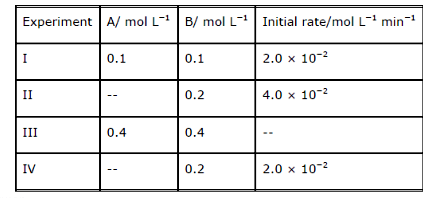
The reaction between A and B is first order with respect to A and zero order with respect to B. Fill in the blanks in the following table:
Text Solution
Verified by Experts
The given reaction is of the first order with respect to A and of zero order with respect to B . Therefore , the rate of the reaction is given by , Rate = `k[A]^(1) [B]^(0)` `implies` Rate = k [A] From experiment l , we obtain `2.0 xx 10^(-2) "mol" L^(-1) "min"^(-1) = k (0.1 "mol" L^(-1))` `implies k = 0.2 "min"^(-1)` From experiment ll , we obtain `4.0 xx 10^(-2) "mol" L^(-1) "min"^(-1) = 0.2 "min"^(-1)[A]` `implies [A] = 0.2 "mol" L^(-1)` From experiment lll , we obtain Rate = `0.2 min^(-1) xx 0.4 "mol" L^(-1)` `= 0.08 "mol" L^(-1) "min"^(-1)` From experiment IV , we obtain `2.0 xx 10^(-2) "mol" L^(-1) "min"^(-1) = 0.2 "min"^(-1)[A]` `implies [A] = 0.1 "mol" L^(-1)`
Topper's Solved these Questions
CHEMICAL KINETICS
NCERT ENGLISH|Exercise Exercise|1 Videos
CHEMICAL KINETICS
NCERT ENGLISH|Exercise SOLVED EXAMPLE|1 Videos
BIOMOLECULES
NCERT ENGLISH|Exercise Exercise|33 Videos
CHEMISTRY IN EVERYDAY LIFE
NCERT ENGLISH|Exercise Exercise|32 Videos
Similar Questions
Explore conceptually related problems
Fill in the blanks in following table:
The reaction between X and Y is first order with respect to X and second order with respect to Y. If the concentration of X is halved and the concentration of Y is doubled, the rate of reaction will be
The reaction between A and B is 1^(st) order w.r.t to A and zero order w.r.t B. Find the value of [A] and rate as per the following blanks
If reaction between A and B to give C shows first order kinetics in A and second order in B, the rate equation can be written as
The initial rate of a reaction A+B to Products is doubled when the concentration of A is doubled and increases eight fold when the initial concentration of both A and B are doubled. State the order of the reaction with respect to A and with respect to B. Write the rate equation.