Home
Class 12
CHEMISTRY
Explain how does the (---OH) group attac...

Explain how does the `(---OH)` group attached to a carbon of benzene ring activate it towards electophililc substitution.

Text Solution

Verified by Experts
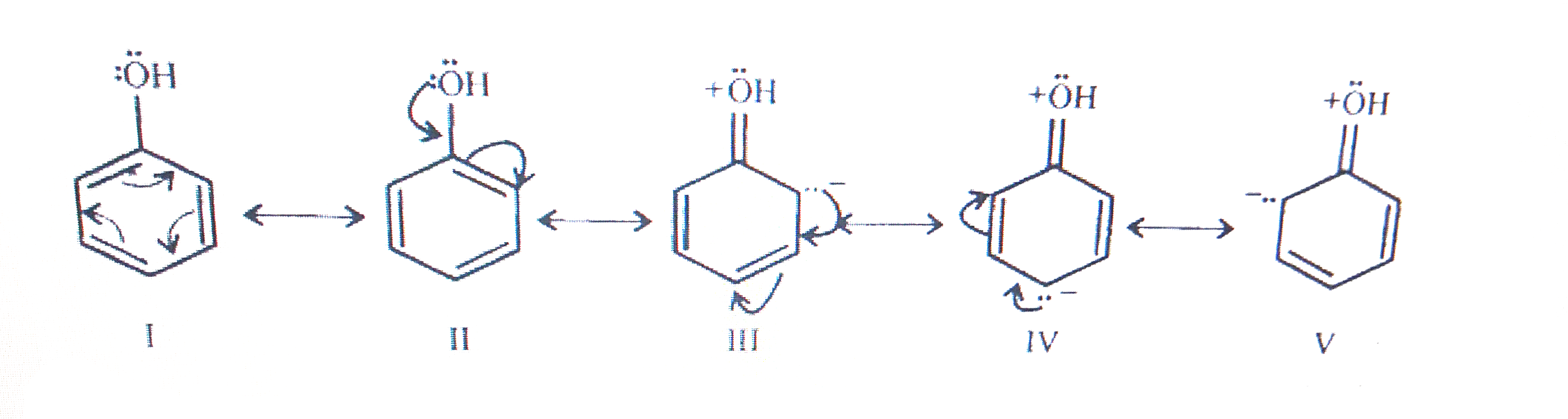
Phenol may be regarded as a hybrid of structures I-V, show below.

As a result of +R effect of the -OH group, the electron density in the benzene ring increases thereby facilitating the attack of an electrophile. In other words, presence of - OH group, activates the benzene ring towards electrophilic substitution reactions. Further, since the electron density is relatively higher at the two O-and one p- position, therefore electrophilic substitution occurs mainly at O-and p-positions.
Promotional Banner

Similar Questions

Explore conceptually related problems

How many of the following are activated towards electrophilic aromatic substitution reactions?

Account for the following: If -NO_(2) or-COOH group is attached to carbon of benzene ring, electrophilic substitution becomes difficult.

Explain the fact that in aryl ethers, (i) the alkoxy group activates the benzene ring towards electrophilic substitution and (ii) it directs the incoming substituents to ortho and para positions in benzene ring.

How many of the following compounds are more reactive than benzene towards electrophilic substitution.

How many of the following groups if substituted at o- and /or p-postions of chlorobenzene, increase its reactivity towards nucleophic substitution? -CN, -CH_3, - NH(CH_3), -COOH, -NO_(2), -OCH_(3) .

The typical reaction of benzene and other aromatic compounds are electrophilic substitution. Presence of electron donating group activates the ring towards electrophilic substitution, while presence of electron withdrawing group deactivates the ring towards electrophilic substituion but at the same time activates the ring towards nucleophilic subsituion. Some groups are predominantly meta-directing and all of these are deactivating. Except halogen, most of the o- and p- directing groups are activating groups. Which of the following compound is not formed. X represents mixture of organic compounds. The mixture does not contain

How many groups (attached with benzene ring) can show +M effect ?

The typical reaction of benzene and other aromatic compounds are electrophilic substitution. Presence of electron donating group activates the ring towards electrophilic substitution, while presence of electron withdrawing group deactivates the ring towards electrophilic substituion but at the same time activates the ring towards nucleophilic subsituion. Some groups are predominantly meta-directing and all of these are deactivating. Except halogen, most of the o- and p- directing groups are activating groups. underset(Delta)overset(C_(2)H_(5)Cl.AlCl_(3))rarr(A) major. A is trisubstituted benzene. The structure of A is :

The typical reaction of benzene and other aromatic compounds are electrophilic substitution. Presence of electron donating group activates the ring towards electrophilic substitution, while presence of electron withdrawing group deactivates the ring towards electrophilic substituion but at the same time activates the ring towards nucleophilic subsituion. Some groups are predominantly meta-directing and all of these are deactivating. Except halogen, most of the o- and p- directing groups are activating groups. underset(Delta)overset(C_(2)H_(5)Cl.AlCl_(3))rarr(A) major. A is trisubstituted benzene. The structure of A is :

