Home
Class 12
PHYSICS
A series LCR circuit connected to a vari...

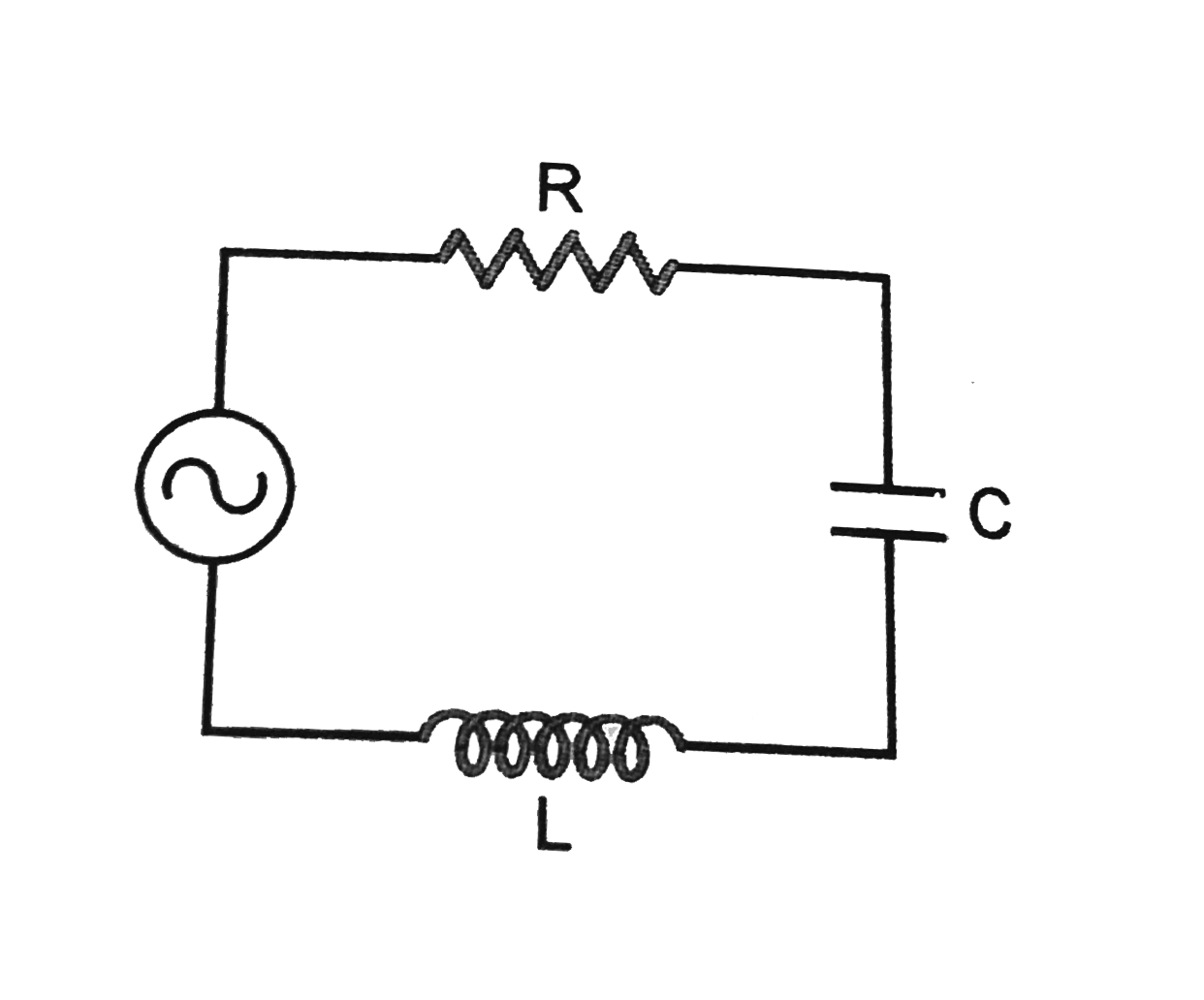
A series LCR circuit connected to a variable frequency 230 V source has L = 5.0 H, `C = 80 mu F`, `R = 40 Omega`, Fig.
(a) Determine the source frequency which drives the circuit in resonance.
(b) Obtain the impedance of the circuit and amplitude of current at at resonating frequency.
(c ) Determine the r.m.s. potential drops acorss the three elements the circuits. Show that the potential drop acorss the LC combination is zero at the resonating frequecny.

Text Solution

Verified by Experts

Inductance of the inductor,L=5.0H
Capacitance of the capacitor, C=80`muH=80xx10^(-6)F`
Resistance of the resistor, R=`40Omega`
Potential of the variable voltage source, V=230V
(a) Resonance angular frequency is given as:
`omega_(R)=(1)/sqrt(LC)`
`=(1)/sqrt(5xx80xx10^(-6))=(10^(3))/(20)=`50rad/s
Hence, the circuit will come in resonance for a source frequency of 50 rad/s.
(b) Impedanc of the circuit is given by the relation,
`Z=sqrt(R^(2)+(omegaL-(1)/(omegaC))^(2))`
At resonance,
`omegaL=(1)/(omegaC)`
`therefore Z=R40Omega`
Amplitude of the current at the resonating frequency is given as `I_(0)=(V_(0))/( Z)`
where,
`v_(0)=` Peak voltage
`=sqrt(2V)`
`therefore I_(0)=sqrt(2V)/(Z)`
`=(sqrt(2)xx230)/(40)=8.13A`
Hence, at resonance, the impedance of the circuit is 40 `Omega` and the amplitude of the current is 8.13A.
(c) RMS potential drop cross the inductor,
`(V_(L))_(rms)=Ixxomega_(R)L`
Whre,
I=rms current
`=(I_(0))/sqrt(2)=sqrt(2V)/(sqrt(2)Z)=(230)/(40)A`
`therefore (V_(L))_(rms)=(230)/(40)xx50xx5=1437.5V`
Potential drop across the capacitor,
`V_(c))_(Rms)=lxx(L)/(omega_(R)C)`
`=(230)/(40)xx(1)/(50xx80xx10^(-6))=1437.5V`
Potential drop across the resistor.
`(V_(R))_(rms)=IR`
`(230)/(40)xx40=230V`
Potential drop across the LC combination,
`V_(LC)=I(omega_(R)L-(1)/(omega_(R)C))` ltbgt At resonance, `(omega _(R)L-(1)/(omega_(R)C))`
`thereforeV_(LC)=0`
Hence, it is proved that the potential drop across the LC combination is zero zt resonating frequency.
Promotional Banner

Topper's Solved these Questions

  • ALTERNATING CURRENT

    NCERT ENGLISH|Exercise Exercise|26 Videos
  • ATOMS

    NCERT ENGLISH|Exercise Exercise|17 Videos

Similar Questions

Explore conceptually related problems

Figure here, shows a series L-C-R circuit connected to a variable frequency 230 V source. L = 5.0H, C = 80 muF and r = 40 Omega (a) Determine the source frequency which drives the circuit in resonance. (b) Obtain the impedance of the circuit and the amplitude of current at the resonating frequency. (c) Determine the rms potential drops across the three elements of the circuit. show that the potential drop across the L-C combination is zero at the resonating frequency.

The figure shows a series LCR circuit connected to a varriable of 200 V source with L=50 mH, C=80muF and R=40Omega find. (i) the source frequency which drives the circuit in resonance, (ii) the quality factor (Q) of the circuit.

For the series LCR circuit shown in the figure, what is the resonance frequency and the amplitude of the current at the resonating frequency

For the series LCR circuit shown in the figure, what is the resonance frequency and the amplitude of the current at the resonating frequency

A series L-C-R circuit is operated at resonance . Then

In an L-C-R series, AC circuit at resonance

At resonance frequency the impedance in series LCR circuit is

In the given figure , a series L-C-R circuit is connected to a variable frequency source of 230 V . The impedance and amplitude of the current at the resonating frequency will be

A series LCR circuit with L = 4.0 H, C = 100 mu F and R = 60 Omega is connected to a variable frequency 240 V source. Calculate (i) angular frequency of the source which drives the circuit in resonance, (ii) current at the resonating frequency, (iii) rms potential drop across the inductance at resonance.

Figure shows a series LCR circuit connected to a variable frequency 230 V source. The source frequency which drives the circuit the circuit in resonance is

NCERT ENGLISH-ALTERNATING CURRENT -Exercise
  1. A charged 30 mu F capacitor is connected to a 27 mH inductor. What is ...

    Text Solution

    |

  2. Suppose the initial charge on the capactor in the above question is 6 ...

    Text Solution

    |

  3. A series LCR circuit with R = 20 Omega, L = 1.5 H and C = 35 mu F is c...

    Text Solution

    |

  4. A radio can tune over the frequency range of a portion of MW broadcast...

    Text Solution

    |

  5. A series LCR circuit connected to a variable frequency 230 V source ha...

    Text Solution

    |

  6. An LC circuit contains a 20 mH inductor and a 50 mu F capacitor with a...

    Text Solution

    |

  7. A coil of inductance 0.50H and resistance 100 Omega is connected to a ...

    Text Solution

    |

  8. Obtain the answers to (a) and (b) Q.13, if the circuit is connected to...

    Text Solution

    |

  9. A 100muF capacitor in series with a 40 Omega resistor is connected to ...

    Text Solution

    |

  10. Obtain the answers to (a) and (b) in Q .15, if the circuit is connecte...

    Text Solution

    |

  11. Keeping the source of frequency equal to the resonating frequency of t...

    Text Solution

    |

  12. A circuit containing an 80mH inductor and a 60muF capacitor in series ...

    Text Solution

    |

  13. Suppose the circuit in Exercise 7.18 has a resistance of 15 Omega Obta...

    Text Solution

    |

  14. A series LCR circuit with L= 0.12H, C=480 nF, and R=23 Omega is connec...

    Text Solution

    |

  15. Obtain the resonant frequency and Q-factor of a series LCR circuit wit...

    Text Solution

    |

  16. Answer the following questions : (a) In any a.c. circuit, is the app...

    Text Solution

    |

  17. A power transmission line feeds input power at 2300 V to a step down t...

    Text Solution

    |

  18. At a hydroelectric power plant, the water pressure head is at a height...

    Text Solution

    |

  19. A small town with a demand of 800 kW of electric power at 220 V is sit...

    Text Solution

    |

  20. Do the same exercise as above with the replacement of the earlier tran...

    Text Solution

    |
