Home
Class 11
PHYSICS
A mass of 4 kg rest on a horizontal plan...

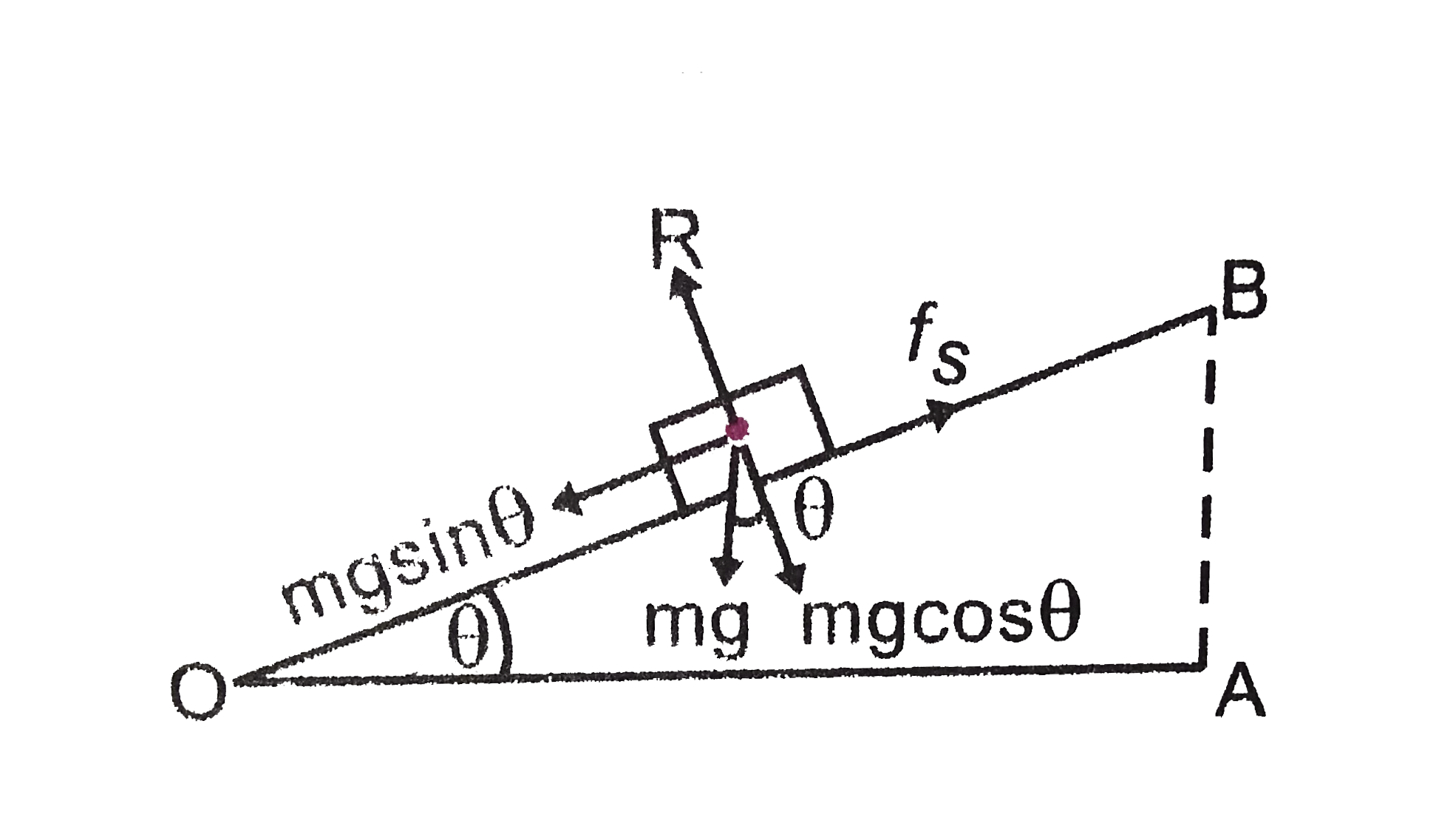
A mass of 4 kg rest on a horizontal plane . The plane is gradually inclined until an angle `0 = 15^(@)` with the horizontal and the mass just begins to slide . What is the coefficient of static friction between the block and the surface ?

Text Solution

Verified by Experts

The forces acting on a block of mass m at rest on an inclined plane are (i) the weight mg acting vertically downwards (ii) the normal force N of the plane on the block , and (iii) the static frictional force `f_s` opposing the impending motion. In equilibrium , the resulatant of these forces must be zero. Resolving the weight mg along the two directions shown, we have
m g sin `theta` = `f_s` , m g `cos theta` = N
As `theta` increases , the self-adjusting frictional force `f_s` increases until at `theta` = `theta_max`, `f_s` achieves its maximum value , (`f_s`)max = `mu_s`N.
Therefore , `tan lttheta_max= mu_s` or `theta_max` = `tan^(-1) mu_s`
When `theta` becomes just a little more than `theta_max` , there is a small net force on the block and it begins to slide. Note that `theta_max` depends only on `mu_s` and is independent of the mass of the block.
For `theta _max` = `15^(@)`
`mu_s` = tan `15^(@)`
= 0.27
Promotional Banner

Topper's Solved these Questions

  • LAWS OF MOTION

    NCERT ENGLISH|Exercise EXERCISE|40 Videos
  • KINETIC THEORY

    NCERT ENGLISH|Exercise EXERCISE|14 Videos
  • MECHANICAL PROPERTIES OF FLUIDS

    NCERT ENGLISH|Exercise EXERCISE|31 Videos

Similar Questions

Explore conceptually related problems

A mass of 2kg rests on a horizontal plane. The plane is gradually inclined until at an angle theta=20^(@) with the horizontal, the mass just begins to slides. What is the coefficient of static friction between the block and the surface ?

A block of mass 4kg rests on a rough horizontal plane. The plane is gradually inclined until at an angle theta=60^(@) , with the vertical, the mass just begins to side. What is the coefficient of static friction between the block and the plane?

A block of mass 5 kg rests on a inclined plane at an angle of 30^(@) with the horizontal. If the block just begins to slide, then what is the coefficient of static friction between the block and the surface?

A block of mass 5 kg rests on a inclined plane at an angle of 30^(@) with the horizontal. If the block just begins to slide, then what is the coefficient of static friction between the block and the surface?

A block of mass 5 kg rests on a inclined plane at an angle of 30^(@) with the horizontal. If the block just begins to slide, then what is the coefficient of static friction between the block and the surface?

A block of mass 8 kg is sliding on a surface inclined at an angle of 45^(@) with the horizontal. Calculate the acceleration of the block. The coefficient of friction between the block and surface is 0.6. (Take g=10m//s^(2) )

A partical of mass 1kg rests on rought contact with a plane inclined at 30^(@) to the horizontal and is just about to slip, Find the coefficient of friction between the plane and the particle.

A block of mass 5 kg is placed on a rough inclined plane. The inclination of the plane is gradually increased till the block just begins to slide down. The inclination of the plane is than 3 in 5. The coefficient of friction between the block and the plane is (Take, g = 10m//s^(2) )

A block of mass 8 kg is sliding on a surface inclined at an angle of 45^(@) with the horizontal . Calculate the acceleration of the block . The coefficient of friction between the block and surface is 0*6 ( Take g = 10 m//s^(2) )

A horizontal force of 20 N is applied to a block of mass 4 kg resting on a rough horizontal table. If the block does not move on the table, how much frictional force the table is applying on the block. What can be said about the coefficient of static friction between the block and the table? Take g=10m/s^2 .

NCERT ENGLISH-LAWS OF MOTION -EXERCISE
  1. A mass of 4 kg rest on a horizontal plane . The plane is gradually inc...

    Text Solution

    |

  2. Give the magnitude and direction of the net force acting on (a) a dr...

    Text Solution

    |

  3. A pebble of mass 0.05 kg is thrown vertically upwards Give the magnitu...

    Text Solution

    |

  4. Give the magnitude and direction of the force acting on a stone of mas...

    Text Solution

    |

  5. One end of string of length l is connected to a particle on mass m and...

    Text Solution

    |

  6. A constant retarding force of 50 N is applied to a body of mass 20 kg ...

    Text Solution

    |

  7. A constant force acting on a body of mass 3 kg changes its speed from ...

    Text Solution

    |

  8. A body of mass 5 kg is acted upon by two perpendicular forces 8 N and ...

    Text Solution

    |

  9. The driver of a three wheeler moving with a speed of 36 km//h sees a c...

    Text Solution

    |

  10. A rocket with a lift off mass 20000 kg is blasted upwards with a net i...

    Text Solution

    |

  11. A body of mass 0.40 kg moving initially with a constant speed of 10 m...

    Text Solution

    |

  12. A truck starts from rest and accelerate uniformly with 2 ms^(-2). At t...

    Text Solution

    |

  13. A bob of mass 0.1 kg hung from the ceiling of a room by a string 2 m l...

    Text Solution

    |

  14. A man of mass 70 kg stands on a weighing machine in a lift, which is m...

    Text Solution

    |

  15. Fig. shows the position-time graph of a particle of mass 4 kg. What is...

    Text Solution

    |

  16. Two bodies of masses 10 kg and 20 kg respectively kept on a smooth hor...

    Text Solution

    |

  17. Two masses 8 kg and 12 kg are connected at the two ends of a light in ...

    Text Solution

    |

  18. A nucleus is at rest in the laboratory frame of reference. Show that i...

    Text Solution

    |

  19. Two billiard balls each of mass 0.05 kg moving in opposite directions ...

    Text Solution

    |

  20. A shell of mass 200g is fired by a gun of mass 100kg. If the muzzle sp...

    Text Solution

    |

  21. A batsman deflects a ball by an angle of 45^(@) without changing its i...

    Text Solution

    |
