Home
Class 12
CHEMISTRY
WERNER’S THEORY OF COORDINATION COMPOUND...

WERNER’S THEORY OF COORDINATION COMPOUNDS

Text Solution

Verified by Experts
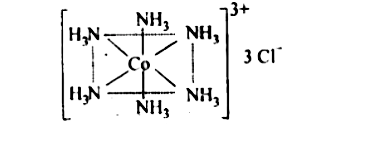
The main postulates of Werner's theory of coordination compounds are as follows
(a) Metals possess two type of valencies called
(i) primary valency which are ionisable (ii) secondary valency which are non ionisable
(b) Primary valency is satisfied by the negative ions and it that which a metal exhibits in the formatio of its simple salts
(c) Secondary valence are satisfied by neutral ligand or negative ligand and are those which metal exerciese in the formation of its complex ions. Every cation has a fixed number of secondary valencies which are directed in space about central metal ion in certain fixed directions e.g., in `CoCl_(3)-6NH_(3)` valencies between Co and Cl are primary valencies and valencies between Co and `NH_(3)` are secondary in `COCl_(3)-6NH_(3)` six ammonia molecules linked and thus account for structure of `COCl_(3)-6NH_(3)` as follows in modern theory it is now referred as coordination number of central metal atom or ion.
Promotional Banner

Topper's Solved these Questions

  • COORDINATION COMPOUNDS

    NCERT ENGLISH|Exercise Exercise|41 Videos
  • CHEMISTRY IN EVERYDAY LIFE

    NCERT ENGLISH|Exercise Exercise|32 Videos
  • ELECTROCHEMISTRY

    NCERT ENGLISH|Exercise Exercise|33 Videos

Similar Questions

Explore conceptually related problems

STABILITY OF COORDINATION COMPOUND is of _____ type

Addition of AgNO_(3) solution to aqueous solution of each of the Pt(IV) amines viz (i) PtCI_(4).6NH_(3) (ii) PtCI_(4).5NH_(3) (iii) PtCI_(4) (iv) PtCI_(4).3NH_(3) and (v) PtCI_(4).2NH_(3) was found by Werner to give 4,3,2,1 and zero moles of AgCI per mole of the amines repectively How did Werner explain these observations? .

Fill in the blanks by choosing the appropriate word/words from those given in the brackets: (double salts, complex compounds, uni, bi, six, four, three, coordination, linkage, imperfect, perfect, normal, penetrating, central ion, chelating, Werner, Pauling) In the complex ion, [Fe("edta")]^(-) , the C.N. and the O.N. of the central metal ion Fe are .......... and ......... respectively.

When a coordination compound CrCl_3 . 6H_2O is mixed with AgNO_3 two moles of AgCl are precipitated per mole of the compound .What is the structural formula of the coordination compound ?

The IUPAC name of the coordination compound [NICl(NO_2)(PPh_3)_2] is :

According to Werner's theory, the primary valency and secondary valency in complex [Co(NH_3 )_4Cl_2]CI is respectively

Fill in the blanks by choosing the appropriate word/words from those given in the brackets: (double salts, complex compounds, uni, bi, six, four, three, coordination, linkage, imperfect, perfect, normal, penetrating, central ion, chelating, Werner, Pauling) [Cr(NH_3)_6][Co(CN)_6] exhibits ..............isomerism.

Complex compounds are molecular compounds which retain their identities even when dissolved in water. They do not give all the simple ions in solution but instead furnish complex ions. The complex compounds are often called coordination compounds because certain groups called ligands are attached to the central metal ion by coordinate or dative bonds. coordination compounds exhibit isomerism, both structural and stereoisomerism. the structure, magnetic property, colour and electrical properties of complexes are explained by various theories: Q. The oxidation number, coordination number and magnetic moment in the following complex is: [Cr(C_(2)O_(4))_(2)(NH_(3))_(2)^(-)]

Complex compounds are molecular compounds which retain their identities even when dissolved in water. They do not give all the simple ions in solution but instead furnish complex ions. The complex compounds are often called coordination compounds because certain groups called ligands are attached to the central metal ion by coordinate or dative bonds. coordination compounds exhibit isomerism, both structural and stereoisomerism. the structure, magnetic property, colour and electrical properties of complexes are explained by various theories: Q. The oxidation number, coordination number and magnetic moment in the following complex is: [Cr(C_(2)O_(4))_(2)(NH_(3))_(2)^(-)]

The correct IUPAC name of the coordination compound K_(3) [Fe(CN)_(5) NO] is

NCERT ENGLISH-COORDINATION COMPOUNDS-Exercise
  1. Predict the number of unpaired electrons in the square planar [Pt(CN)4...

    Text Solution

    |

  2. The hexaquo manganese(II) ion contains five unpaired electrons, while ...

    Text Solution

    |

  3. WERNER’S THEORY OF COORDINATION COMPOUNDS

    Text Solution

    |

  4. FeSO4 solution mixed with (NH4)2SO4 solution is 1:1 molar ratio gives ...

    Text Solution

    |

  5. Explain with two examples each of the following: coordination entity, ...

    Text Solution

    |

  6. What is meant by unidentate and ambidentate ligands? Give two examples...

    Text Solution

    |

  7. Specify the oxidation numbers of the metals in the following coordinat...

    Text Solution

    |

  8. Using IUPAC norms write the fomulas for the following (i). Tetrahydr...

    Text Solution

    |

  9. Using IUPAC norms write the systematic names of the following: (i). ...

    Text Solution

    |

  10. List various types of isomerism possible for coordination compounds, g...

    Text Solution

    |

  11. How many geometrical isomers are possible in the following corrdinatio...

    Text Solution

    |

  12. Draw the structures of optical isomers of: (i). [Cr(C2O4)3]^(3-) (...

    Text Solution

    |

  13. Draw all the isomers (geometrical and optical) of: (i) [CoCl(2)(en)(...

    Text Solution

    |

  14. Write all the geometrical isomers of [Pt(NH3)(Br)(Cl)(py)] and how man...

    Text Solution

    |

  15. Aqueous copper sulphate solution (blue in colour) gives: (i). A gree...

    Text Solution

    |

  16. What is the coordination entity formed when excess of aqueous KCN is a...

    Text Solution

    |

  17. Discuss the nature of bonding in the following coordination entities o...

    Text Solution

    |

  18. Draw figure to show the splitting of d orbitals in an octahedral cryst...

    Text Solution

    |

  19. What is spectrochemical series? Explain the difference between a weak ...

    Text Solution

    |

  20. The magnitude of CFSE (Crystal Field Splitting Energy , Delta(0)) can ...

    Text Solution

    |

