

Home
Class 11
PHYSICS
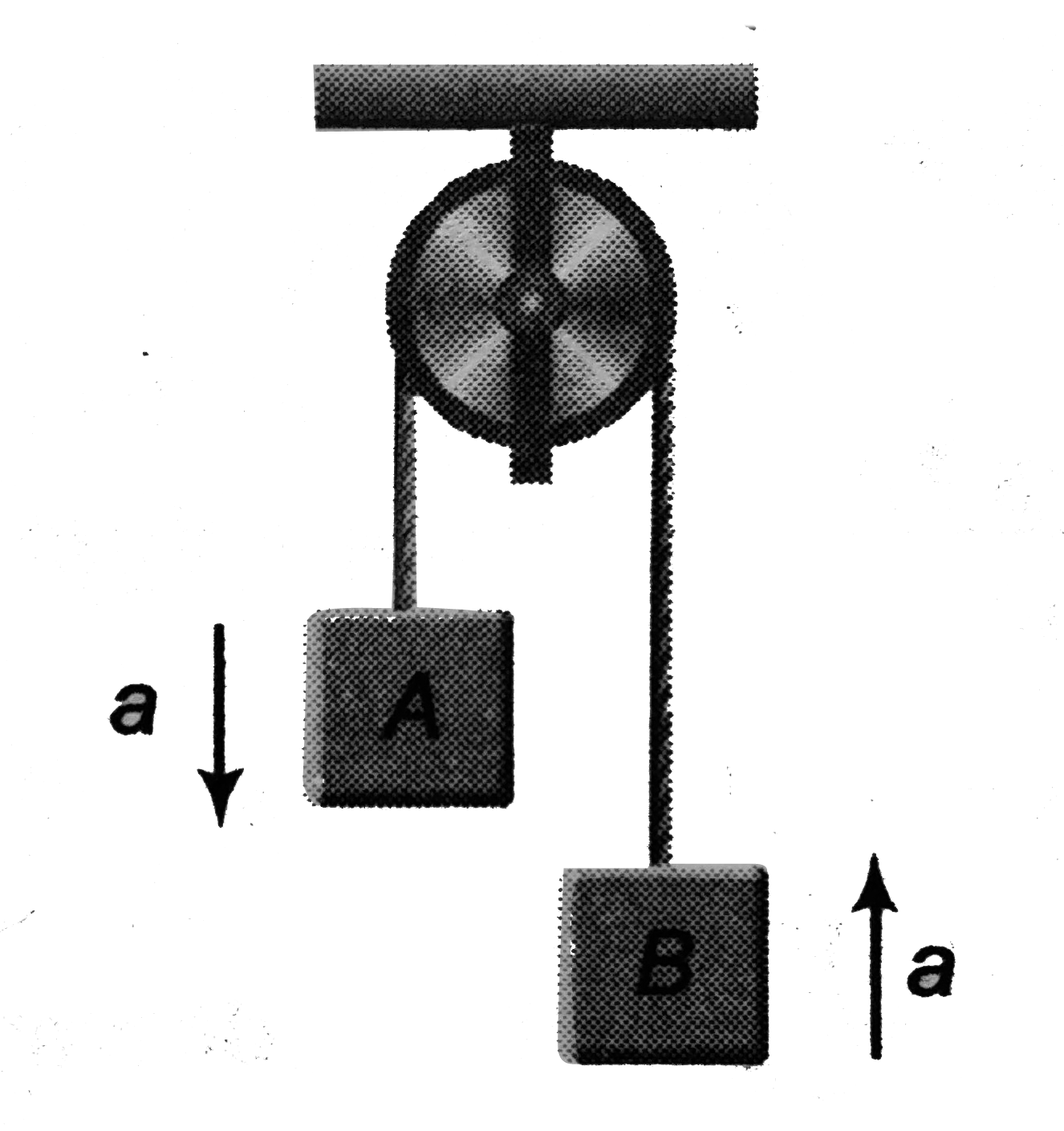
In the arrangement shown in Figure, mA=2...

In the arrangement shown in Figure, `m_A=2kg` and `m_B=1kg`. String is light and inextensible. Find the acceleration of centre of mass of both the blocks. Neglect friction everywhere.

Promotional Banner

Similar Questions

Explore conceptually related problems

In the arrangment shown in figure, m_(A) =1 kg, m_(B) =4 kg. String is light and inextensible while pulley is smooth. Coefficient of friction between block A and the table is mu =0.2. Find the speed of both the blocks when block B has descended a height h=1 m. (Take ,g=10 ms^(-2) )

In the arrangement shown in figure, string is light and inextensible and friction is absent every where. The speed of both blocks after the block 'A' has ascend a height of 1m will be (g=10 m//s^(2))

Two blocks of equal mass are tied with a light string, which passes over a massless pulley as shown in figure. The magnitude of acceleration of centre of mass of both the blocks is : (neglect friction everywhere)

Two blocks A and B are arranged as shown in figure.The pulleys are light and frictionless.The strings are light and inextensible.If the acceleration of the block B is 3m/s^(2) ,then the acceleration of the block A is __________ m/s^(2)

In the arrangement shown in figure m_(1)=1kg, m_(2)=2kg , pullyes are massless and strings are light. For what value of M the mass m_(1) moves with constant velocity? (Neglect friction)

In the arrangement shown in figure. The strings are light and inextensible. The surface over which block are placed is smooth.Find (a) the acceleration of each block, (b) the tension in each string.

In the arrangement shown in figure. The strings are light and inextensible. The surface over which block are placed is smooth.Find (a) the acceleration of each block, (b) the tension in each string.

In the arrangement shown in fig m_(1)=1kg, m_(2)=2 kg Pulleys are massless and string are light. For what value of M the mass m_(1) moves with constant velocity (neglect friction):

In the arrangement shown in figure pulley P can move whereas other two pulleys are fixed. All of them are light. String is light and inextensible. The coefficient of friction between 2 kg and 3 kg block is mu = 0.75 and that between 3 kg block and the table is mu = 0.5 . The system is released from rest (i) Find maximum value of mass M, so that the system does not move. Find friction force between 2 kg and 3 kg blocks in this case. (ii) If M = 4 kg, find the tension in the string attached to 2 kg block. (iii) If M = 4 kg and mu_(1) = 0.9 , find friction force between the two blocks, and acceleration of M. (iv) Find acceleration of M if m_(1) = 0.75, m_(2) = -0.9 and M = 4 kg.