

Home
Class 11
PHYSICS
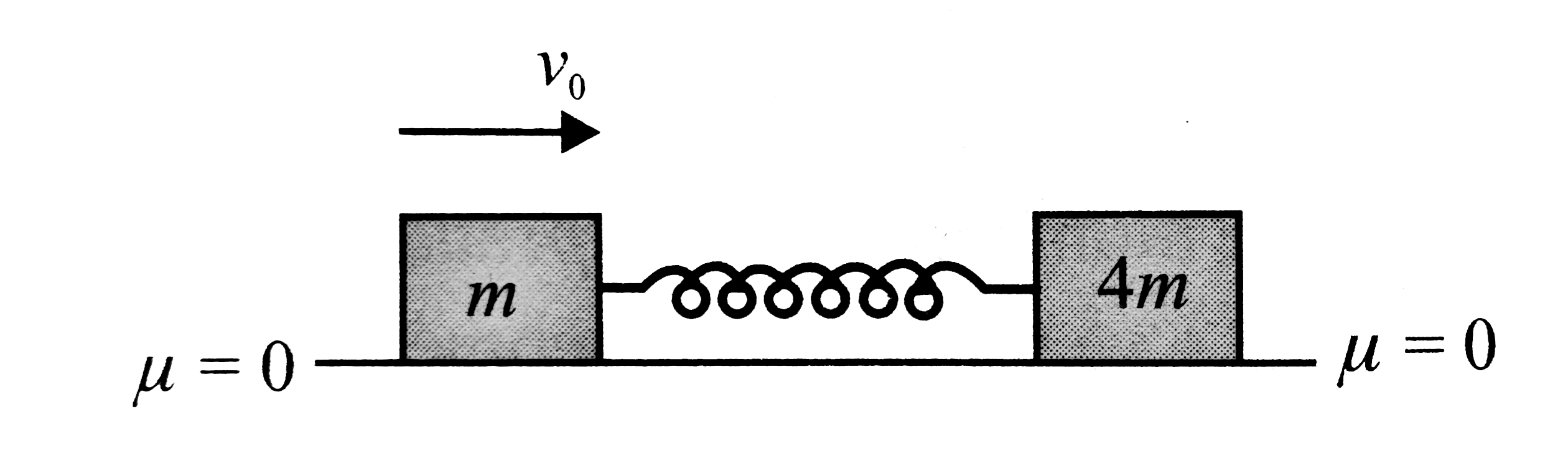
Two blocks of masses in and 4m lie on a ...

Two blocks of masses in and `4m` lie on a smooth horizontal surface connected with a spring in its natural length. Mass `m` is given velocity `v_(0)` through an impulse as shown in Fig. Which of the following is not true about subsequent motion?

Promotional Banner

Similar Questions

Explore conceptually related problems

A block of mass m lie on a horizontal smooth surface and connected with the springs at their natural length as shown in figure. When block slightly displaced then find the time period of oscillation.

Two blocks A and B of masses m & 2m placed on smooth horizontal surface are connected with a light spring. The two blocks are given velocities as shown when spring is at natural length. (i) Find velocity of centre of mass (b) maximum extension in the spring

Two blocks A and B of the same mass are connected to a light spring and placed on a smooth horizontal surface B is given velocity v_(0) (as shown in the figure) when the spring is in natural length. In the subsequent motion.

Mass m is connected with an ideal spring of natural length l whose other end is fixed on a smooth horizontal table. Initially spring is in its natural length l . Mass m is given a velocity 'v' perpendicular to the spring and released . The velocity perpendicular to the spring when its length l+x , will be

Mass m is connected with an ideal spring of natural length l whose other end is fixed on a smooth horizontal table. Initially spring is in its natural length l . Mass m is given a velocity 'v' perpendicular to the spring and released . The velocity perpendicular to the spring when its length l+x , will be

Two blocks A and B of masses m and 2m respectively, attached at opposite ends of a spring of constant K, placed on a smooth horizontal surface. Spring is initially at its natural length l. A is given a velocity 2V_(0) and B given velocity V_(0) as shown. Maximum separation between m and centre of mass of the system will be :

A dumbbell consists of two balls A and B of mass m=1 kg and connected by a spring. The whole system is placed on a smooth horizontal surface as shown in the figure. Initially the spring is at its natural length, the ball B is imparted a velocity v_(0)=8/(sqrt(7))m//s in the direction shown. The spring constant of the spring is adjusted so that the length of the spring at maximum elongation is twice that of the natural, length of the spring. Find the maximum potential energy stored (in Joule) in the spring during the motion.

A dumbbell consists of two balls A and B of mass m=1 kg and connected by a spring. The whole system is placed on a smooth horizontal surface as shown in the figure. Initially the spring is at its natural length, the ball B is imparted a velocity v_(0)=8/(sqrt(7))m//s in the direction shown. The spring constant of the spring is adjusted so that the length of the spring at maximum elongation is twice that of the natural, length of the spring. Find the maximum potential energy stored (in Joule) in the spring during the motion.

A block of mass m moving with velocity v_(0) on a smooth horizontal surface hits the spring of constant k as shown. Two maximum compression in spring is