

Home
Class 11
PHYSICS
One end of a light string of length L is...

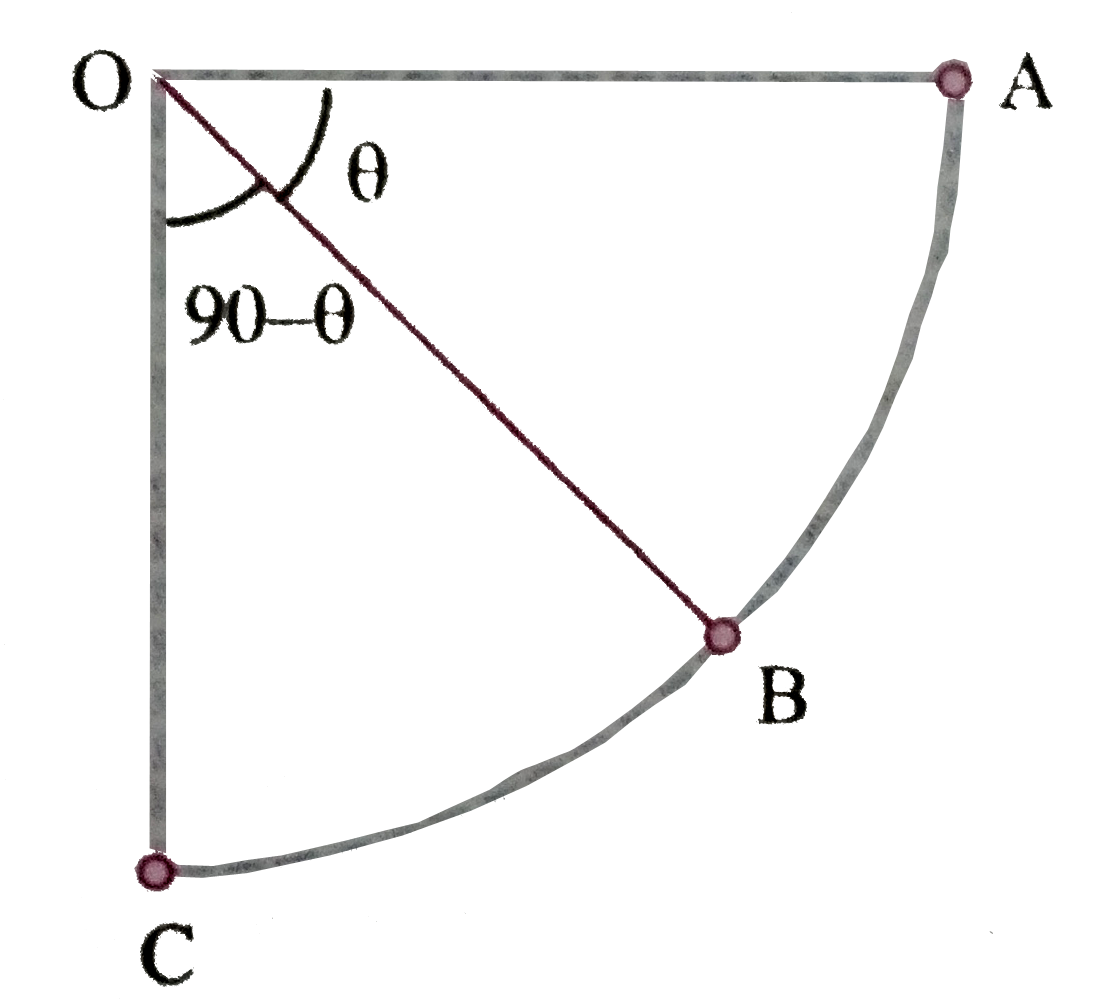
One end of a light string of length `L` is connected to a ball and the other end is connected to a fixed point `O`. The ball is released from rest at `t = 0` with string horizontal and just taut. The ball then moves in vertical circular path as shown. The time taken by ball to go from position `A` to `B` is `t_(1)` and from `B` to lowest position `C` is `t_(2)`. Let the velocity of ball at `B` is `vec v_(B)` and at `C` is `vec v_(C)` respectively.

If `|vec v_(C)=2|vecv_(B)|` then the value of `theta` as shown is

Promotional Banner

Similar Questions

Explore conceptually related problems

One end of a light string of length L is connected to a ball and the other end is connected to a fixed point O . The ball is released from a rest at t=0 with string horizontal and just taut. The ball then moves invertical circular path as shown. The time taken by ball to go from position A to B is t_(1) and from B to lowest position B to lowest position C is t_(2) . Let the velocity of ball at B is vec(v)_(B) and C is vec(v)_(C) respectively. If |vec(v)_(C)|=|vec(v)_(B)| then the value of theta as shown is

One end of a light of length L is connected to a ball and other end is connected to a fixed point O . The ball is released from rest at t=0 with string horizontal and just taut. The ball then moves it vertival circular pathh as shown. The time taken by ball to go from position A to B is t_(1) and from B to lowest position C is t_(2) . Let the velocity of ball at B is vecv_(B) and at C is vecv_(C) respectively. if |vecv_(c)|=2|vecv_(B)| then the value of theta shown is

One end of a light of length L is connected to a ball and other end is connected to a fixed point O . The ball is released from rest at t=0 with string horizontal and just taut. The ball then moves it vertival circular pathh as shown. The time taken by ball to go from position A to B is t_(1) and from B to lowest position C is t_(2) . Let the velocity of ball at B is vecv_(B) and at C is vecv_(C) respectively. If |vecv_(c)|=2|vecv_(B)| then

One end of a light string of length L is connected to a ball and the other end is connected to a fixed point O . The ball is released from a rest at t=0 with string horizontal and just taut. The ball then moves invertical circular path as shown. The time taken by ball to go from position A to B is t_(1) and from B to lowest position B to lowest position C is t_(2) . Let the velocity of ball at B is vec(v)_(B) and C is vec(v)_(C) respectively. If |vec(v)_(C)-vec(v)_(B)|=|vec(v)_(B)| , then the value of theta as shown is :

One end of a light string of length L is connected to a ball and the other end is connected to a fixed point O . The ball is released from a rest at t=0 with string horizontal and just taut. The ball then moves invertical circular path as shown. The time taken by ball to go from position A to B is t_(1) and from B to lowest position B to lowest position C is t_(2) . Let the velocity of ball at B is vec(v)_(B) and C is vec(v)_(C) respectively. If |vec(v)_(C)|=|vec(v)_(B)| then :

A ball of mass 1.00 kg is attached to a loose string fixed to a ceiling. The ball is released from rest and falls 2.00 m, where the string suddenly stops it. Find the impulse on it from the string.

A ball of mass 1 kg is attached to an inextensible string. The ball is released from the position shown in figure. Find the impulse imparted by the string to the ball immediately after the string becomes taut.