

Home
Class 12
PHYSICS
Charges -q and +q located at A and B, re...

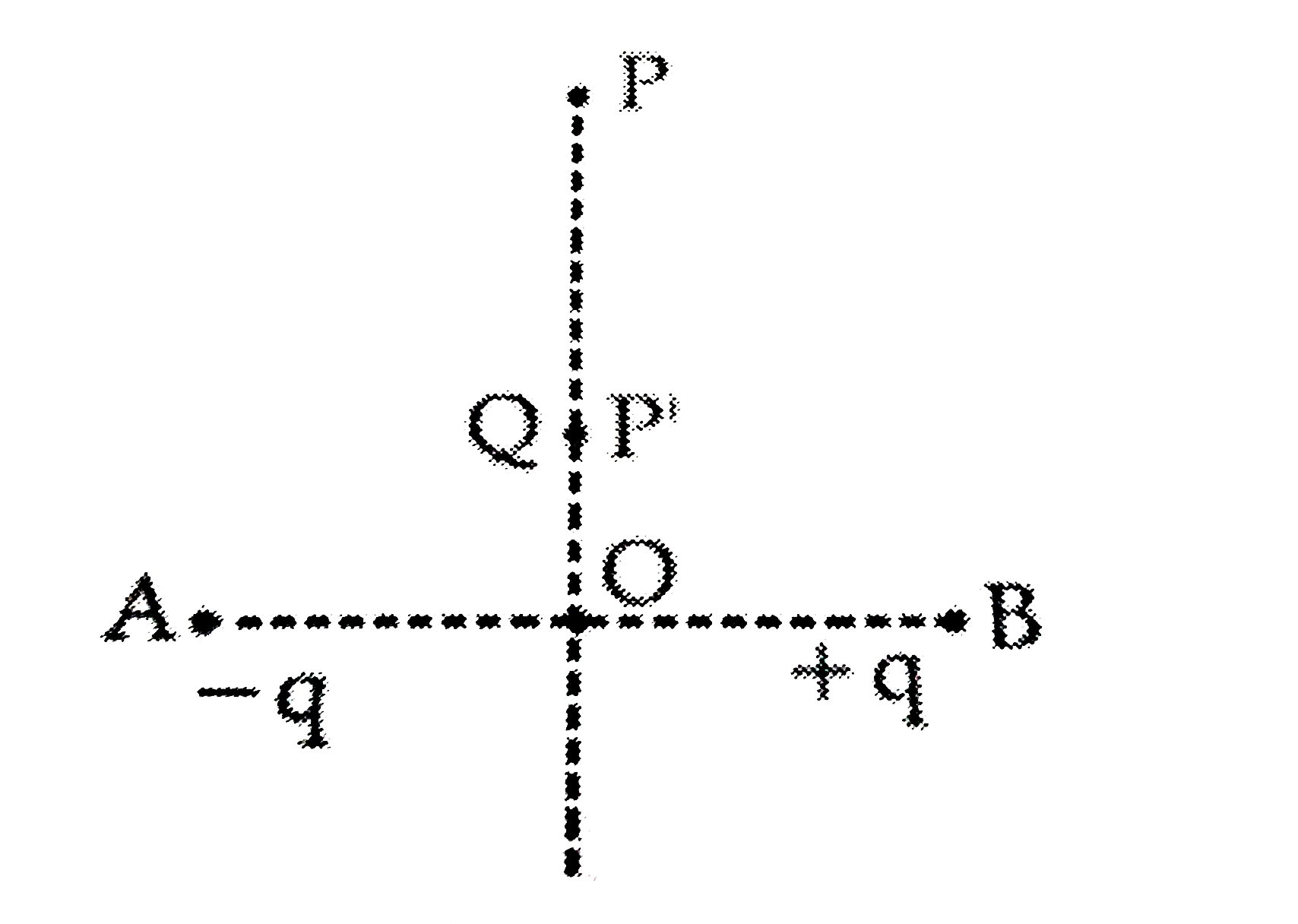
Charges `-q and +q` located at A and B, respectively, constitute an electric dipole. Distance AB = 2a, O is the mid point of the dipole and OP is perpendicular to AB. A charge Q is placed at P where OP = y and `y gt gt 2a`. The charge Q experiences an electrostatic force F. If Q is now moved along the equatorial line to P' such that `OP' = ((y)/(3))`, the force on Q will be close to `((y)/(3) gt gt 2a)`

Promotional Banner

Similar Questions

Explore conceptually related problems

Charge +q and -q are placed at points A and B respectively which are distance 2 L apart . C is the mid point of A and B . The work done in moving a charge +Q along the semicircle CRD as shown in the figure below is

Two point charges +q and -q are placed at points A and B respectively separated by a samll distance. The electric field intensity at the midpoint O of AB :

A charge +q is placed at the origin of X-Y axes as shown in the figure. The work done in taking a charge Q from A to B along the straight line AB is

If P is any point on the plane lx+my+nz=p and Q is a point on the line OP such that OP.OQ=p^(2), then find the locus of the point Q.

A charge Q is kept at the centre of a conducting sphere of inner radius R_(1) and outer radius R_(2) . A point charge q is kept at a distance r(gt R_(2)) from the centre. If q experiences an electrostatic force 10 N then assuming that no other charges are present, electrostatic force experienced by Q will be :

A charge Q is kept at the centre of a conducting sphere of inner radius R_(1) and outer radius R_(2) . A point charge q is kept at a distance r(gt R_(2)) from the centre. If q experiences an electrostatic force 10 N then assuming that no other charges are present, electrostatic force experienced by Q will be :

If P be any point on the plane ln+my+nz=P and Q be a point on the line OP such that (OP)(OQ)=P^(2). The locus of point Q is

What is the work done in moving a test charge q through a distance of 1 cm along the equatorial axis of an electric dipole ?

What is the work done in moving a test charge q through a distance of 1 cm along the equatorial axis of an electric dipole ?