

Home
Class 12
PHYSICS
When a high frequency electromagnetic ra...


When a high frequency electromagnetic radiation is incident on a metallic surface, electrons are emitted from the surface. Energy of emitted photoelectrons depends only on the frequency of incident electromagnetic radiation and the number of emitted electrons depends only on the intensity of incident light.
Einstein's protoelectron equation `[K_(max)=hv-phi]` correctly ecplains the PE, where `upsilon=` frequency of incident light and `phi=` work function.
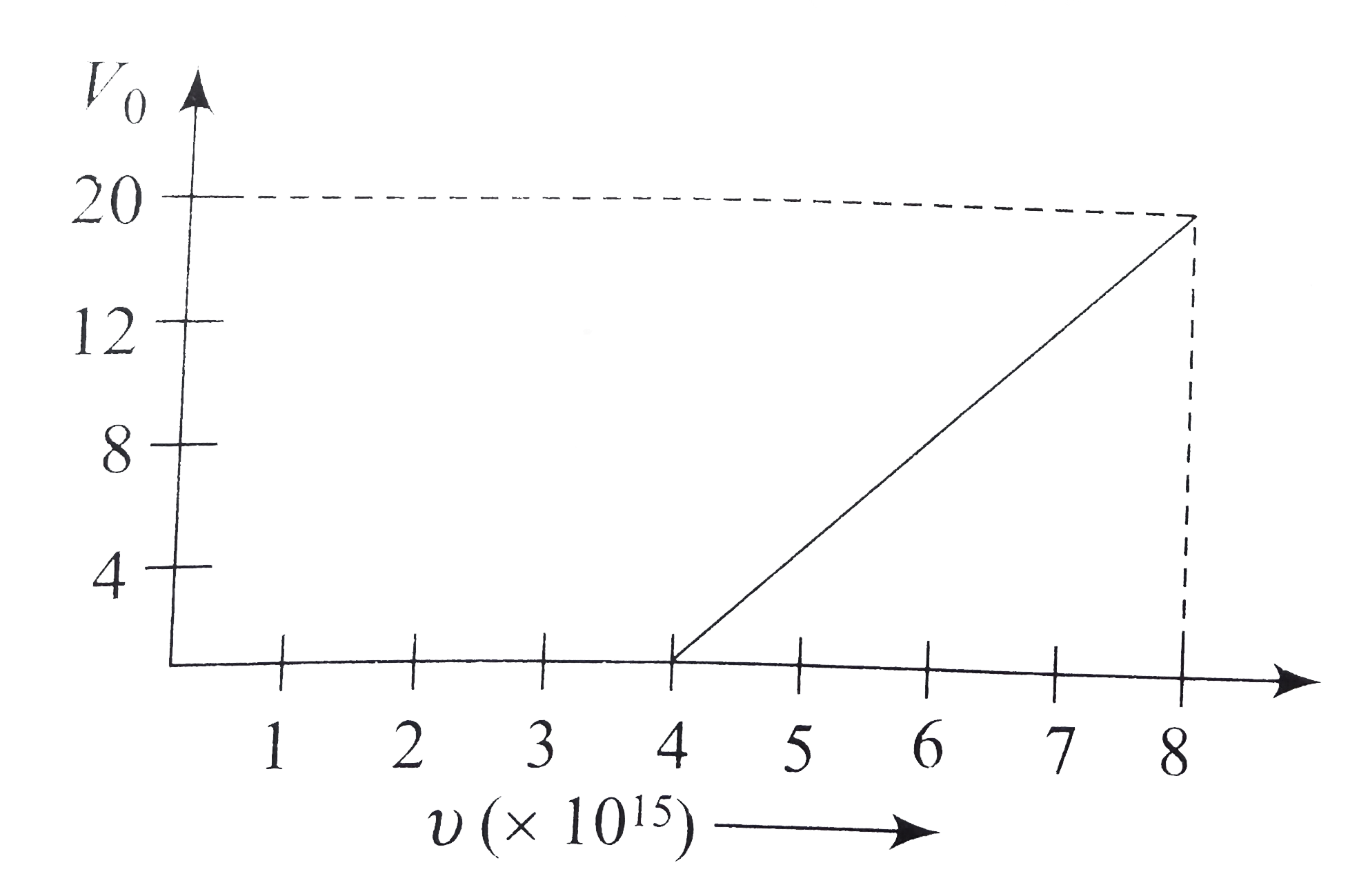
Q. For photoelectric effect in a metal, the graph of the stopping potential `V_0` (in volt) versus frequency `upsilon` (in hertz) of the incident radiation is shown in Fig. The work function of the metal (in eV) is.

Promotional Banner

Similar Questions

Explore conceptually related problems

When a high frequency electromagnetic radiation is incident on a metallic surface, electrons are emitted from the surface. Energy of emitted photoelectrons depends only on the frequency of incident electromagnetic radiation and the number of emitted electrons depends only on the intensity of incident light. Einstein's protoelectron equation [K_(max)=hv-phi} correctly ecplains the PE, where upsilon= frequency of incident light and phi= work function. Q. Light of wavlength 3300 is incident on two metals A and B, whose work function are 4 eV and 2 eV, respectively. Then

When a high frequency electromagnetic radiation is incident on a metallic surface, electrons are emitted from the surface. Energy of emitted photoelectrons depends only on the frequency of incident electromagnetic radiation and the number of emitted electrons depends only on the intensity of incident light. Einstein's protoelectron equation [K_(max)=hv-phi} correctly ecplains the PE, where upsilon= frequency of incident light and phi= work function. Q. The slope of the graph shown if Fig. [here h is the Planck's constant and e is the charge of an electron] is

When a high frequency electromagnetic radiation is incident on a metallic surface, electrons are emitted from the surface. Energy of emitted photoelectrons depends only on the frequency of incident electromagnetic radiation and the number of emitted electrons depends only on the intensity of incident light. Einstein's protoelectron equation [K_(max)=hv-phi} correctly explains the PE, where upsilon= frequency of incident light and phi= work function. Q. The slope of the graph between stopping potential and frequency is [here h is the Planck's constant and e is the charge of an electron] is

When light is incident on a surface, photoelectrons are emitted. For photoelectrons,

When light is incident on a surface, photoelectrons are emitted. For photoelectrons,

Does work function depend on the frequency of incident radiation?