

Home
Class 12
PHYSICS
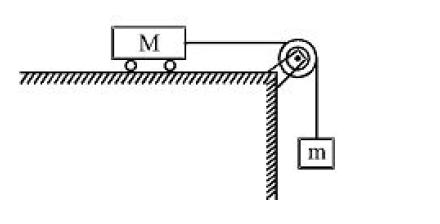
A trolley of mass M is attached to a blo...

A trolley of mass M is attached to a block of mass m by a string passing over a frictionless pulley as shown in the figure. If the coefficient of friction between the horizontal surface and wheels of trolley is `mu`, then acceleration of the block m and that of trolley M on releasing the system is :-

Promotional Banner

Similar Questions

Explore conceptually related problems

A trolley of mass 20 kg is attached to a block of mass 4kg by massless string passing over a frictionless pulley as shown in the figure. If the coefficient of kinetic friction between trolley and the surface is 0.02, then the accderal ion of the trolley and block system is ("Take" g=10ms^(-2))

A trolley of mass 20 kg is attached to a block of mass 4kg by massless string passing over a frictionless pulley as shown in the figure. If the coefficient of kinetic friction between trolley and the surface is 0.02, then the accderal ion of the trolley and block system is ("Take" g=10ms^(-2))

Three masses m, 2m and 3m are attached with light string passing over a fixed frictionless pulley as shown in the figure. The tension in the string between 2m and 3m is (g is acceleration due to gravity)

A force F accelerates a block of mass m on horizontal surface. The coefficient of friction between the contact surface is . The acceleration of m will be -

Two blocks of masses M_(1)=4 kg and M_(2)=6kg are connected by a string of negligible mass passing over a frictionless pulley as shown in the figure below. The coefficient of friction between the block M_(1) and the horizontal surface is 0.4. when the system is released, the masses M_(1) and M_(2) start accelrating. What additional mass m should be placed over M_(1) so that the masses (M_(1)+m) slide with a uniform speed?

Two blocks of masses M_(1)=4 kg and M_(2)=6kg are connected by a string of negligible mass passing over a frictionless pulley as shown in the figure below. The coefficient of friction between the block M_(1) and the horizontal surface is 0.4. when the system is released, the masses M_(1) and M_(2) start accelrating. What additional mass m should be placed over M_(1) so that the masses (M_(1)+m) slide with a uniform speed?

Mass moves on a slope making an angle 9 with the horizontal and is attached to mass m_(2) by a string passing over a frictionless pulley . The coefficient of friction between nq and the sloping surface is mu . Which of the following statements are true ?