

Home
Class 12
PHYSICS
A uniform,horizontal beam of light is in...

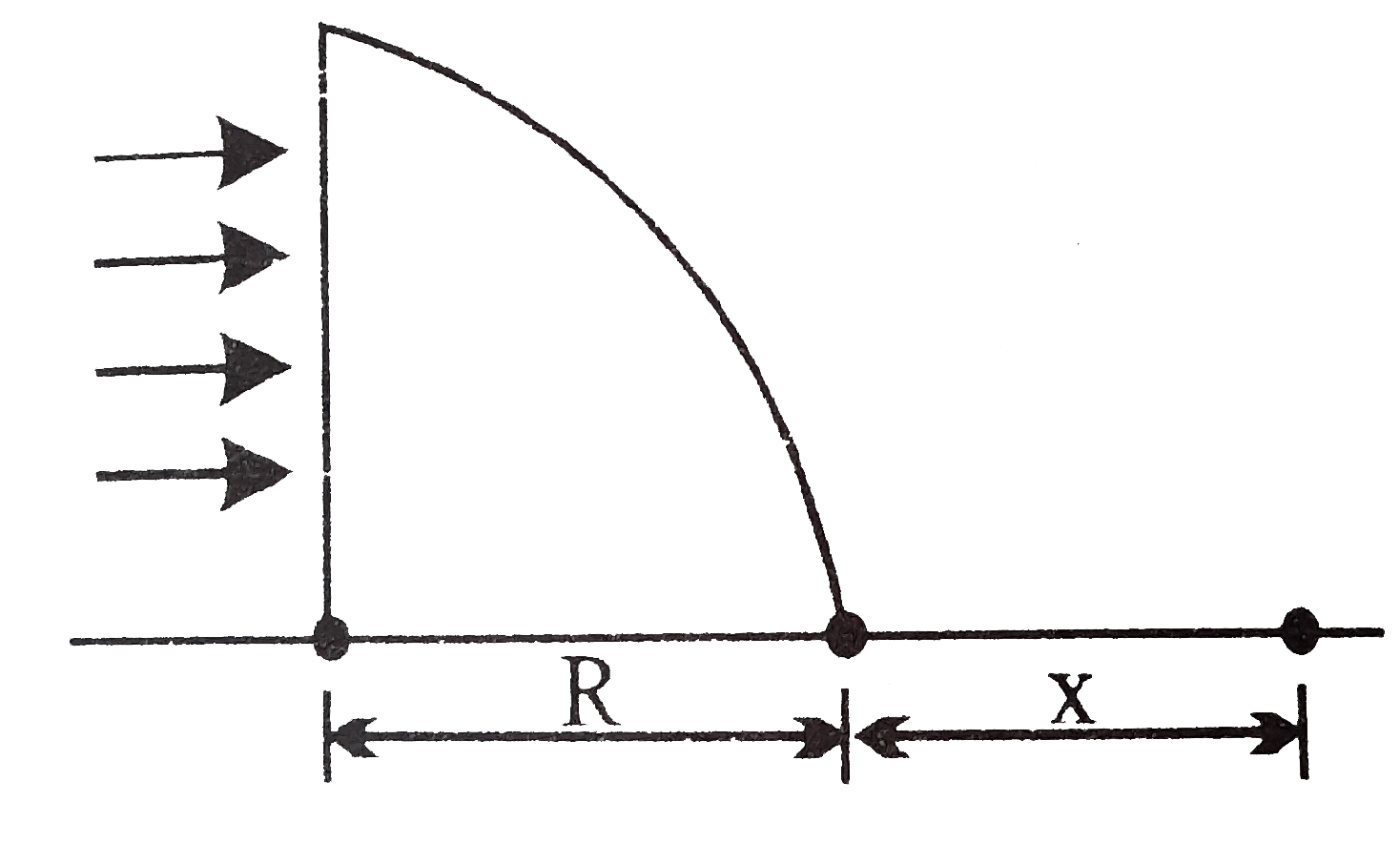
A uniform,horizontal beam of light is incident upon a quarter cylinder of radius`R=5`cm and has a refractive index `2//sqrt(3)`.A patch on the table for a distance `'x'`from the cylinder is unilluminated ,find the value of `'x'`?

Promotional Banner

Similar Questions

Explore conceptually related problems

A uniform, horizontal parallel beam of light is incident upon a prism as shown. The prism is in the shape of a quarter cylinder, of radius 5cm, and has refractive index 5/3. The width of the regionat which the incident rays after normal incidence on plane surface and subsequent refraction at curved surface intersect on x axis is (Neglect the ray which travels along x-axis)

A parallel beam of light is incident on a glass prism in the shape of a quarter cylinder of radius R=0.5 m and refractive index n 1.5 placed on a horizontal table as shown in the figure. Beyond the cylinder a patch of light is found whose nearest distance x from the cylinder is

A horizontal ray of light is incident on a solid glass sphere of radius R and refractive index mu . What is net deviation of the beam when it emerged from the other side of the sphere?

A horizontal ray of light is incident on a solid glass sphere of radius R and refractive index mu . What is net deviation of the beam when it emerged from the other side of the sphere?

A light beam of diameter sqrt(3R) is incident symmetrically on a glass hemispher of radius R and of refractive index n=sqrt(3) . Find radius of the beam at the base of hemispher.

A light beam of diameter sqrt(3R) is incident symmetrically on a glass hemispher of radius R and of refractive index n=sqrt(3) . Find radius of the beam at the base of hemispher.

A light beam of diameter sqrt(3R) is incident symmetrically on a glass hemisphere of radius R and of refractive index n=sqrt(3) . Find radius of the beam at the base of hemisphere.

A narrow parallel beam of light falls on a glass sphere of radius R and refractive index mu at normal incidence. The distance of the image from the outer edge is given by-