

Home
Class 12
PHYSICS
A material of resistivity rho is formed ...

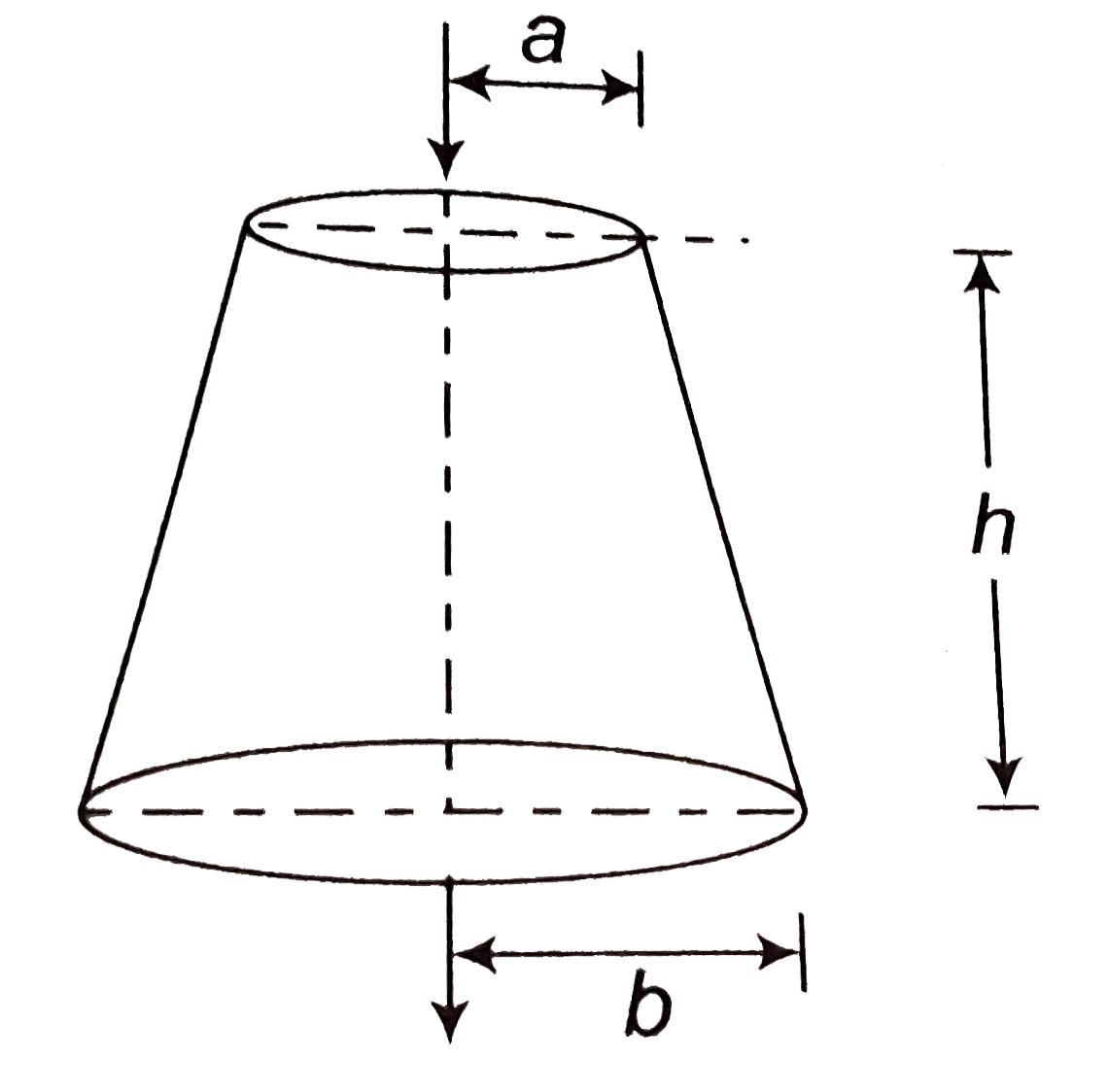
A material of resistivity `rho` is formed in the shape of a truncated cone of altitude `h` as shown in the figure. The top end has radius a while bottom `b`. Assuming a uniform current density through any circular cross-section of the cone, the resistance between two ends is :
.

Promotional Banner

Similar Questions

Explore conceptually related problems

A material of resistivity rho is formed in the shape of a truncated cone of altitude h. The top end has a radius a while bottom b. Assuming a uniform current density through any circular cross-section of the cone. Find the resistance between the two ends.

A resistance is in the shape of a turnacated right circuit cone The radit are a and b (bgt a) the special resistance of the material is p and the alitude is h If laper is small then find the resistance between the plate faces of the resistor

Two rods (one semi-circular and other straight) of same material and of same cross-sectional area are joined as shown in the figure. The point A and B are maintained at different temperature. Find the ratio of the heat transferred through a cross-section of a semi-circular rod to the heat transferred through a cross section of the straight rod in a given time.

Two rods (one semi-circular and other straight) of same material and of same cross-sectional area are joined as shown in the figure. The point A and B are maintained at different temperature. Find the ratio of the heat transferred through a cross-section of a semi-circular rod to the heat transferred through a cross section of the straight rod in a given time.

Two rods (one semi-circular and other straight) of same material and of same cross-sectional area are joined as shown in the figure. The points A and B are maintained at different temperature. The ratio of the heat transferred through a cross-section of a semi-circular rod to the heat transferred through a cross section of the straight red in a given time is

A glass capillary tube is of the shape of a truncated cone with an apex angle alpha so that its two ends have cross sections of different radii. When dipped in water vertically, water rises in it to a high h, where the radius of its cross section is b. If the surface tension of water is S, its density if rho , and its contact angle with glass is theta , the value of h will be (g is the acceleration due to gravity)

A glass capillary tube is of the shape of a truncated cone with an apex angle alpha so that its two ends have cross sections of different radii. When dipped in water vertically, water rises in it to a high h, where the radius of its cross section is b. If the surface tension of water is S, its density if rho , and its contact angle with glass is theta , the value of h will be (g is the acceleration due to gravity)

A glass capillary tube is of the shape of a truncated cone with an apex angle alpha so that its two ends have cross sections of different radii. When dipped in water vertically, water rises in it to a high h, where the radius of its cross section is b. If the surface tension of water is S, its density if rho , and its contact angle with glass is theta , the value of h will be (g is the acceleration due to gravity)

A glass capillary tube is of the shape of a truncated cone with an apex angle alpha so that its two ends have cross sections of different radii. When dipped in water vertically, water rises in it to a high h, where the radius of its cross section is b. If the surface tension of water is S, its density if rho , and its contact angle with glass is theta , the value of h will be (g is the acceleration due to gravity)