Text Solution
Verified by Experts



Topper's Solved these Questions
LAWS OF MOTION
AAKASH SERIES|Exercise LONG ANSWER TYPE QUESTIONS|4 VideosLAWS OF MOTION
AAKASH SERIES|Exercise SHORT ANSWER TYPE QUESTION|5 VideosGEOMETRICAL OPTICS
AAKASH SERIES|Exercise ADDITIONAL PRACTICE EXERCISE (LEVEL-II PRACTICE SHEET (ADVANCED) INTEGER TYPE QUESTIONS)|6 VideosLOGIC GATES
AAKASH SERIES|Exercise Exercise (Very Short Answer)|16 Videos
AAKASH SERIES-LAWS OF MOTION-PRACTICE EXERCISE
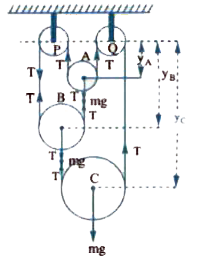
- In the pulley system shown in figure. P and Q are fixed pulleys while ...
Text Solution
|
- A force of 50 N acts on a body of mass 10 kg at rest. Its velocity aft...
Text Solution
|
- A force of 10 N inclined to the horizontal at an angle of 60^(@) acts ...
Text Solution
|
- A constant retarding force of 20 N acts on a body of mass 5 kg moving ...
Text Solution
|
- A bullet of mass 0.005 kg moving with a speed of 200 ms^(-1) enters a ...
Text Solution
|
- A body of mass m falls from a height h1 and rises to a height h2. The ...
Text Solution
|
- Two bodies of masses 4 kg and 16 kg at rest to acted upon by same forc...
Text Solution
|
- In a football match a ball is kicked by a player with a force of 25N f...
Text Solution
|
- A ball of mass 10 gm dropped from a height of 5 m hits the floor and r...
Text Solution
|
- A body of mass 5 kg is at rest on a smooth horizontal surface. A horiz...
Text Solution
|
- A balloon of total mass 1000 Kg float motionless over the earth's surf...
Text Solution
|
- The horizontal speed of a jet of water is 100 cm/sec and 50 cm^3 of wa...
Text Solution
|
- A disc of mass 0.5kg is kept floating horizontally in mid air by firin...
Text Solution
|
- A constant horizontal force of 20N acts on a body on a smooth horizont...
Text Solution
|
- A gun of mass 10Kg fires four bullets per second. The mass of each bul...
Text Solution
|
- A balloon has 5 gm of air. A small hole is pierced into it. The air es...
Text Solution
|
- A 1.5 kg hammer moving with a velocity of 10 m/s strikes a nail for 0....
Text Solution
|
- Six forces lying in a plane and forming angles of 60^(@) relative to o...
Text Solution
|
- A body is acted on by a force given by F = (10+2t) N. The impulse rece...
Text Solution
|
- The linear momentum of a particle varies with time as p = a0 +at+bt^2....
Text Solution
|
- A constant force actson a body of mass m, at rest and produces a veloc...
Text Solution
|