Home
Class 12
PHYSICS
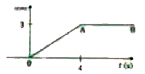
Figure shows the position-time graph of ...

Figure shows the position-time graph of a particle of mass 4 kg, then
a) force on the particle for `t lt 0, t gt 4 s, 0 lt t lt 4 s`? ?
b) impulse at t = 0 and t = 4 s. (consider one-dimensional motion only)

Text Solution

Verified by Experts

i) For `t lt 0` in the position time graph is at O which means displacement of the particle is zero. i.e. particle is at rest at the origin. Hence force on the particle must be zero
ii) For 0 < t < 4 s, the position time graph OA has a constant slope. Therefore velocity of the particle is constant in this interval i.e. particle has zero acceleration. Hence force on the particle must be zero.
iii) For t > 4 s, the position time graph AB is parallel to time axis. Therefore, the particle remains at a distance 3m from the origin, i.e. it is at rest. Hence force on the particle is zero.
b) i) impulse at t = 0
We know, Impulse = change in linear momentum, Before t = 0 particle is at rest i.e. u = 0.
After t = 0, particle has a constant velocity
`v=3/4 = 0.75 m//s`
`therefore` Impulse `=m(v-u) =m(0.75 -0) = 3` kgm//s
(ii) `therefore` Impulse at t = 4 s, Before t = 4s,
particle has a constant velocity u = 0.75 m/s After t = 4s, particle is at rest i.e. v = 0 Impulse = `m(v - u) = 4(0 - 0.75 - - 3` kg m/s
Promotional Banner

Similar Questions

Explore conceptually related problems

Figure shows the position-time graph of a particle of mass 4 kg. What is the (a) force on the particle for t 4 s, 0

In the figure given below, the position - time graph of a particle of mass 0.1 kg is shown. Find impulse at t=2sec.

The acceleration of a particle varie with time as shown in the figure Find the displacement of the particle in the interval from 1 = 2s to t = 4s Assume that v = 0 at t=0

Figure. shows the x-t plot of one-dimensional motion of a particle. Is it correct to say from the graph that the particle moves in a straight line for t lt 0 and on a parabolic path for t gt 0 ? If not, suggest a suitable physical context for this graph.

Figure shows the x-t plot of one dimensional motion of a particle. Is it correct to say from the graph that the particle moves in a straight line for t lt 0 and on a parabolic path for t gt 0 ? If not, suggest a suitable physical context for this graph.
