

Home
Class 11
PHYSICS
Same spring is attached with 2kg , 3kg a...

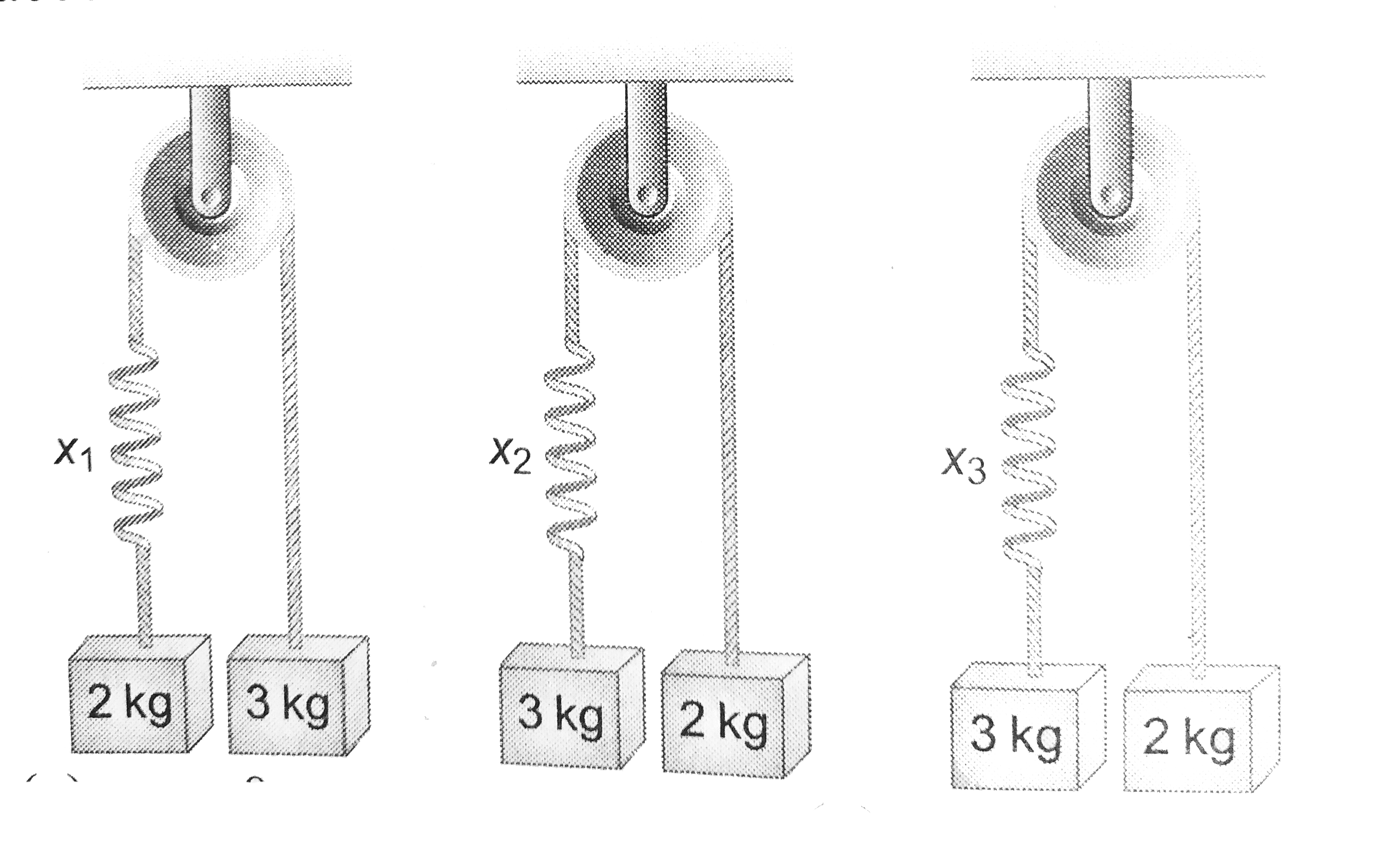
Same spring is attached with `2kg` , `3kg` and `1kg` blocks in three different cases as shown in figure. If `x_(1)` , `x_(2)` and `x_(3)` be the extensions in the soring in these cases then (Assume all the block s to move with uniform acceleration).

Promotional Banner

Similar Questions

Explore conceptually related problems

Same spring is attached with 2kg, 3kg and lkg blocks in three different cases as shwon in figure. Then,

Consider three cases, same spring is attached with 2kg , 3kg and 1kg blocks as shown in figure. If x_(1) , x_(2) , x_(3) be the extensions in the spring in the three cases, then.

In the arrangement shown in figure , find the retio of tension in the strings attached with 4kg block and the with 1kg block

In the system shown in the figure, the acceleration of 1 kg block is

In the arrangement shown in figure , find the ratio of tension in the strings attached with 4kg block and the with 1kg block

From the fixed pulley, masses 2kg, 1kg and 3kg are suspended as shown in the figure. Find the extension in the spring if k=100 N//m . (Neglect oscillations due to spring)

From the fixed pulley, masses 2kg, 1kg and 3kg are suspended as shown in the figure. Find the extension in the spring if k=100 N//m . (Neglect oscillations due to spring)

Three block of masses 1kg , 4 kg and 2 kg are placed on a smooth horizontal plane as shown in figure. Find (a) the acceleration of the system, (b) the normal force between 1kg block and 4 kg block, ( c) the net force on 2kg block

Three block of masses 1kg,4 kg and 2 kg are placed on a smooth horizontal plane as shown in figure. Find (a) the acceleration of the system, (b) the normal force between 1kg block and 4 kg block, ( c) the net force on 2kg block

Three blocks of m asses 1 kg, 2 kg and 3 kg are placed in contact w ith each other on a horizontal frictionless surface, as show n in figure. A force of 12 N is applied as shown in the figure. Calculate (i) the acceleration of the system o f these three blocks, (ii) the contact force acting on 2 kg block by first block of 1 kg and (iii) the contact force on 3 kg block.