

Home
Class 12
PHYSICS
Figure shows a uniform rod of length 30 ...

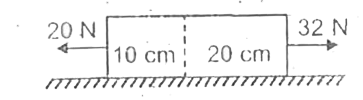
Figure shows a uniform rod of length 30 cm having a mass 3.0 kg. The rod is pulled by constant forces of 20N and 32N as shown. Find the force exerted by 20 cm part of the rod on the 10 cm part (all surfaces are smooth) is

Promotional Banner

Similar Questions

Explore conceptually related problems

Figure shows a uniform rod of length 30 cm having a mass of 3.0 kg. The strings shown in the figure are pulled by constant forces of 20 N and 32N. Find the force exerted by the 20 cm part of the rod on the 10 cm part. All the surfaces are smooth and the strings and the pulleys are light.

Figure shwos a uniform rod of length 30 cm having a mass of 3.0 kg. The strings shownin the figure are pulled by constant forces of 20 N and 32N. Find the force exerted by the 20 cm part of the rod on the 10 cm part. All the surfaces are smoth and the strings and the pulleys are light.

fig shows a uniform rod of length of 3.0 kg The string shown in the figure are pulled by constant forces of 20 N and 32 N. The force exerted by the 20 cm part of the rod on the 10 cm part is found to be 8T. Find out value of T (all the surfaces are smooth and the strings and the pulleys are light).

A uniform rod of length 60 cm and mass 6kg is acted upon by two forces as shown in the diagram. The force exerted by 45 cm part ofthe rod on 15 cm part of the rod is

A uniform rod of length 60 cm and mass 6kg is acted upon by two forces as shown in the diagram. The force exerted by 45 cm part ofthe rod on 15 cm part of the rod is

Figure shows a uniform rod of mass 3 kg and of length 30 cm. The strings shown in figure are pulled by constant forces of 20 N and 32 N .The acceleration of the rod is-

All the surface are smooth and the strings ans pulleys are light. The force exerted by the 20 cm part of the rod on the 10 cm part is

A uniform rod of length 1m having mass 1 kg rests against a smooth wall at an angle of 30^(@) with the ground. Calculate the force exerted by the ground on the rod. Take g = 10 ms^(-2) .

A uniform rod of length l is placed symmetrically on two walls as shown in Fig. The rod is in equilibrium. If N_(1) and N_(2) are the normal forces exerted by the walls on the rod, then

A uniform rod of length l is placed symmetrically on two walls as shown in Fig. The rod is in equilibrium. If N_(1) and N_(2) are the normal forces exerted by the walls on the rod, then