

Home
Class 12
PHYSICS
Three point charges 1C, 2C and 3C are pl...

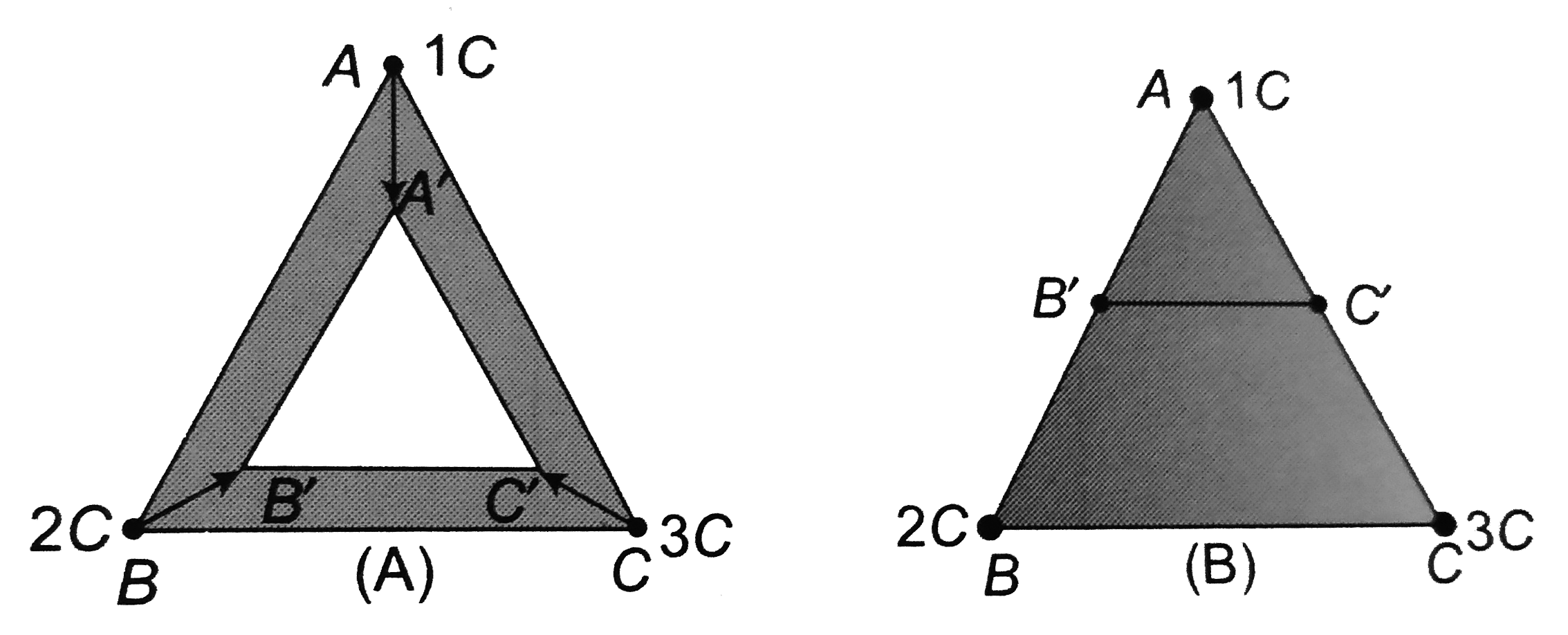
Three point charges `1C, 2C` and `3C` are placed at the corners of an equilaternal triangle of side `1m`. The work required to move these charges to the corners of a smaller equilaternal triangle of side `0.5 m` in two differenct ways as in fig. `(A)` and fig. `(B)` are `W_(a)` and `W_(b)` then:

Promotional Banner

Similar Questions

Explore conceptually related problems

Three point charges of 1C, 2C and 3C are placed at the . corners of an equilateral triangle of side 1m. Calculate the work required to move these charges to the corners of a smaller equilateral triangle of side 1.5m.

Three points charges of 1 C, 2C and 3C are placed at the corners of an equilateral triangle of side 100 cm. Find the work done to move these charges to the corners of a similar equilateral triangle of side 50 cm.

Three points charges of 1 C, 2C and 3C are placed at the corners of an equilateral triangle of side 100 cm. Find the work done to move these charges to the corners of a similar equilateral triangle of side 50 cm.

Three points charges of 1 C, 2C and 3C are placed at the corners of an equilateral triangle of side 100 cm. Find the work done to move these charges to the corners of a similar equilateral triangle of side 50 cm.

Three point charges 3nC, 6nC and 9nC are placed at the corners of an equilateral triangle of side 0.1m. The potential energy of the system is:

Three point charges 3nC, 6nC and 6nC are placed at the corners of an equilateral triangle of side 0.1 m. The potential energy of the system is

Three point charges 1 C, 2 C and 3 C are placed at the corners of a equilateral triangle. The length of triangle is 1 m. What would be the work required to put these charge on the corner of an equilateral triangle of length 0.5 m ?

Three point charges 3 nC , 6 nC and 9 nC are placed at the corners of an equilateral triangle of side 0.1 m . The potential energy of the system is

Three points charges are placed at the corners of an equilateral triangle of side L as shown in the figure: