

Home
Class 12
PHYSICS
Initially spring is compressed by x(0) a...

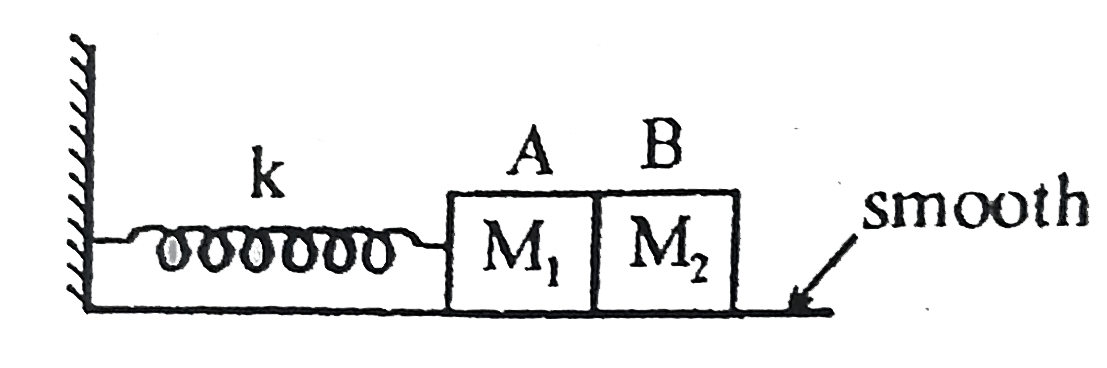
Initially spring is compressed by `x_(0)` and blocks are in contact when system is released, then block starts moving and after some time contact between blocks, then

Promotional Banner

Similar Questions

Explore conceptually related problems

According to the principle of conservation of linear momentum, if the external force acting on the system is zero, the linear momentum of the system will remain conserved. It means if the centre of mass of a system is initially at rest, it will remain, at rest in the absence of external force, that is, the displacement of centre of mass will be zero. Two blocks of masses 'm' and '2m' are placed as shown in Fig. There is no friction anywhere. A spring of force constant k is attached to the bigger block. Mass 'm' is kept in touch with the spring but not attached to it. 'A' and 'B' are two supports attached to '2m' . Now m is moved towards left so that spring is compressed by distance 'x' and then the system is released from rest. Find the relative velocity of the blocks after 'm' leaves contact with the spring.

In the system shown in figure, the block A is released from rest. Find Contact force between ‘A’ and ‘B’.

Two identical blocks each of mass 1kg are joined together with a compressed spring. When the system is released the two blocks appear to be moving with unequal speeds in the opposite directions as shown in fig. Choose the correct statement -

Two identical blocks each of mass 1kg are joined together with a compressed spring. When the system is released the two blocks appear to be moving with unequal speeds in the opposite directions as shown in fig. Choose the correct statement -

In the figure, the block of mass m, attached to the spring of stiffness k is in correct with the completely elastic wall, and the compression in the spring is e. The spring is compressed further by e by displacing the block towards left and is then released. If the collision between the block and the wall is completely eleastic then the time period of oscillation of the block will be

In the figure, the block of mass m, attached to the spring of stiffness k is in correct with the completely elastic wall, and the compression in the spring is e. The spring is compressed further by e by displacing the block towards left and is then released. If the collision between the block and the wall is completely eleastic then the time period of oscillation of the block will be

In the figure shown the spring is compressed by 'x_(0)' and released . Two block 'A' and 'B' of masses 'm' and '2m' respectively are attached at the ends of the spring. Blocks are kept on a smooth horizontal surface and released. Find the work done by the spring on 'A' by the time compression of the spring reduced to (x_(0))/(2) .

The spring is compressed by a distance a and released. The block again comes to rest when the spring is elongated by a distance b . During this