

Home
Class 11
PHYSICS
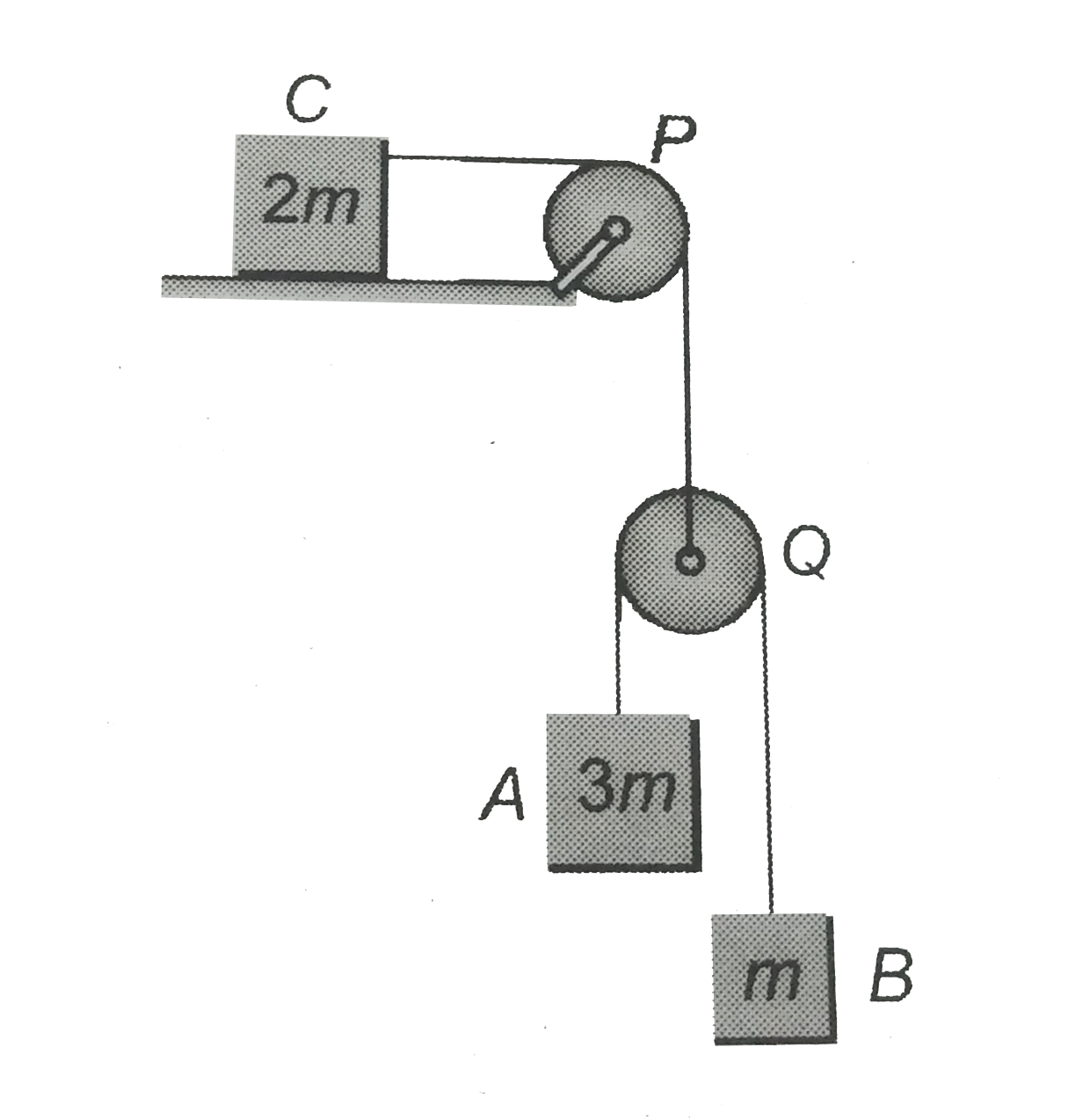
In the arrangement shown in the figure, ...

In the arrangement shown in the figure, the blocks have masses `3m,m` and `2m`, the friction is absent, the masses of the pulleys and the threads are negligible. Find the acceleration of mass `3m`.

Promotional Banner

Similar Questions

Explore conceptually related problems

In the arrangement shown in figure the bodies have masses m_0 , m_1 , m_2 , the friction is absent, the masses of the pulleys and the threads are negligible. Find the acceleration of the body m_1 . Look into possible cases.

In the arrangement shown in fig the bodies have masses m_(0), m_(1) and m_(2) the friction is absent the masses of pulleys and the threads are negligible find the acceleration of the body m_(1)

In the arrangement shown in figure the masses of the wedge M and the body m are known. The appreciable friction exists only between the wedge and the body m, the friction coefficient being equal to k. The masses of the pulley and the thread are negligible. Find the acceleration of the body m relative to the horizontal surface on which the wedge slides.

In the arrangement of figure the masses m_0 , m_1 , and m_2 of bodies are equal, the masses of the pulley and the threads are negligible, and there is no friction in the pulley. Find the acceleration w with which the body m_0 comes down, and the tension of the thread binding together the bodies m_1 and m_2 , if the coefficient of friction between these bodies and the horizontal surface is equal to k. Consider possible cases.

A pulley fixed to the ceiling carries a thread with bodies of masses m_1 and m_2 attached to its ends. The masses of the pulley and the thread are negligible, friction is absent. Find the acceleration w_C of the centre of inertia of this system.

In the arrangement shown in figure the masses of the wedge M and the body m are known. The appreciable friction exists only between the wedge and the body m , the friction coefficient being equal to k . The masses of the pulley and the thread are negligible. Find the acceleration of the body m relative to the horizontal surface on which the wedge slides.

In the arrangement shown in figure the masses m of the bar and M of the wedge, as well as the wedge angle alpha , are known. The masses of the pulley and the thread are negligible. The friction is absent. Find the acceleration of the wedge M.

A pulley fixed to the ceiling carries a thread with bodies of masses m_(1) and m_(2) attached at its ends. The masses of the pulley and thread are negligible, friction is absent. Find the acceleration of the centre of mass (a_("cm")) of this system.

A pulley fixed to the ceiling carried a thread with bodies of masses m_(1) and m_(2) attached to its ends. The mases of the pulley and the thread are negligible and friction is absent. Find the acceleration of the centre of mass of this system.