

Home
Class 11
PHYSICS
A block A is connected to spring and per...


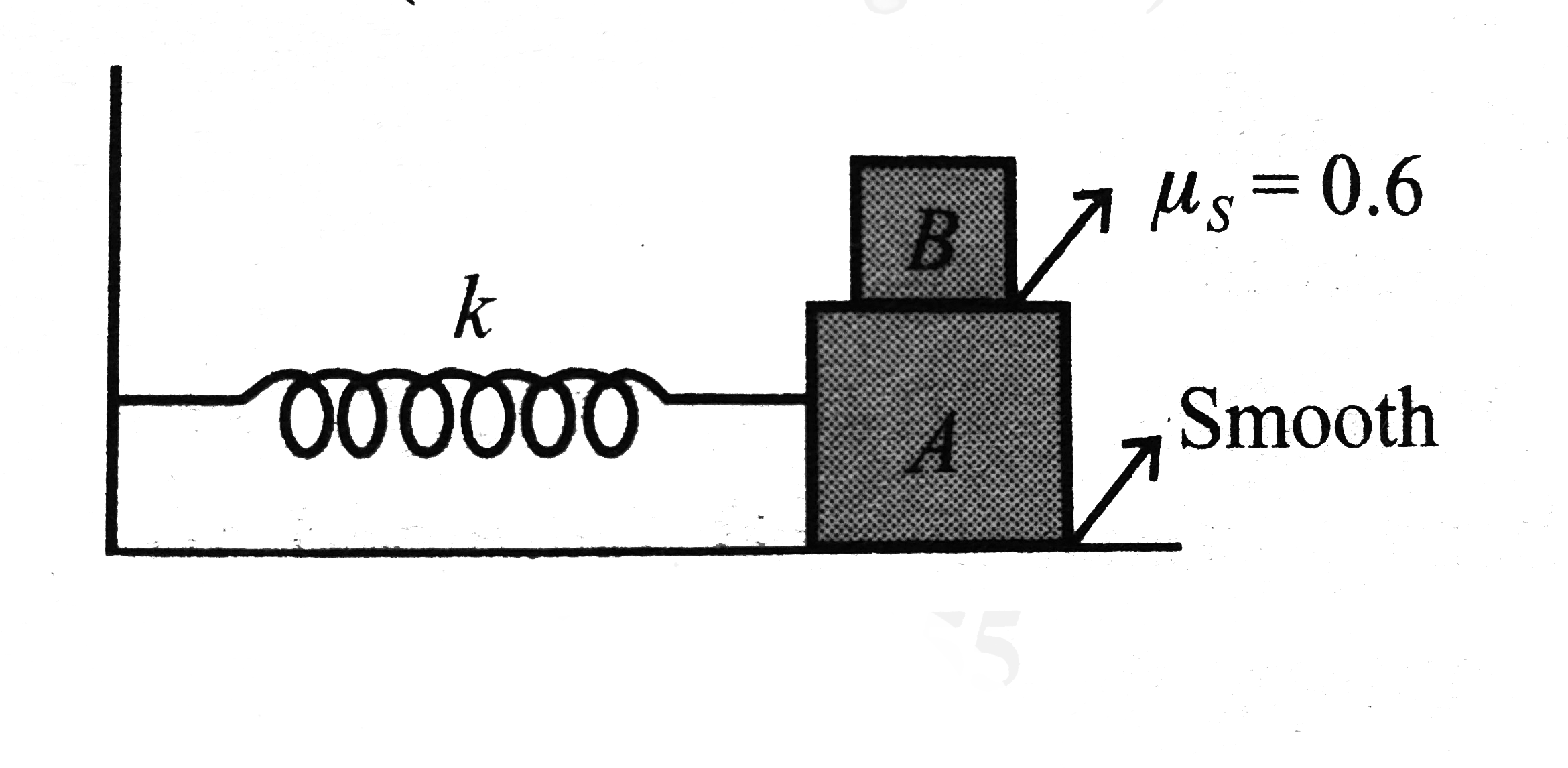
A block A is connected to spring and performs simple harmonic motion with a time period of 2 s. Another block B restes on a. The coefficient of static friction between `A` and `B` is `mu_S=0.6`. The maximum amplitude of oscillation which the system can have so that there is no relative motion between A and B is (take `pi^2=g=10`)

Promotional Banner

Similar Questions

Explore conceptually related problems

Block B rests on a smooth surface .The coefficient of static friction between A and B is mu = 0.4 where F = 30 N then Acceleration of upper block is

Block B rests on a smooth surface .The coefficient of static friction between A and B is mu = 0.4 where F = 30 N then Acceleration of lower block is

Block B rests on a smooth surface .The coefficient of static friction between A and B is mu = 0.4 where F = 30 N then Acceleration of upper block is

In Fig. A is a large block which executes shm by sliding across a frictionless surface with a frequency n. The block B is at rest on the surface of the block mu_s The coefficient of static friction between the two is H. Find the maximum amplitude of oscillation of the system so that the block B does not slip.

A block on a horizontal slab is moving horizontally with a simple harmonic motion of frequency two oscillations per second. If the coefficient of static friction between block and slab is 0.5, then the amplitude of the oscillation will be (if the block does not slip along the slab)

Block B rests on surface . If the coefficient of static friction between A and B is mu = 0.4 . Determine the acceleration of each , if (a) F = 30 N and (b) F = 250 N (g = 10 m//s^(2))

Block B rests on surface . If the coefficient of static friction between A and B is mu = 0.4 . Determine the acceleration of each , if (a) F = 30 N and (b) F = 250 N (g = 10 m//s^(2))

A block is kept on a horizontal table that is executing simple harmonic motion of frequency v in the horizontal plane. The coefficient of static friction between the block and the table is mu . Determine the maximum amplitude of the table for which the block does not slip on the surface of the table.