

Home
Class 11
PHYSICS
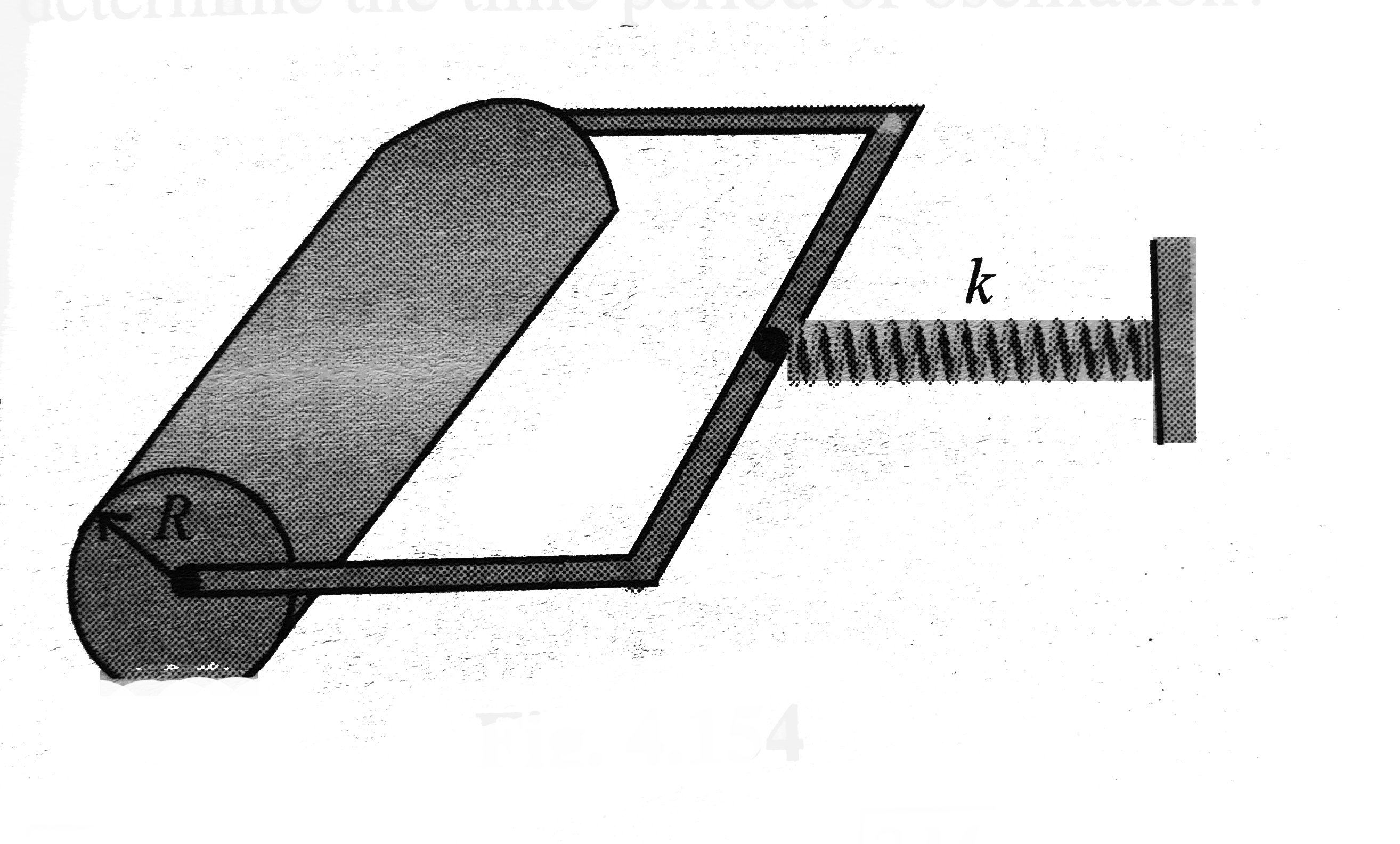
A soil cylinder of mass M and radius R i...


A soil cylinder of mass `M` and radius `R` is connected to a spring as shown in fig. The cylinder is placed on a rough horizontal surface. All the parts except the cylinder shown in the figure are light. If the cylinder is displaced slightly from its mean position and released, so that it performs pure rolling back and forth about its equilibrium position, determine the time period of oscillation?

Promotional Banner

Similar Questions

Explore conceptually related problems

A pendulum of mass m and length L is connected to a spring as shown in figure. If the bob is displaced slightly from its mean position and released, it performs simple harmonic motion. The angular frequency of the oscillation of bob is

A uniform solid cylinder of mass m and radius R is placed on a rough horizontal surface. A horizontal constant force F is applied at the top point P of the cylinder so that it start pure rolling. The acceleration of the cylinder is

A uniform solid cylinder of mass m and radius R is placed on a rough horizontal surface. A horizontal constant force F is applied at the top point P of the cylinder so that it start pure rolling. The acceleration of the cylinder is

A solid cylinder of mass M and radius R pure rolls on a rough surface as shown in the figure. Choose the correct alternative (s).

A cylinder of mass m and radius R is kept on a rough surface after giving its centre a horizontal speed v_(0) . Find the speed of the centre of the cylinder when it stops slipping.

A cylinder of mass m and radius R is kept on a rough surface after giving its centre a horizontal speed v_(0) . Find the speed of the centre of the cylinder when it stops slipping.

Find the time period of mass M when displaced from its equilibrium position and then released for the system shown in figure. .

Find the time period of mass M when displaced from its equilibrium position and then released for the system shown in figure.

Find the time period of mass M when displaced from its equilibrium position and then released for the system shown in figure.