

Home
Class 11
PHYSICS
There is a spring with netural length L(...

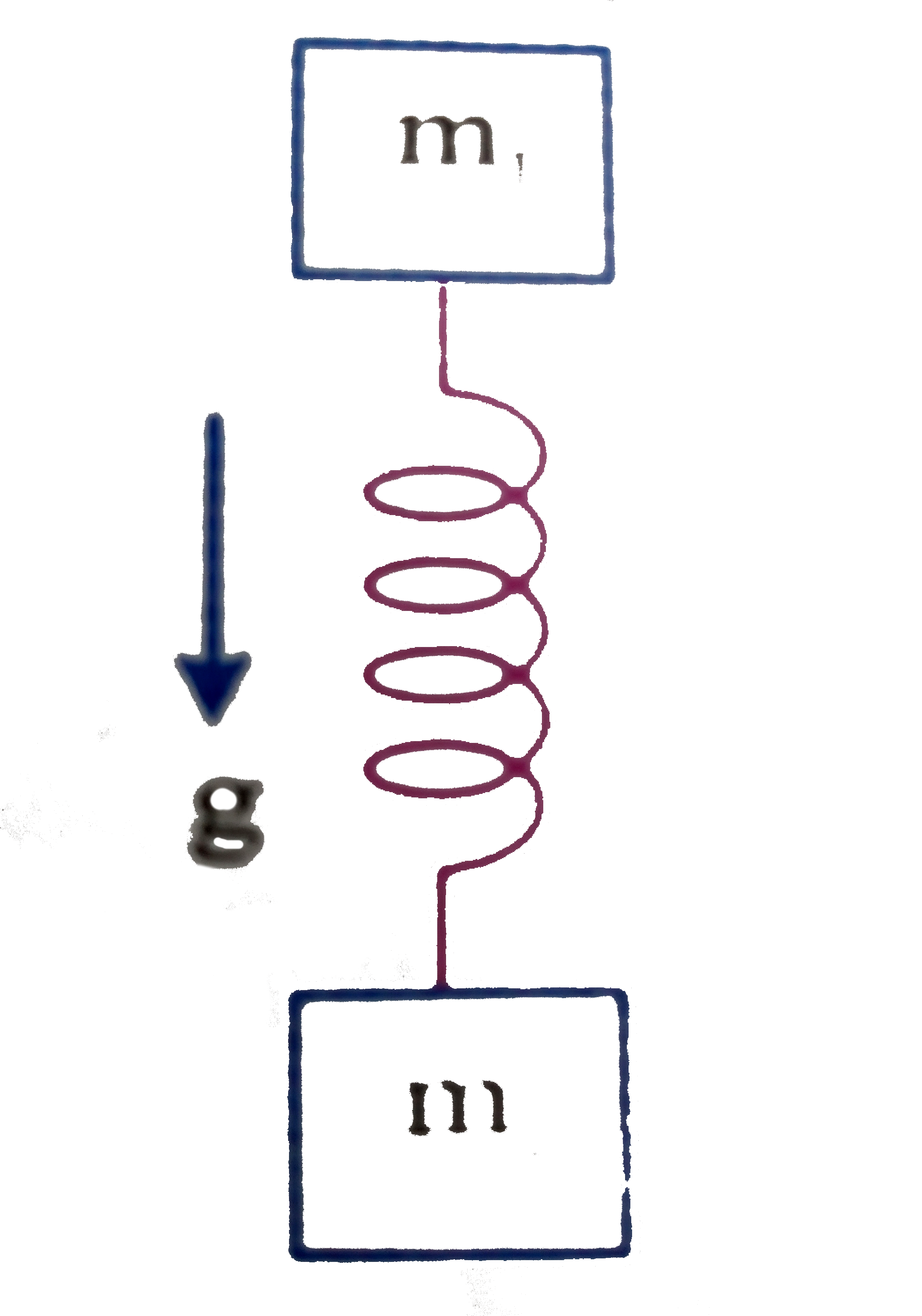
There is a spring with netural length `L_(0)`. Two masses `m_(1)` and `m_(2)` are connected to both of its ends as shown in figure. The whole system is held at rest. At any time `t =0, m_(2)` is released and system starts free fall. Initial stretched length of spring before fall is `L.` what is the displacement of centre of mass as function of time?

Promotional Banner

Similar Questions

Explore conceptually related problems

The two masses m_(1) and m_(2) are joined by a spring as shown. The system is dropped to the ground from a height. The spring will be

The two masses m_(1) and m_(2) are joined by a spring as shown. The system is dropped to the ground from a height. The spring will be

The two masses m_(1) and m_(2) are joined by a spring as shown. The system is dropped to the ground from a height. The spring will be

Two masses m and 2m are attached to two ends of an ideal spring as shown in figure. When thye spring is in the compressed state, the energy of the spring is 60 J, if the spring is released, then at its natural length

Two masses m and 2m are attached to two ends of an ideal spring as shown in figure. When the spring is in the compressed state, the energy of the spring is 60 J, if the spring is released, then at its natural length

Two blocks of masses m_(1) and m_(2) are connected by a massless spring and placed on smooth surface. The spring initially stretched and released. Then :

Two blocks of masses m_(1) and m_(2) are connected by a massless spring and placed on smooth surface. The spring initially stretched and released. Then :

Two blocks of mass m_(1) and m_(2) (m_(1) lt m_(2)) are connected with an ideal spring on a smooth horizontal surface as shown in figure. At t = 0 m_(1) is at rest and m_(2) is given a velocity v towards right. At this moment, spring is in its natural length. Then choose the correct alternative :

Two blocks of mass m_(1) and m_(2) (m_(1) lt m_(2)) are connected with an ideal spring on a smooth horizontal surface as shown in figure. At t = 0 m_(1) is at rest and m_(2) is given a velocity v towards right. At this moment, spring is in its natural length. Then choose the correct alternative :