

Home
Class 11
PHYSICS
What is the largest mass of C in kg that...

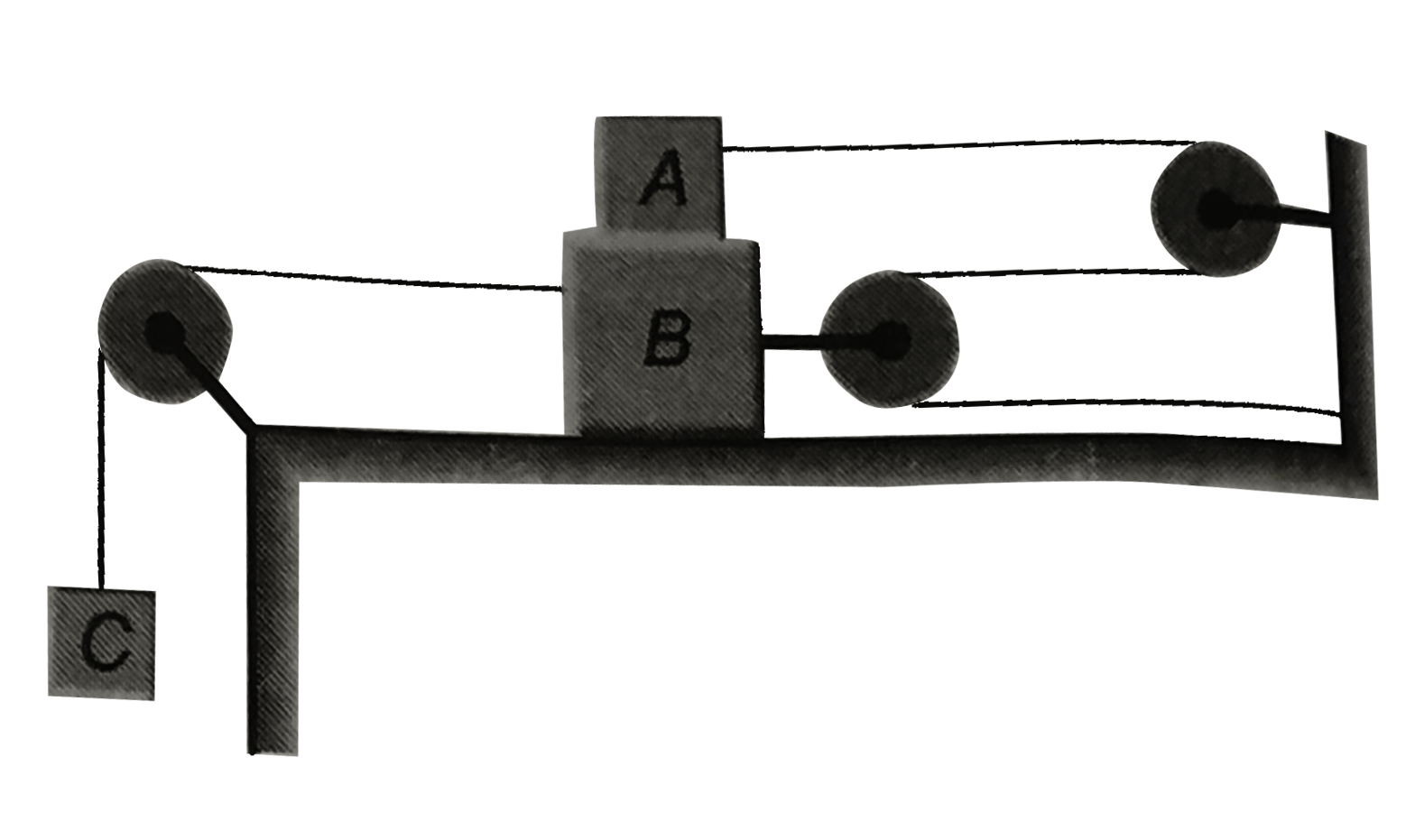
What is the largest mass of `C` in `kg` that can be suspended without moving blocks `A` and `B` ? The static coefficent of friction for all plane surface of contact is `0.3` Mass of block `A` is `50 kg` and block `B` is `70 kg`. Neglect feriction in the pulleys.

Promotional Banner

Similar Questions

Explore conceptually related problems

Block A of weight 500 N and block B of weight 700 N are connected by rope pulley system as shown. The largest weight C that can be suspended without moving block A and B is W . The coefficient of friction for all plane surfaces of contact is 0.3 . The pulleys are ideal. Find (W)/(90) .

If the mass of the block A = 10 kg and the coefficient of static and kinetic friction is 0.2, then the mass of block B to start the motion is

Two blocks are connected over massless pulley as shown in figure. The mass of block Ais 10 kg and the coefficient of kinetic friction is 0.2 .Block A sliders down the incline at constant speed. The mass of block B in kg is

The mass of block A is 100 kg and that of block B is 200 kg. The coefficient of friction between A and B is 0.2 and that between B and ground level is 0.3. The minimum force which will make the block B move, will be:

Two blocks are connected over a massless pulley as shown in figure. The mass of block A is 10 kg and the coefficient of kinetic friction is 0.2 Block A sliders down the incline at constant speed. The mass of block B in kg is

Block B of mass m_(B) = 0.5 kg rests on block A, with mass m_(A) = 1.5kg which in turn is on a horizontal tabletop (as shown in figure) .The coefficient of kinetic friction between block A and the tabletop is mu_(k) = 0.4 and the coefficient of static friction between block A and blockB is mu_(s) = 0.6 A light string attached block A passes over a frictionless, massless pulley and block C is suspeneded from the other end of the string. What is the largest mass m_(c) (in kg) that block C can have so that block A and B still slide together when the system is relaced from rest?

Block B of mass m_(B) = 0.5 kg rests on block A, with mass m_(A) = 1.5kg which in turn is on a horizontal tabletop (as shown in figure) .The coefficient of kinetic friction between block A and the tabletop is mu_(k) = 0.4 and the coefficient of static friction between block A and blockB is mu_(s) = 0.6 A light string attached block A passes over a frictionless, massless pulley and block C is suspeneded from the other end of the string. What is the largest mass m_(c) (in kg) that block C can have so that block A and B still slide together when the system is relaced from rest?