

Home
Class 12
PHYSICS
A horizontal metallic rod of mass 'm' an...

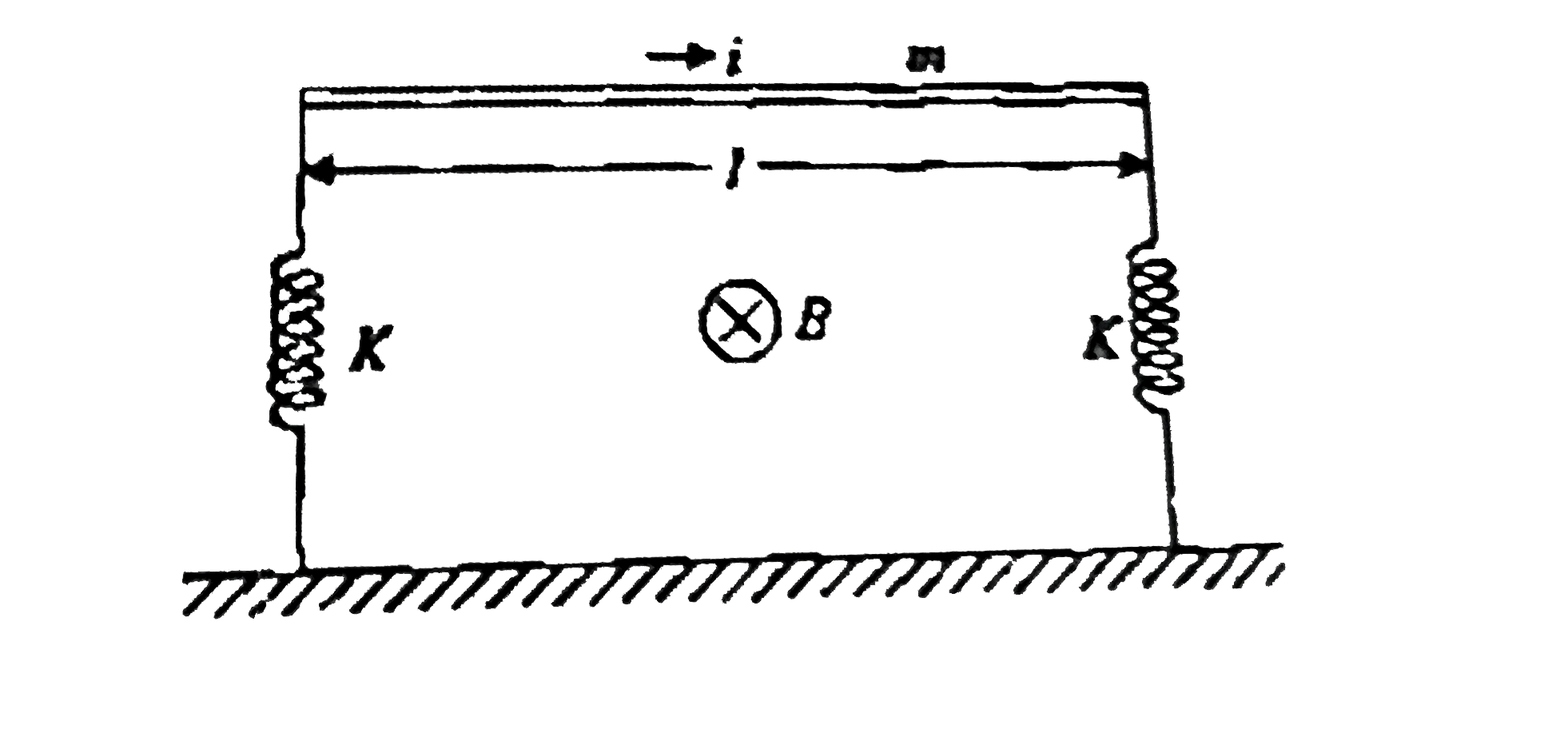
A horizontal metallic rod of mass 'm' and length 'l' is supported by two vertical identical springs of spring constant 'k' each and natral length `i_(0)` A current 'l' is flowing in the rod in the direction shown if the rod is in equilibrium then the length of each spring in this state is:

Promotional Banner

Similar Questions

Explore conceptually related problems

A rod of mass m and length l is connected by two spring of spring constants k_(1) and k_(2) , so that it is horizontal at equilibrium. What is the natural frequency of the system?

A rod of mass m and length l is connected by two spring of spring constants k_(1) and k_(2) , so that it is horizontal at equilibrium. What is the natural frequency of the system?

A ring of mass m is attached to a horizontal spring of spring constant k and natural length l_0 . The other end of the spring is fixed and the ring can slide on a horizontal rod as shown. Now the ring is shifted to position B and released Find the speed of the ring when the spring attains its natural length.

There are two identical spring each of spring constant k. here springs, pulley and rods are massless and the block has mass m . What is the extension of each spring at equilibrium?

There are tow identical spring each of spring constant k. here springs, pulley and rods are massless and the block has mass m . What is the extension of each spring at equilibrium?

In the figure a uniform rod of mass 'm' and length 'l' is hinged at one end and the other end is connected to a light vertical of spring constant 'k' as shown in figure. The spring has extension such that rod is equilibrium when it is horizontal . The rod rotate about horizontal axis passing through end 'B' . Neglecting friction at the hinge find (a) extension in the spring (b) the force on the rod due to hinge.

In the figure a uniform rod of mass 'm' and length 'l' is hinged at one end and the other end is connected to a light vertical of spring constant 'k' as shown in figure. The spring has extension such that rod is equilibrium when it is horizontal . The rod rotate about horizontal axis passing through end 'B' . Neglecting friction at the hinge find (a) extension in the spring (b) the force on the rod due to hinge.

In the figure shown a uniform conducing rod of mass m and length l is suspended invertical plane by two conducing springs of spring constant k each. Upper end of springs are connected to each other by a capacitor of capacitance C. A uniform horizontal magnetic field (B_(0)) perpendicular to plane of springs in space initially rod is in equillibrium. If the rod is pulled down and released, it performs SHM. (Assume resistance of springs and rod are negligible) Find the period of oscillation of rod.

In the figure shown a uniform conducing rod of mass m and length l is suspended invertical plane by two conducing springs of spring constant k each. Upper end of springs are connected to each other by a capacitor of capacitance C. A uniform horizontal magnetic field (B_(0)) perpendicular to plane of springs in space initially rod is in equillibrium. If the rod is pulled down and released, it performs SHM. (Assume resistance of springs and rod are negligible) Find the period of oscillation of rod.