Home
Class 7
MATHS
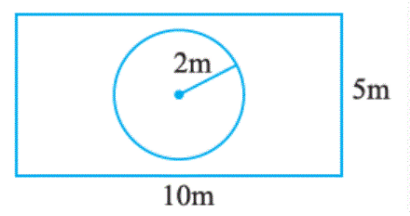
The adjoining figure represents a recta...

The adjoining figure represents a rectangular lawn with a circular flower bed in the middle. Find:
(i) the area of the whole land
(ii) the area of the flower bed
(iii) the area of the lawn excluding the area of the flower bed
(iv) the circumference of the flower bed.

Text Solution

Verified by Experts

(i) Area of the rectangular lawn = Length × Breadth
= `10 m × 5 m`
= `50 m^2`
(ii) Area of the circular flower bed = `πr^2`
...
Promotional Banner

Topper's Solved these Questions

  • PERIMETER AND AREA

    NCERT|Exercise SOLVED EXAMPLES|22 Videos
  • PERIMETER AND AREA

    NCERT|Exercise EXERCISE 11.2|8 Videos
  • PERIMETER AND AREA

    NCERT|Exercise EXERCISE 11.3|17 Videos
  • LINES AND ANGLES

    NCERT|Exercise SOLVED EXAMPLES|1 Videos
  • RATIONAL NUMBERS

    NCERT|Exercise SOLVED EXAMPLES|6 Videos

Similar Questions

Explore conceptually related problems

Find the area of the flower bed (with semicircular ends).

Find the area of the flower bed (with semicircular ends).

Find the area of the flower bed (with semi-circular ends) shown in figure.

Find the area of the flower bed (with semi-circular ends) shown in figure

A circular flower bed is surrounded by a path 4m wide.The diameter of the flower bed is 66m. What is the area of this path? (pi=3.14)

A rectangular flower garden 20m by 15m has a 3m wide path running in the middle.Find the area of the path.

One side of a rectangular lawn is 12 m and its diagonal is 13 m . Find the area of the field.

A square lawn with side 100 m long has a circular flower bed in the centre. If the area of the lawn, excluding the flower bed, is 8614 m2, the radius of the circular flower bed is (a) 21 m (b) 31 m (c) 41 m (d) None of these

In the given figure, two circular flower beds have been shown on two sides of a square lawn ABCD of side AB=42m . If the centre of each circular flower bed is the point of intersection O of the diagonals of the square lawn, find (i) the sum of the areas of the lawn and flower beds, (ii) the sum of the areas of two flower beds.
