

Home
Class 11
PHYSICS
A block of mass M connected to an ideal ...

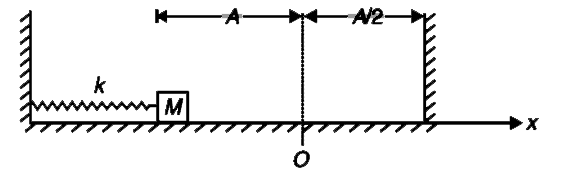
A block of mass M connected to an ideal spring of force constant k, is placed on a smooth surface. The block is pushed to the left so as to compress the spring by a length A and then it is released. The block hits an elastic wall at a distance `(3A)/(2)` from its point of release. Assume the collision to be instantaneous.
(a) Calculate the time required by the block to complete one oscillation
(b) Draw the velocity - time graph for one oscillation of the block.
(c) Find the value of k for which average force experienced by the wall due to repeated hitting of the block is `F_(0)`.

Promotional Banner

Similar Questions

Explore conceptually related problems

A block of mass m connected to a spring of stiffness k is placed on horizontal smooth surface. When block is at x=0 , spring is in natural length. The block is also subjected to a force F=(k|x|)/(@) then

Two blocks of masses m_(1) and m_(2) are connected by a massless spring and placed on smooth surface. The spring initially stretched and released. Then :

Two blocks of masses m_(1) and m_(2) are connected by a massless spring and placed on smooth surface. The spring initially stretched and released. Then :

A block of mass M is tied to a spring of force constant k and placed on a smooth horizontal surface. The natural length of the spring is L. P is a point on the spring at a distance (L)/(4) from its fixed end. The block is set in oscillations with amplitude A. Find the maximum speed of point P on the spring.

Two blocks A and B of mass m and 2m respectively are connected by a light spring of force constant k. They are placed on a smooth horizontal surface. Spring is stretched by a length x and then released. Find the relative velocity of the blocks when the spring comes to its natural length

Two blocks A and B of mass m and 2m respectively are connected by a light spring of force constant k. They are placed on a smooth horizontal surface. Spring is stretched by a length x and then released. Find the relative velocity of the blocks when the spring comes to its natural length

Two blocks A and B of masses m and 2m, respectively , are connected by a massless spring of force constant k and are placed on a smooth horizontal plane. The spring is stretched by an amount x and then released . The relative velocity of the blocks when the spring comes to its natural length is

A block of mass m, attacted to a string of spring constant k, oscillates on a smooth horizontal table. The other end of the spring is fixed to a wall. The block has a speed v when the spring is at its natural length. Before coming to an instantaneous rest. If the block moves a distance x from the mean position, then

A block of mass m, attacted to a string of spring constant k, oscillates on a smooth horizontal table. The other end of the spring is fixed to a wall. The block has a speed v when the spring is at its natural length. Before coming to an instantaneous rest. If the block moves a distance x from the mean position, then