

Home
Class 11
PHYSICS
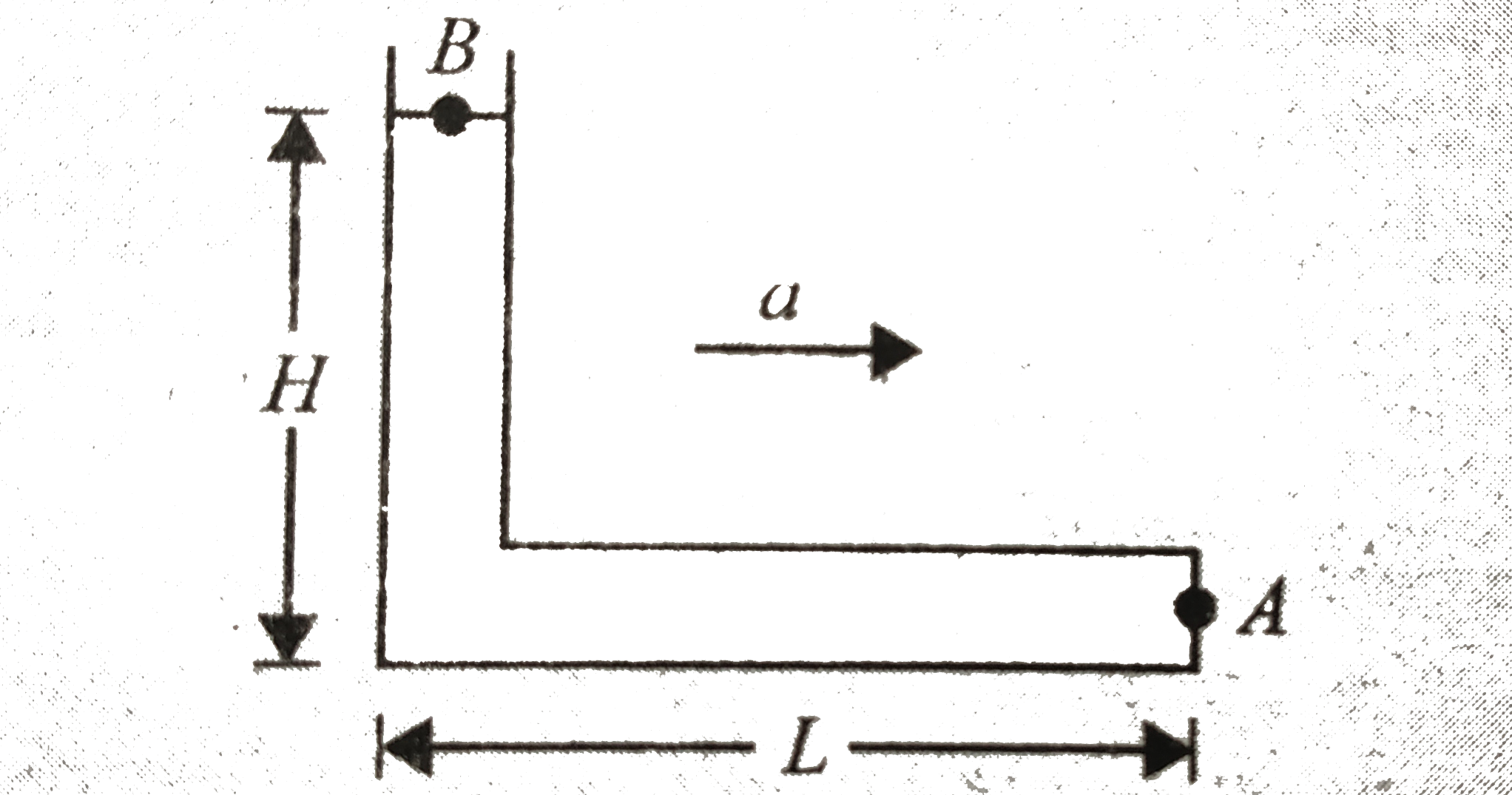
Figure shows an L-shaped tube tilled wit...

Figure shows an `L`-shaped tube tilled with a liquid to a height `H`. What should be the horizontal acceleration a of the tube so that the pressure at the point `A` becomes atmospheric.

Promotional Banner

Similar Questions

Explore conceptually related problems

A tank with base area L^2 is filled with a liquid to height H. The tank is acceleration horizontally with acceleration a as shown in figure. If a small hole is made at the point A. then it is observed that the liquid does not come out of the tank. The magnitude of acceleration should be

A capillary tube is made of glass of refractive index n' . The outer radius of the tube is R . The tube is filled with a liquid of refractive index n lt n' . What should be the minimum internal radius of the tube so that any ray that hits the tube would enter the liquid.

A capillary tube is made of glass of refractive index n' . The outer radius of the tube is R . The tube is filled with a liquid of refractive index n lt n' . What should be the minimum internal radius of the tube so that any ray that hits the tube would enter the liquid.

Figure shows as a L-shaped tube in which a liquid of density rho is filled. Find with what acceleration the tube is accelerated towards right so that no liquid will fall out of the tube.

The minimum horizontal acceleration of the container a so that pressure at the point A of the container becomes atmospheric is (The tank is of sufficient height)

The minimum horizontal acceleration of the container a so that pressure at the point A of the container becomes atmospheric is (The tank is of sufficient height)

The minimum horizontal acceleration of the container4 so that pressure at the point A of the container becomes atmospheric is (The tank is of sufficient height)

For the L -shaped vessel shown in the figure, determine the value of acceleration a so that pressure at point A becomes equal to p_(0)/2 ? ( p_(0) is the atmospheric pressure)

For the L -shaped vessel shown in the figure, determine the value of acceleration a so that pressure at point A becomes equal to p_(0)/2 ? ( p_(0) is the atmospheric pressure)