

Home
Class 12
PHYSICS
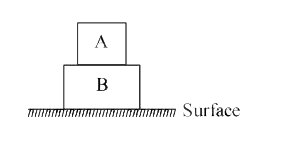
Two blocks A and B of masses 2kg and 3kg...

Two blocks A and B of masses 2kg and 3kg respectively, are placed on a horizontal surface as shown (one on top of other). Find the ratio of magnitude of normal reaction between A and B to that between B and the surface, respectively

Promotional Banner

Similar Questions

Explore conceptually related problems

Two Block A and B of masses 10 kg and 6 kg respectively are connected through pulley as shown in figure. Find acceleration of block A.

Three blocks A , B and C of masses 4kg , 2kg and 1kg respectively are in contact on a frictionless surface, as shown. If a force of 14N is applied on the 4kg block, then the contact force between A and B is.

Three blocks A, B and C , of masses 4 kg , 2kg and 1kg respectively, are in contact on a frictionless surface, as shown. If a force of 14 N is applied on the 4kg block, then the contact force between A and B is:

Three blocks A , B and C of masses 4kg , 2kg and 1kg respectively are in contact on a frictionless surface, as shown. If a force of 14N is applied on the 4kg block, then the contact force between A and B is.

Three blocks A , B and C of masses 4kg , 2kg and 1kg respectively are in contact on a frictionless surface, as shown. If a force of 14N is applied on the 4kg block, then the contact force between A and B is.

Three blocks A, B and C of masses 4 kg, 2 kg and 1 kg respectively, are in contact on a frictionless surface, as shown. If a force of 14 N is applied on the 4 kg block, then the contact force between A and B is

Two block A and B of masses 5 kg. and 3 kg. respectively rest on smooth horizontal surface with B over A. The coefficient of friction between A and B. 0.5 the maximum horizontal force that can be applied to A so that there will be motion of A and B without separation is :-

Two block A and B of masses 5 kg. and 3 kg. respectively rest on smooth horizontal surface with B over A. The coefficient of friction between A and B. 0.5 the maximum horizontal force that can be applied to A so that there will be motion of A and B without separation is :-