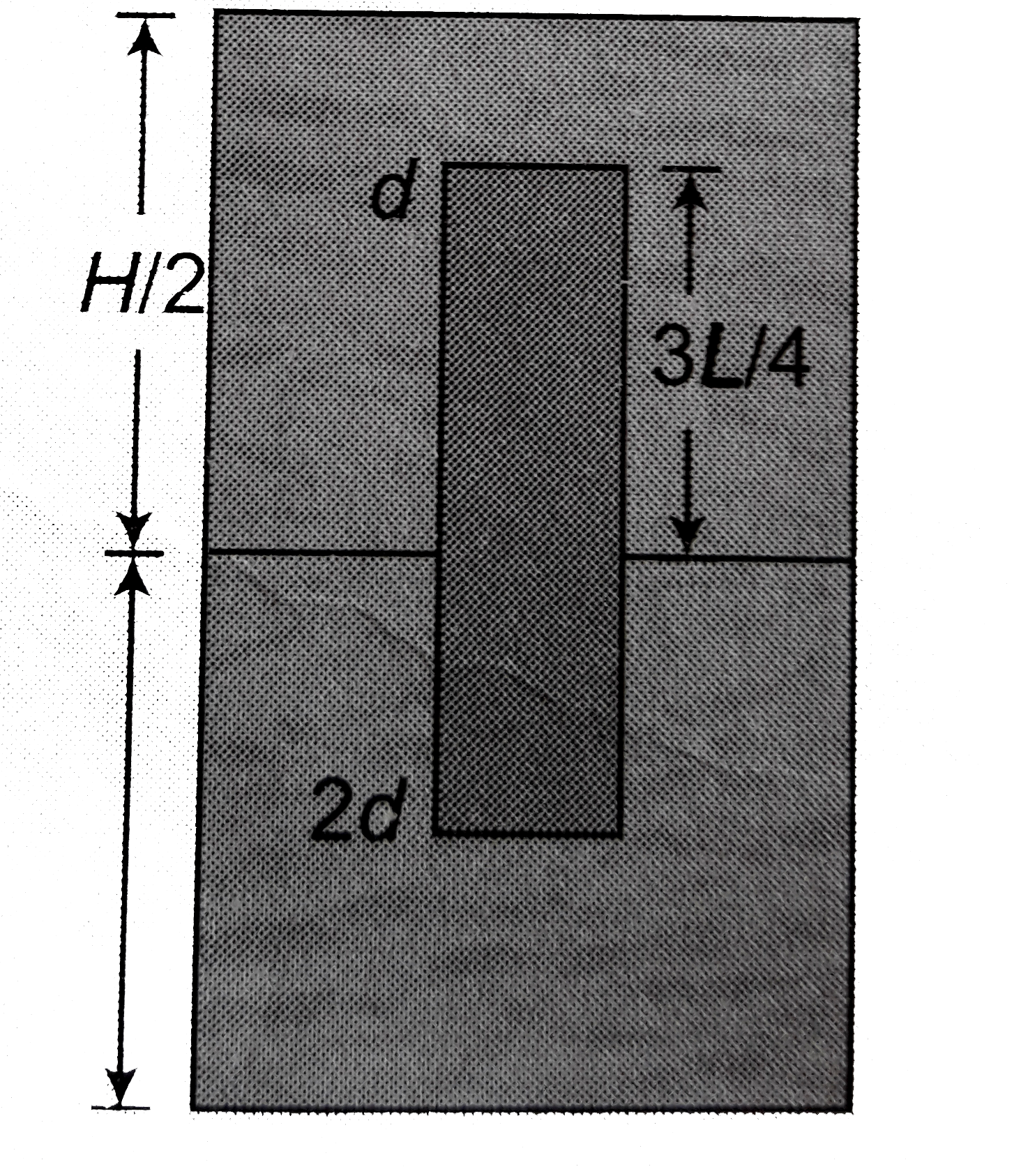
A container of a large uniform cross-sectional area `A` resting on a horizontal surface holds two immiscible, non viscous and incompressible liquids of densities `d` and `2d`, each of height `H//2` as shown in figure. The lower density liquid is open to atmosphere. A homogeneous solid cylinder of length `L(L lt (H)/(2))`, cross-sectional area `A//5` is immersed such that it floats with its axis vertical of the liquid-liquid interface with length `L//4` denser liquid. Determine
(a) density `D` of the solid and
(b) the total pressure at the bottom of the container. (Atmospheric pressure `= P_0`).
 .
.
A container of a large uniform cross-sectional area `A` resting on a horizontal surface holds two immiscible, non viscous and incompressible liquids of densities `d` and `2d`, each of height `H//2` as shown in figure. The lower density liquid is open to atmosphere. A homogeneous solid cylinder of length `L(L lt (H)/(2))`, cross-sectional area `A//5` is immersed such that it floats with its axis vertical of the liquid-liquid interface with length `L//4` denser liquid. Determine
(a) density `D` of the solid and
(b) the total pressure at the bottom of the container. (Atmospheric pressure `= P_0`).
.
(a) density `D` of the solid and
(b) the total pressure at the bottom of the container. (Atmospheric pressure `= P_0`).
.


Similar Questions
Explore conceptually related problems
A container of large uniform cross-sectional area A resting on a horizontal surface, holds two immiscible, non-viscous and incompressible liquids of densities d and 2d, each of height H/2 as shown in the figure. The lower density liquid is open to the atmosphere having pressure P_0 . (a) A homogeneous solid cylinder of length L(LltH//2) , cross-sectional area A//5 is immersed such that it floats with its axis vertical at the liquid-liquid interface with length L//4 in the denser liquid. Determine: (i) the density D of the solid and (ii) the total pressure at the bottom of the container. (b) The cylinder is removed and the original arrangement is restored. A tiny hole of area s(slt ltA) is punched on the vertical side of the container at a height h(hltH//2) . Determine: (i) the initial speed of efflux of the liquid at the hole, (ii) the horizontal distance x travelled by the liquid initially, and (iii) the height h_m at which the hole should be punched so that the liquid travels the maximum distance x_m initially. Also calculate x_m .
A container of large uniform cross-sectional area A resting on a horizontal surface, holes two immiscible, non-viscous and incompressible liquids of densities d and 2d each of height H//2 as shown in the figure. The lower density liquid is open to the atmosphere having pressure P_(0) . A homogeneous solid cylinder of length L(LltH//2) and cross-sectional area A//5 is immersed such that it floats with its axis vertical at the liquid-liquid interface with length L//4 in the denser liquid, The density D of the material of the floating cylinder is
Fluids at rest exert a normal force to the walls of the container or to the sruface of the body immersed in the fluid. The pressure exerted by this force at a point inside the liqid is the sum of atmospheric pressure and a factor which depends on the density of the liquid, the acceleration due to gravity and the height of the liquid, above that point. The upthrust acting on a body immersed in a stationary liquid is the net force acting on the body in the upward direction. A number of phenomenon of liquids in motion can be explain by Bernoulli's theorem which relates the pressure, flow speed and height for flow of an ideal incompressible fluid. A container of large uniform corss sectional area. A resting on a horizontal surface holds two immiscible, non viscous and incompressile liquids of densities d and 2d , each of height H//2 as shown in the figure. The lower density liquid is open to the atmosphere having pressure P_(0) . Situation I: A homogeneous solid cylinder of length L(LltH//2) . cross sectional area A//5 is immersed such that it floats with its axis vertical at liquid -liquid interface with lenght L//4 in the denser liquid. The total pressure at the bottom of the container is
Fluids at rest exert a normal force to the walls of the container or to the sruface of the body immersed in the fluid. The pressure exerted by this force at a point inside the liqid is the sum of atmospheric pressure and a factor which depends on the density of the liquid, the acceleration due to gravity and the height of the liquid, above that point. The upthrust acting on a body immersed in a stationary liquid is the net force acting on the body in the upward direction. A number of phenomenon of liquids in motion can be explain by Bernoulli's theorem which relates the pressure, flow speed and height for flow of an ideal incompressible fluid. A container of large uniform corss sectional area. A resting on a horizontal surface holds two immiscible, non viscous and incompressile liquids of densities d and 2d , each of height H//2 as shown in the figure. The lower density liquid is open to the atmosphere having pressure P_(0) . Situation I: A homogeneous solid cylinder of length L(LltH//2) . cross sectional area A//5 is immersed such that it floats with its axis vertical at liquid -liquid interface with lenght L//4 in the denser liquid. The total pressure at the bottom of the container is
A container of large uniform cross-sectional area A resting on a horizontal surface, holes two immiscible, non-viscon and incompressible liquids of densities d and 2d each of height H//2 as shown in the figure. The lower density liquid is open to the atmosphere having pressure P_(0) . A homogeneous solid cylinder of length L(LltH//2) and cross-sectional area A//5 is immeresed such that it floats with its axis vertical at the liquid-liquid interface with length L//4 in the denser liquid, The cylinder is then removed and the original arrangement is restroed. a tiny hole of area s(sltltA) is punched on the vertical side of the container at a height h(hltH//2) . As a result of this, liquid starts flowing out of the hole with a range x on the horizontal surface. The density D of the material of the floation cylinder is
A container of large uniform cross-sectional area A resting on a horizontal surface, holes two immiscible, non-viscon and incompressible liquids of densities d and 2d each of height H//2 as shown in the figure. The lower density liquid is open to the atmosphere having pressure P_(0) . A homogeneous solid cylinder of length L(LltH//2) and cross-sectional area A//5 is immeresed such that it floats with its axis vertical at the liquid-liquid interface with length L//4 in the denser liquid, The cylinder is then removed and the original arrangement is restroed. a tiny hole of area s(sltltA) is punched on the vertical side of the container at a height h(hltH//2) . As a result of this, liquid starts flowing out of the hole with a range x on the horizontal surface. The total pressure with cylinder, at the bottom of the container is
A container of large uniform cross-sectional area A resting on a horizontal surface, holes two immiscible, non-viscon and incompressible liquids of densities d and 2d each of height H//2 as shown in the figure. The lower density liquid is open to the atmosphere having pressure P_(0) . A homogeneous solid cylinder of length L(LltH//2) and cross-sectional area A//5 is immeresed such that it floats with its axis vertical at the liquid-liquid interface with length L//4 in the denser liquid, The cylinder is then removed and the original arrangement is restroed. a tiny hole of area s(sltltA) is punched on the vertical side of the container at a height h(hltH//2) . As a result of this, liquid starts flowing out of the hole with a range x on the horizontal surface. The total pressure with cylinder, at the bottom of the container is
Recommended Questions
- A container of a large uniform cross-sectional area A resting on a hor...
Text Solution
|
- A homogeneous solid cylinder of length L(LltH/2), cross-sectional area...
Text Solution
|
- A container of large uniform cross-sectional area A resting on a horiz...
Text Solution
|
- A container of large uniform cross-sectional area A resting on a horiz...
Text Solution
|
- A container of large uniform cross-sectional area A resting on a horiz...
Text Solution
|
- A container of large uniform cross-sectional area A resting on a horiz...
Text Solution
|
- A container of large uniform cross sectional area A resting on a horiz...
Text Solution
|
- A container of a large uniform cross-sectional area A resting on a hor...
Text Solution
|
- A container of large uniform cross-sectional area A resting on a horiz...
Text Solution
|