

Home
Class 11
PHYSICS
A spool of thread of mass m is placed on...

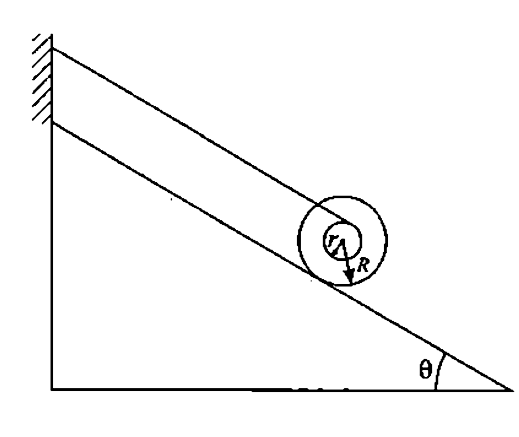
A spool of thread of mass m is placed on an inclined smooth plane set at an angle`theta` to the horizontal. The free end of the thread is attached to the wall as shown in figure-5.74. Calculate the acceleration of the centre of mass of the spool , if its moment of inertia about its axis is Iand the radius of the wound thread layer is r.
`[("g sin" theta)/(1 + (I)/(mr^(2)))]`

Promotional Banner

Similar Questions

Explore conceptually related problems

A spool with a thread wound on it is placed on an inclined smooth plane set an angle alpha=30^@ to the horizontal. The free end of the thread is attached to the wall as shown in figure. The mass of the spool is m=200g , its moment of inertia relative to its own axis I=0.45g*m^2 , the radius of the wound thread layer r=3.0cm . Find the acceleration of the spool axis.

A spool with a thread wound on it is placed on a smooth inclined plane set at an angle of 30 to the horizontal. The free end of the thread is attached to the wall as shown. The mass of the spool is m r m  200g, its moment of inertia relative to its own axis is I 0.45gm2, the radius of the wound thread layer is r 3 cm. The acceleration of the spool axis is:

The acceleration down the plane of spherical body of mass m radius R and moment of inertia I having inclination theta to the horizontal is

A spool is pulled at an angle theta with the horizontal on a rough horizontal surface as shown in the figure. If the spool remains at rest, the angle theta is equal to

A spool is pulled at an angle theta with the horizontal on a rough horizontal surface as shown in the figure. If the spool remains at rest, the angle theta is equal to

A uniform rod of mass m is kept in equilibrium making angle 30° with horizontal as shown, with a thread. The tension in the thread is?

A pulley fixed to the ceiling carried a thread with bodies of masses m_(1) and m_(2) attached to its ends. The mases of the pulley and the thread are negligible and friction is absent. Find the acceleration of the centre of mass of this system.